FYI: This website contains affiliate links. As an Amazon Associate I earn from qualifying purchases.
- Home
- Water Collection
- Preventing Algae
Preventing Algae in Rain Barrels: What Works and What to Skip
By Amy DeVries
Short answer: For preventing algae in rain barrels, remember that algae needs three things to grow: light, warmth, and food from roof debris. The fix that matters most is blocking the light, with an opaque barrel, a coat of paint, a cover, or shade. A screen and using the water regularly help too. Green water is common, it's rarely harmful to plants, and you don't need harsh chemicals to deal with it.
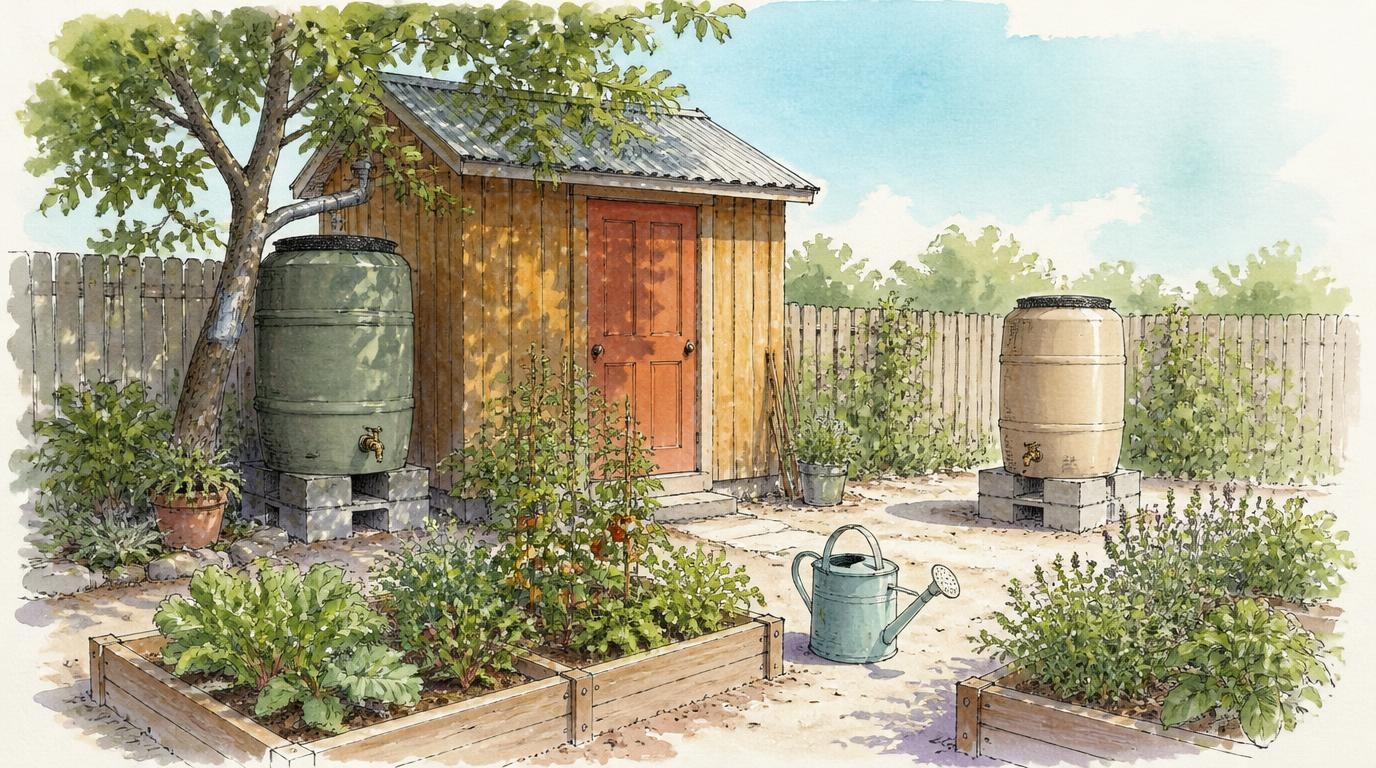 Light is what algae needs most. A barrel in the shade, or one light can't get through, stays clear much longer.
If you just lifted the lid and found green water, you didn't do anything wrong. Rain barrels hold still water outdoors, and sooner or later a lot of them grow a little algae. It's one of the most common rain barrel questions there is.
Here's what surprised me: in all our years of collecting rainwater, our rain barrels and tanks never really had an algae problem. They've come in a lot of colors. We had pretty blue ones that faded after one season, dark green ones, and now beige tanks. The one thing they had in common is that light couldn't get through them.
Where we did get algae was in our rabbits' white plastic waterers. They didn't even hold rainwater, just regular water sitting in white plastic that let the light through. That's all algae needed.
So this page starts with the fix that does the most work, then goes through the ones that help, the ones that are optional, and the ones I'd skip. You don't need to do all of them. Most people only need one or two.
Why rain barrel water turns green
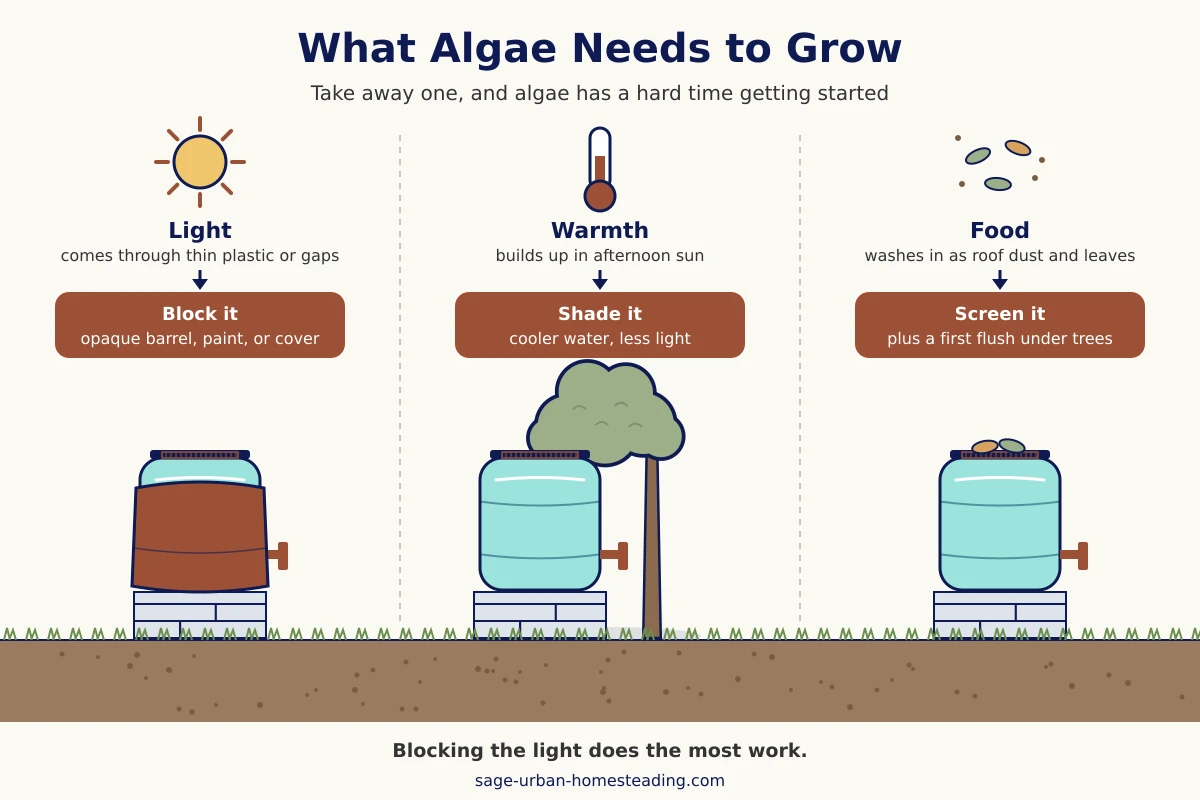
Algae are tiny plant-like organisms, and like plants, they need a few things to grow. In a rain barrel, that comes down to three:
- Light. Algae make their food from sunlight. If light gets into the water, through thin or translucent plastic, a loose lid, or an open top, algae can grow.
- Warmth. Algae grow faster in warm water. A barrel sitting in afternoon sun warms up quickly.
- Food. Dust, pollen, leaf bits, and bird droppings wash off the roof with every rain. As they break down, they feed the algae.
Time ties them together. Water that sits for weeks in a warm, bright barrel gives algae a long, easy run.
The good news is that you don't have to take away all three. Cut off one, especially the light, and algae has a hard time getting started.
Is algae in a rain barrel harmful?
For your plants, usually not. Green water is still rainwater, and it's fine for watering flower beds, shrubs, and the garden. University of Florida Extension puts it simply: algae isn't really bad for your plants or your barrel, though over time it can clog the spigot.
Algae becomes a real problem in a few specific ways:
- Clogged spigots and hoses. Thick strands or slime can slow the spigot to a trickle or block a hose.
- Clogged drip emitters. This is the big one if you water with drip lines or soaker hoses. Tiny bits of algae slip through filters, and dead algae feeds the slime that plugs emitters. See Gravity Drip Irrigation from Rain Barrels.
- A bad smell. Fresh algae smells a bit like a pond. A sour or rotten smell usually means the barrel has a lot of decaying material in it and needs emptying and rinsing.
- Slime you have to deal with. A slick green coating on the walls isn't dangerous, but it's unpleasant, and it's a sign the barrel is getting light.
If you water with a can or a hose and nothing smells or clogs, a little green is a cosmetic issue. You can fix it at your own pace.
Which algae fixes matter most?
There's a lot of advice out there about rain barrel algae, and not all of it is worth your time or money. Here's how I'd rank it.
- Block the light. This is the one that matters most. An opaque barrel, a coat of paint, a cover, or shade. If you only do one thing, do this.
- Keep debris out. A fine screen on the lid and reasonably clean gutters take away a lot of algae's food.
- Use the water. Water that gets used and refilled doesn't sit long enough for algae to take hold.
- Optional upgrades. A first flush diverter if your roof is under trees, and a rinse at the end of the season.
- Skip. Barley straw, vinegar or algaecide in the water, and routine bleach. More on why below.
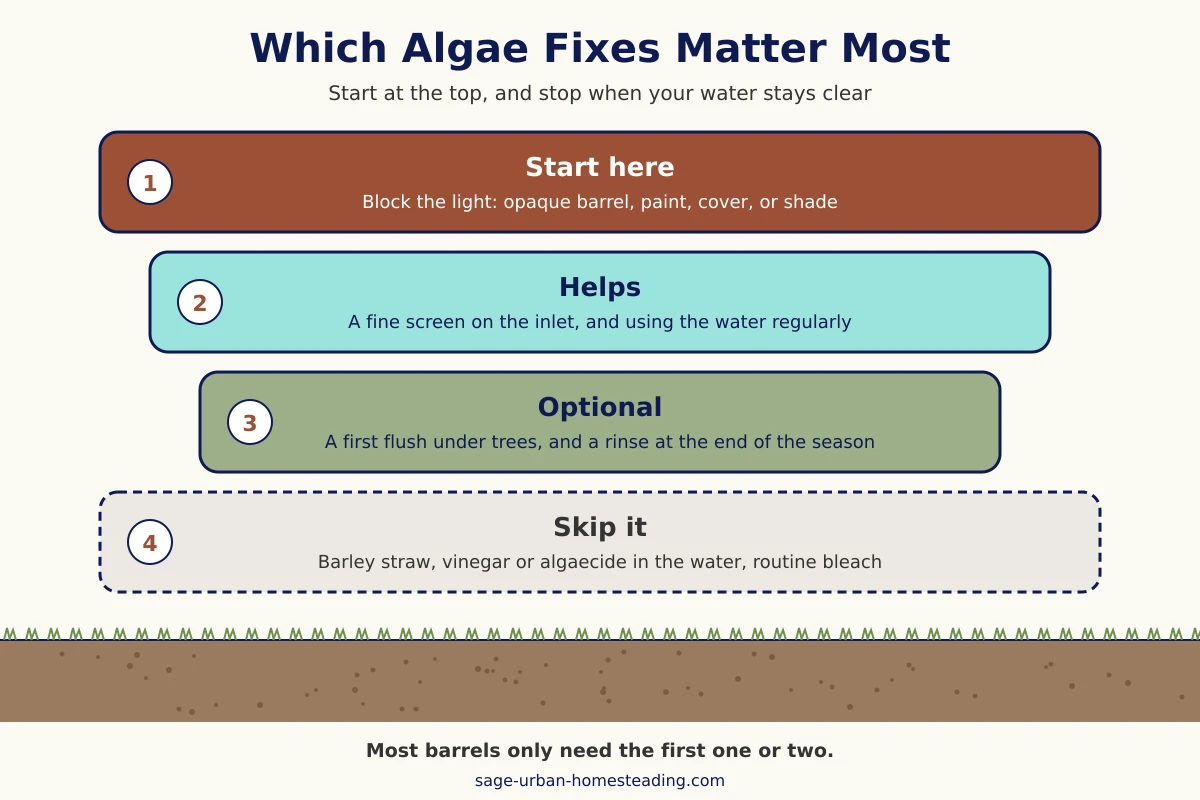 Start with the light. Add the helpers if you need them, and skip the products that don't earn their keep.
Not sure rain barrels are the right place to start? My free 2-page guide, Which Urban Homestead System Should You Start First?, helps you pick the one system that fits your space and your time, so you put your energy where it pays off first.
Block the light first
If light can't reach the water, algae can't make food, and most of the problem goes away. This is why dark, opaque barrels rarely turn green, even when they sit in the sun.
Is your barrel letting light in?
Some barrels look solid but still let light through, especially white, pale blue, or natural plastic, and thin recycled barrels. To check, take the lid off on a sunny day and look inside. If the walls glow or you can see shadows through them, light is getting in.
Also check the lid. A loose lid, a gap around the downspout, or a cracked spot lets in a surprising amount of light. A fine mesh screen is fine; the small amount of light through the screen isn't usually enough to cause trouble.
What about faded barrels? Our pretty blue barrels faded after one season, but they stayed opaque, and the water stayed clear. Fading changes how a barrel looks. It doesn't matter for algae unless the plastic gets thin enough to glow.
Paint it
Painting a translucent barrel is a cheap, permanent fix for preventing algae in rain barrels. Alabama Extension's rainwater guide recommends:
- Clean the outside with a 1:1 mix of white vinegar and water.
- Lightly sand with fine sandpaper (220 grit or finer) so the paint grips.
- Use a primer and paint made for plastic. Check the label.
- Tape off the spigot and overflow, then spray several thin coats rather than one thick one.
- Pick a dark color. Darker barrels block more light. A color that matches your house or fence helps the barrel blend in, too.
Only paint the outside. The inside stays bare plastic.
You can buy a bottle of spray paint made for plastic, in a dark color, on Amazon (affiliate link). This is the simplest fix for a translucent barrel you already own. Plan on two cans for a 55-gallon barrel. Skip it if your barrel is already a dark, solid color, or if you'd rather not deal with painting and a cover would be easier.
Cover it
If you don't want to paint, wrap the barrel. Anything opaque works: a dark tarp cut to size, an old opaque shower curtain, a barrel cover, or a simple wooden or lattice surround lined with landscape fabric. Leave the spigot, overflow, and lid screen open, and make sure the cover can't blow into the inlet.
You can buy an opaque rain barrel cover on Amazon (affiliate link). This is handy if you're renting or don't want to paint, since it comes off in seconds. Skip it if your barrel is already opaque, or if a tarp or fabric you have on hand will do the job.
Shade it
Shade blocks light and keeps the water cooler, so it works on two of algae's needs at once. The north side of a shed or fence, under an overhang, or behind a shrub are all good spots.
We learned this the warm way. Our rain barrels at the corner of the house sat on the southwest side and really heated up in summer. Our current rain tanks are in the shade, and that's where I'd put a barrel today if I had the choice.
Shade is also the fix for small containers. Our rabbits' white plastic waterers were the only place we ever had an algae problem. Moving them to the shady side of the cage in summer helped. The tradeoff was winter: we wanted them in the sun so the frozen water would thaw. So we moved them with the seasons. If you have a white bucket, a waterer, or a translucent jug catching rain, the same idea applies.
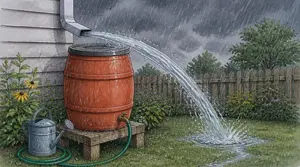
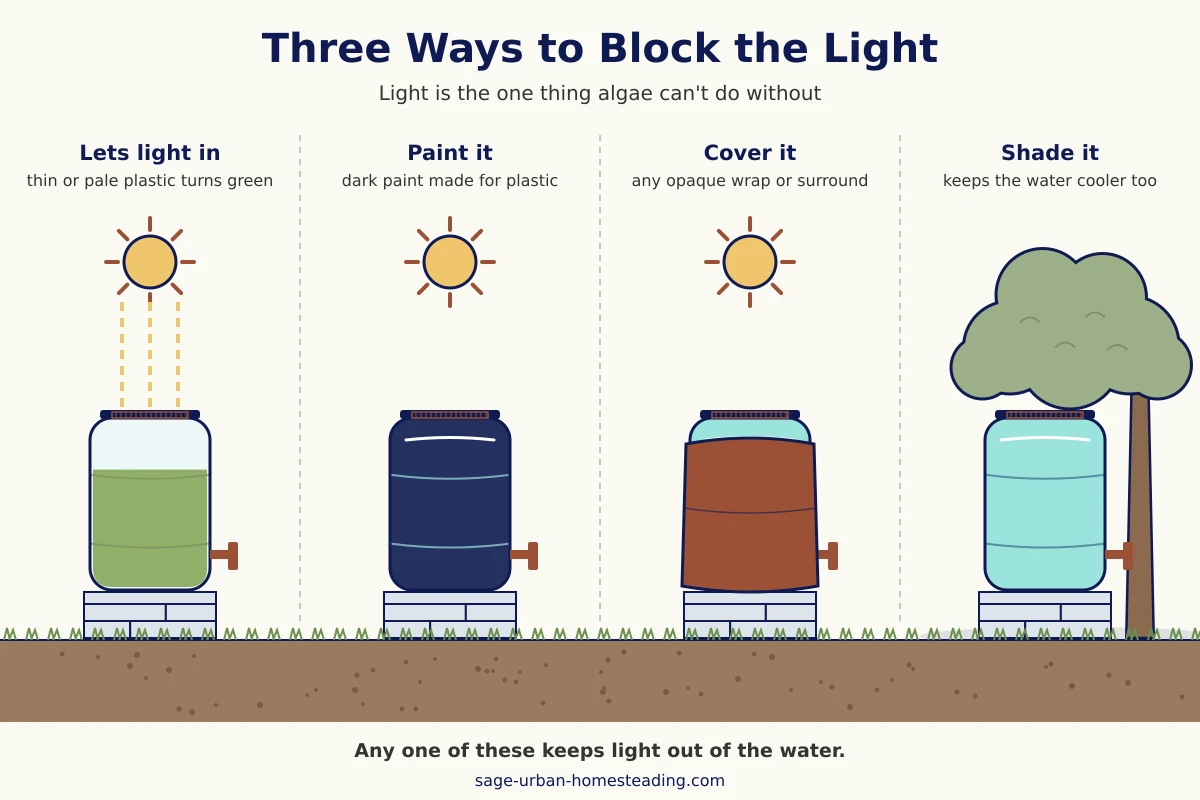 A translucent barrel lets light in. Paint it, cover it, or move it into the shade, and the water stays clear much longer.
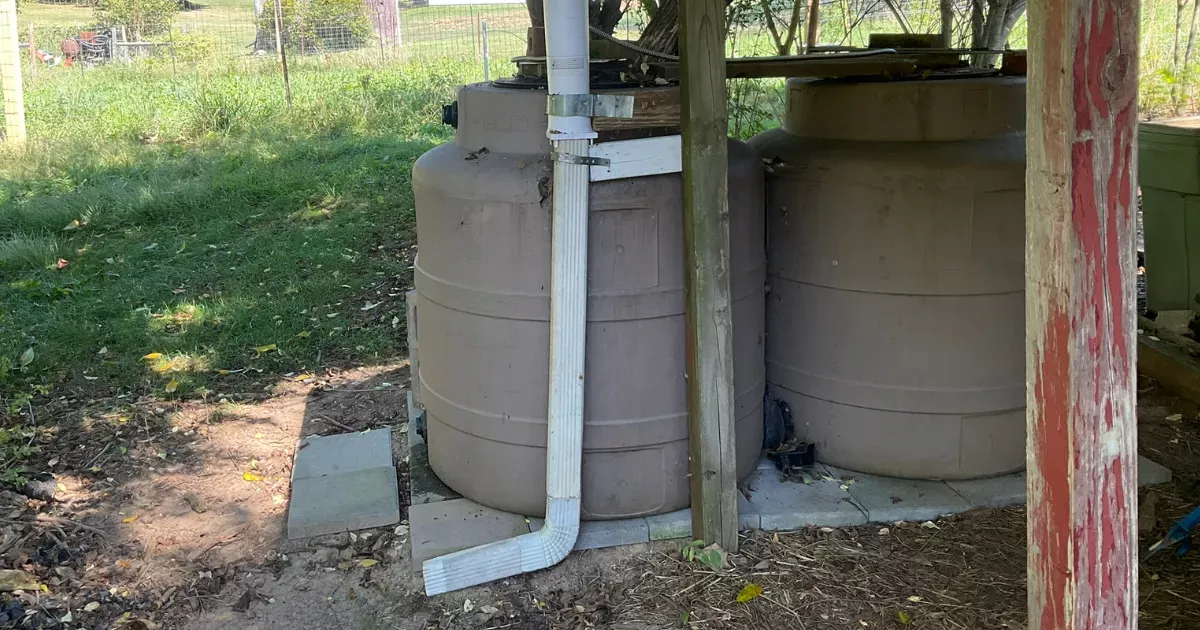 Our current tanks are opaque and sit in the shade. We've never had algae in them.
Cut off the food supply
Every rain carries a little roof dust, pollen, and leaf litter into the barrel. That's algae food. You can't stop all of it, and you don't need to. Cutting it down is enough.
- Keep a fine screen on the inlet. A screen catches leaves, petals, and twigs before they reach the water. It also keeps mosquitoes out. Clear it off when it collects debris, so water doesn't spill over the top in a downpour. See Mosquito-Proof Rain Barrel.
- Keep the gutters reasonably clear. Leaves that sit and rot in the gutter turn into fine sludge that washes right through a screen.
- Add a first flush if your roof is under trees. A first flush catches the first, dirtiest water off the roof, along with most of the fine dust and pollen a screen lets through. See First Flush Diverter Basics.
Our rain tanks sit under a tree that drops leaves and petals in cycles, so they have a first flush with a leaf screen built into the top. For that roof, it's worth the upkeep. For an open roof with no trees nearby, a good screen on the lid is usually all you need.
You can buy a fine mesh rain barrel inlet screen on Amazon (affiliate link). If your barrel came without a screen, or the old one is torn, this is the cheapest upgrade on the page, and it helps with mosquitoes too. Skip it if your screen is still whole and fits snugly.
Use the water regularly
Algae needs time. Water that gets used and refilled with fresh rain doesn't sit long enough for algae to build up. When rain is scarce, it's a good idea to empty and refill your barrel every few weeks, especially if you're using the water on food plants.
This doesn't have to be a project. Filling a watering can every few days keeps the level moving. If you've had a long dry spell and the water has been sitting, use it on ornamentals or the lawn and let the next rain refill it.
It also helps to size your collection to what you'll actually use. A barrel that stays full all summer because nobody draws from it is the one most likely to turn green. See How to Set Up a Rain Barrel.
How to clean a green barrel safely
If your barrel has already turned green, you don't need anything harsh. Plain water and a brush handle most of it.
- Use or drain the water. Pour it on ornamentals, shrubs, or the lawn. It's fine for them.
- Disconnect the barrel and tip it on its side. Take the lid and screen off.
- Hose it out. A strong spray removes most loose algae and the sludge at the bottom.
- Scrub the green spots with a long-handled brush. A little mild dish soap helps on stubborn slime.
- Rinse well, especially if you used soap, and clean the screen, spigot, and overflow while you're there.
- Fix the cause before you reconnect it. If it turned green, light is getting in somewhere. Paint, cover, or move it.
For a barrel that's slimy or smells bad, some extension guides suggest a scrub with diluted hydrogen peroxide or a dilute bleach solution. If you go that route, use it on the empty barrel only, rinse it thoroughly, and pour the rinse water down a household drain, not on the garden. Never add bleach or cleaners to a barrel full of water you plan to use on plants.
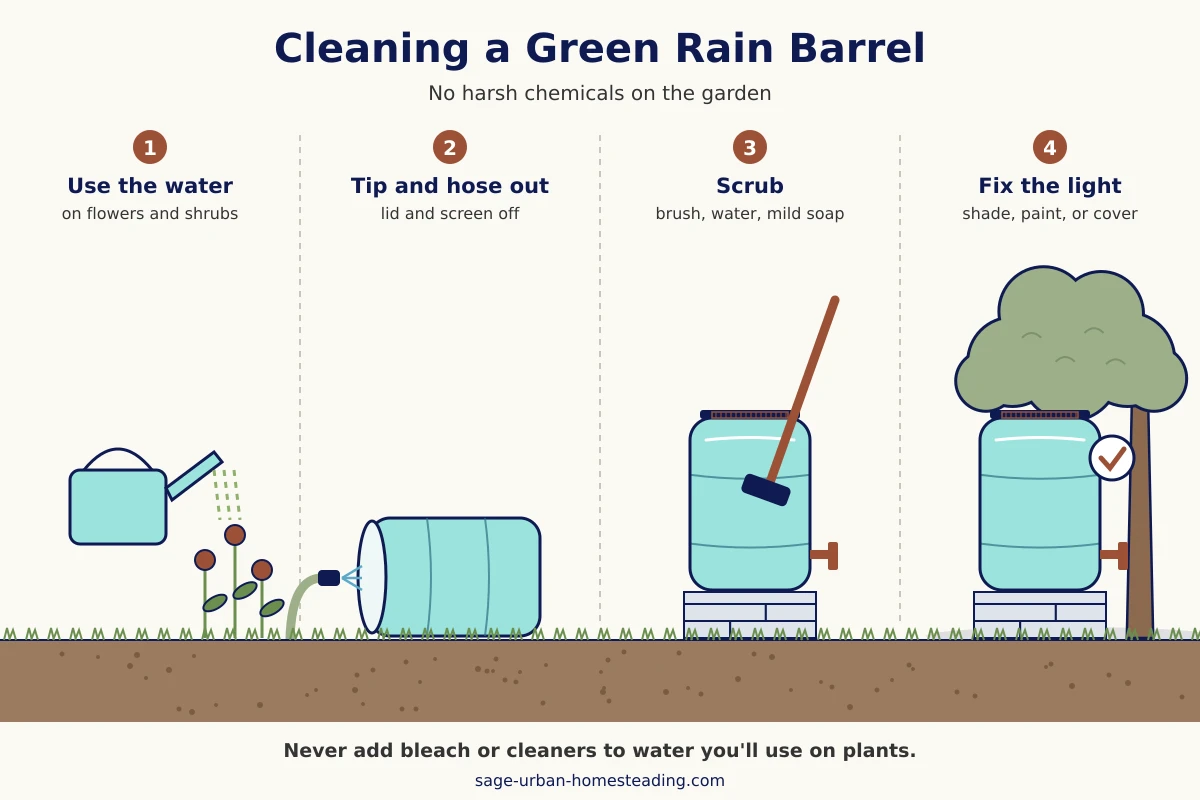
You can buy a long-handled scrub brush on Amazon (affiliate link). It makes it much easier to reach the bottom of a barrel without climbing in. Skip it if you have a long-handled deck or bottle brush you can retire to the garden.
You don't need to scrub it spotless
Honestly, we never did much scrubbing. We kept the screens clear of debris and emptied the barrels at the end of each season, and that was about it.
There's a reason that works. Over time, a thin natural film called biofilm forms on the inside of a rain tank. Engineers at Seoul National University who studied biofilm in rainwater tanks found that this film can actually help the water, by trapping bacteria and other particles out of it. They go so far as to call frequent cleaning or disinfecting counterproductive for that reason.
So there's a difference between a thin, normal film and a problem: A slick, bright green coat, strands of algae, a clogged spigot, or a bad smell are worth cleaning. A faint, even film on an opaque barrel with clear water isn't something you need to scrub away.
Algae fixes that don't work well or aren't worth it
These come up a lot. Here's the honest version.
- Barley straw. It's a real pond-management tool, and it has some research behind it. But according to Rutgers Cooperative Extension, it keeps new algae from growing rather than killing what's already there, it needs warm water and a few weeks to start working, and results vary by the kind of algae. It's designed for ponds, not a 55-gallon barrel, and decaying straw is one more thing breaking down in your water. Blocking light works faster and costs less.
- Vinegar or algaecide in the water. Both can kill algae, but they don't know the difference between algae and your plants. Treating barrel water this way can make it unusable for the garden. Vinegar is fine for cleaning the outside before you paint, just not in the water.
- Bleach in the water as a routine fix. One of the nice things about rainwater is that it's free of chlorine. Use bleach as rarely as possible, and keep bleach rinse water out of the garden. Adding it to the water doesn't fix why algae grew in the first place.
- Scrubbing all the time. If the barrel keeps turning green, more scrubbing won't fix it. Light is getting in. Cleaning is a reset, not a prevention plan.
Winter cleaning gives you a head start
The end of the season is the easiest time to get ahead for preventing algae in rain barrels next year. Every fall we empty our barrels, leave the spigots open, and clear the screens. Starting spring with an empty, clean barrel means no old sludge or leftover algae waiting for warm weather.
While it's empty, take a quick look:
- Hose out any sludge at the bottom.
- Check the lid and walls for cracks or gaps that let light in.
- Clean or replace a torn screen.
- If the barrel turned green this year, paint it or plan a cover or a shadier spot before spring.
Ready to plan more than one system? The Small-Space Self-Sufficiency Starter Map helps you choose your first 3 homestead systems and decide what to start now, what to start next, and what to save for later, with a 30-day action map.
FAQ for preventing algae in rain barrels
Can I use green rain barrel water on my vegetables?
Can I use green rain barrel water on my vegetables?
The algae itself isn't the main concern, but rain barrel water in general isn't as clean as tap water. The CDC suggests tap water for watering plants you plan to eat when that's an option. If you do use barrel water on food plants, water at the soil rather than over the leaves, and rinse your harvest well with tap water. Save the greenest water for flowers, shrubs, and the lawn.
Is the sludge at the bottom algae?
Is the sludge at the bottom algae?
Usually not. Brown or gray sludge at the bottom is mostly roof grit, pollen, and broken-down leaf bits that settled out of the water. Algae is green and grows where light reaches, usually near the top and on the walls. A first flush cuts down on sludge if it builds up fast. See First Flush Diverter Basics.
Will a dark barrel get too hot in the sun?
Will a dark barrel get too hot in the sun?
A dark barrel in full afternoon sun will warm up, like ours did on the southwest corner of the house. It still blocks light, which matters more for algae. If you can, give it some shade too. Shade keeps the water cooler and makes aging easier on the plastic over time.
My barrel is always full. Does that make algae worse?
My barrel is always full. Does that make algae worse?
It can, because full and unused means the water sits. Draw from it more often, add a soaker hose or drip line, or send extra rain somewhere useful instead of letting it pile up. A downspout diverter can send rain back down the downspout when the barrel is full. See Downspout Diverter Options and Rain Barrel Overflow Routing.
Can I drink rain barrel water if it's clear?
Can I drink rain barrel water if it's clear?
Not as it comes out of the barrel, even if it looks clean. For everyday use, keep rain barrel water for the garden. In an emergency, you can treat it the way you'd treat stream water when camping: filter it, then boil it. Boiling kills germs but won't remove chemicals from roofing, so draw from your cleanest roof, ideally a metal one.
Algae prevention checklist
Here's the page in one place. Start at the top and stop when your water stays clear.
Start here
- Check whether light gets through your barrel's walls or lid.
- If it does, paint it a dark color, cover it, or move it into the shade.
- Put small containers like waterers and buckets in the shade in summer.
Helpful habits
- Keep a fine screen on the inlet and clear it when debris collects.
- Keep gutters reasonably clear of leaves.
- Use the water every week or two, and empty it on ornamentals after long dry spells.
If it turns green
- Use the water on flowers, shrubs, or the lawn.
- Hose out the empty barrel and scrub with a brush.
- Rinse well, and keep any bleach or cleaner rinse water out of the garden.
- Fix the light leak before you reconnect it.
Optional and seasonal
- Add a first flush if your roof is under trees.
- Empty and rinse barrels at the end of the season.
- Skip barley straw, vinegar or algaecide in the water, and routine bleach.

Amy DeVries helps beginner urban homesteaders learn by doing. A lifelong gardener, she has grown food in spaces that expanded to 16 raised beds, patio containers, dwarf fruit and nut trees, and gravity-fed rainwater systems. She shares practical lessons shaped by real experience. Amy homeschools her children and teaches the same hands-on skills that guide her work.
You might like these
Rain Barrels: A Beginner's Guide
How to choose, place, and set up your first rain barrel, with real lessons from our own rain barrels and links to every next step.
Rain Barrel Stand Designs for Real Yards and Setups
Choose the best rain barrel stand designs for your yard, barrel, and skill level, with practical guidance on height, base prep, materials, and safety.
Downspout Diverter Options: What Happens When It Overflows
Compare downspout diverter options by what they do when your rain barrel fills up, and what each setup can realistically water.


More Information
Disclosure
All information found on this website is editorial in nature and intended to motivate and inspire rather than be used as medical advice or legal advice.
As an Amazon Associate, I earn from qualifying purchases. I also use Google Ads and cookies as described in the Privacy Policy.
Thank you for your support!
By Amy DeVries, Copyright © 2011-2026 Sage-Urban-Homesteading.com All rights reserved.
