FYI: This website contains affiliate links. As an Amazon Associate I earn from qualifying purchases.
- Home
- Water Collection
- Downspout Diverter
Downspout Diverter Options by Use and Overflow
By Amy DeVries
Short answer: There are four main downspout diverter options: an open downspout over the barrel, a manual flap, an automatic diverter, and a first flush diverter. The biggest difference is what happens when the barrel is full. An automatic diverter sends extra water back down the downspout on its own. The others need an overflow plan. For most beginners watering a small garden, one barrel with an automatic diverter, or an open downspout with overflow aimed away from the house, is the easiest place to start.
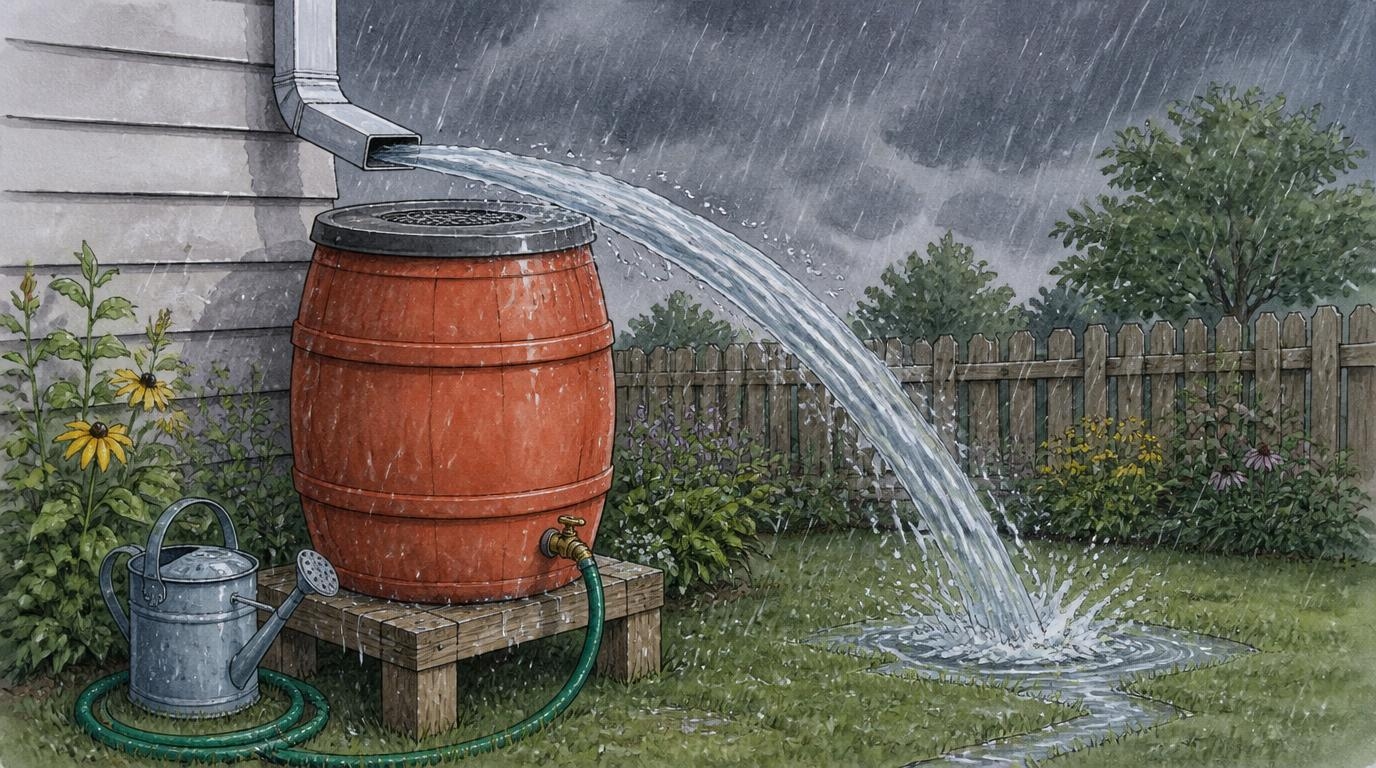 In a downpour, an open downspout can shoot right past the barrel. Ours did. Woosh!
Our first rain barrels were as simple as it gets: an open downspout pouring onto a screen on top of the barrel. This is the simplest of downspout diverter options. In a light rain, it worked beautifully.
Then came our first big storm. The water came down the gutter with so much force that it gushed out of the downspout, flew right over the opening, and sprayed out into the yard. Woosh! Most of it never made it into the barrel at all.
That's the part nobody mentioned when we were picking out supplies. Most guides to downspout diverter options focus on what fits your downspout. The question that matters more for a beginner is this: What happens when there's more water than your barrel can take? Sometimes that's a full barrel. Sometimes it's a downpour coming too fast to land where you aimed it.
If you're comparing downspout diverter options and feel a little stuck, that's normal. There are only a few main types, and the clearest way to sort them is by how they handle overflow. Once you know that, it gets much easier to match a setup to what you actually want to do with the water.
You don't need a big yard, a fancy tank, or a perfect plan to start collecting rainwater. One barrel and one downspout count. You do want to know where the extra water goes before the first big storm shows you.
Before you buy anything, check your local rules, HOA, or landlord. Most places allow rain barrels, but some have restrictions.
The 4 main downspout diverter options, sorted by overflow
Every setup answers the same question differently: When the barrel is full, where does the next gallon go? Here are the four you'll see most often.
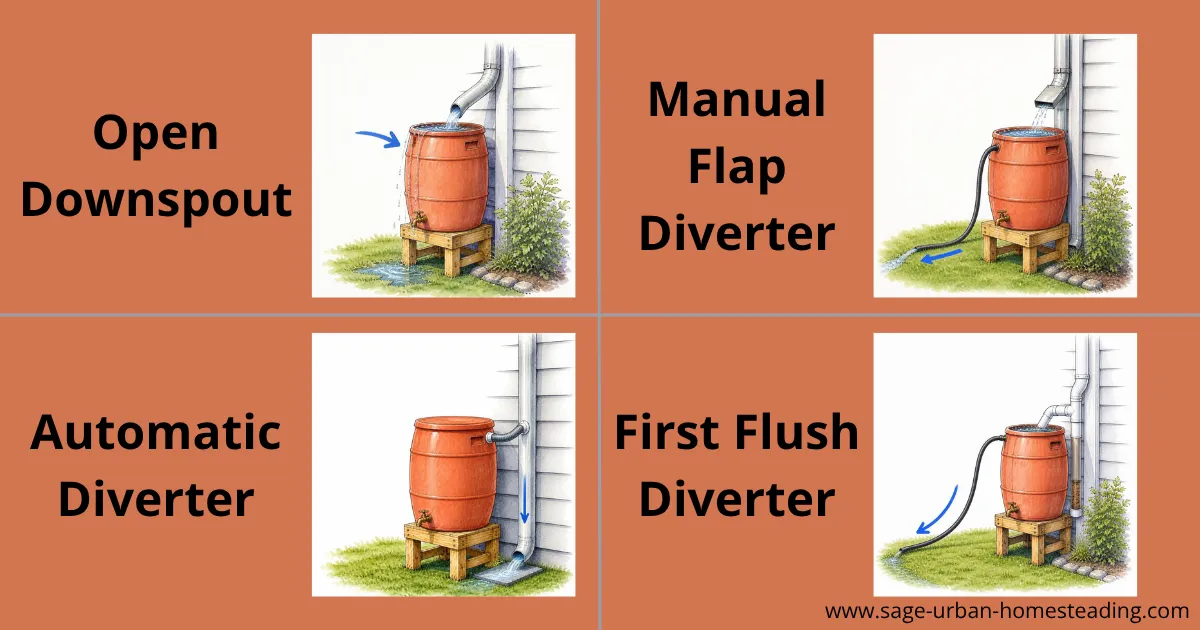
1. Open downspout into an open-top barrel
How it works: You cut the downspout above the barrel, or add a flexible elbow, and let it pour straight in. A screen on top keeps out leaves and mosquitoes.
When it's full (or the rain is heavy): The water goes wherever it can. That might be an overflow port near the top, or it might be over the rim. Most barrel overflow ports are much smaller than the downspout feeding them, so in a heavy rain they can't keep up. An open downspout can also overshoot in a downpour. That's what happened to us: the water flew right past the screen and into the yard.
Good fit if: You want the cheapest, simplest start and can live with some spillover. It also works if you can aim the overflow toward a garden bed instead of your foundation.
Skip it if: The barrel sits right against your house, or you can't control where the extra water flows.
2. Manual flap or door diverter
How it works: A section of downspout has a little door or flap. Open it, and water drops into the barrel underneath. Close it, and water goes down the downspout as usual.
When it's full: Nothing changes on its own. If you leave it open, the barrel overflows just like an open downspout. You either need a good overflow hose on the barrel or the habit of closing the flap.
Good fit if: You like control and will actually check it. Closing it for winter is easy.
Skip it if: You know you'll forget to check it during a storm. (No judgment. Most of us would.)
3. Automatic (self-regulating) diverter
How it works: A fitting goes into a hole in your downspout. It catches part of the flow and sends it through a short hose into the barrel.
When it's full: Water backs up in the hose to the same level as the barrel. Extra water then continues down the downspout like normal. This is the option that handles overflow for you.
The catch: Height matters. The diverter has to sit at the right level compared with the top of the barrel. Mount it too high on an open-top barrel, and the barrel can still overflow at the rim. Follow your kit's instructions closely, and measure twice.
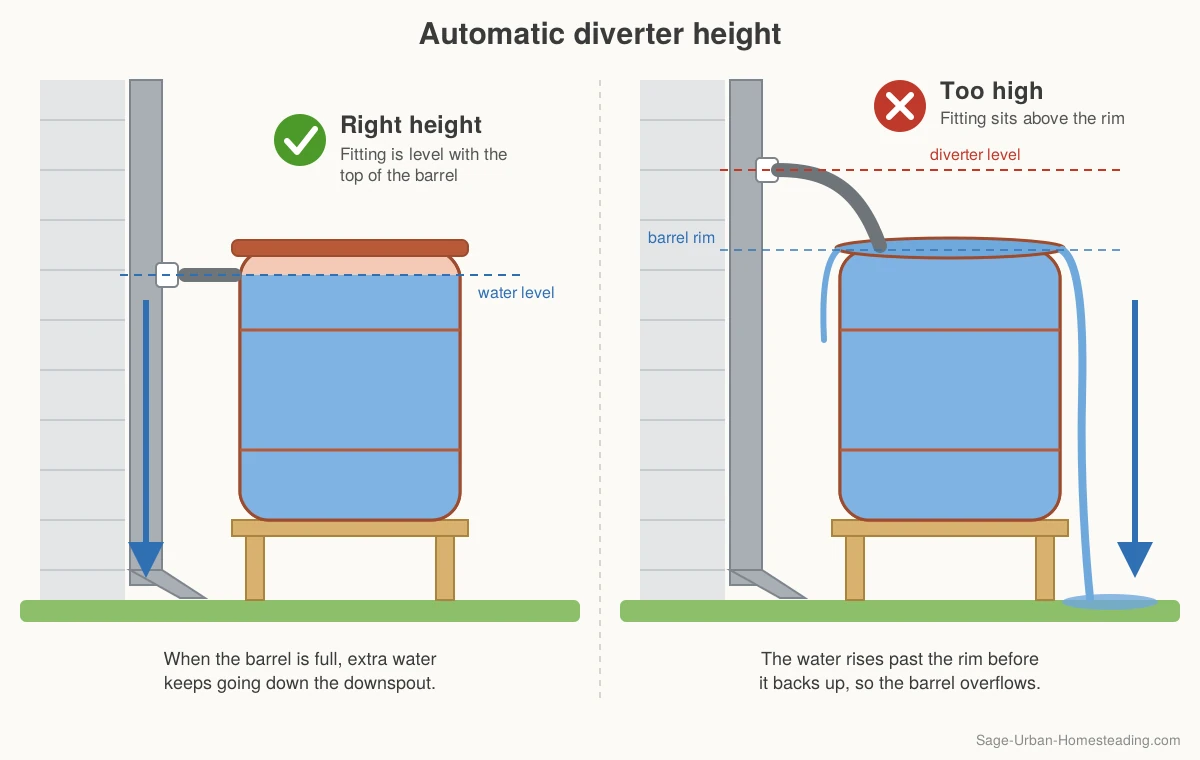 With an automatic diverter, height is everything. Mount it too high, and an open-top barrel overflows anyway.
Good fit if: Your barrel sits near the house and you want it to take care of itself.
Skip it if: You need every drop. These usually fill a bit slower than an open downspout because they only catch part of the flow.
4. First flush diverter
How it works: The first water off the roof carries the most dust, pollen, and bird droppings. A first flush diverter catches that dirty first bit in a separate pipe. Once that pipe fills, cleaner water flows on to your tank or barrel.
When it's full: A first flush diverter doesn't solve overflow by itself. It's about cleaner water, not extra water. Your tank still needs its own overflow outlet, and that outlet needs somewhere to go.
This is what we use now, on rain tanks fed by the metal roof of our shed. Two honest notes:
- It needs regular cleaning. The pipe that catches the dirty water collects gunk, and it has to be cleaned out somewhat regularly.
- We had to lengthen the overflow hose. The original overflow dumped too close to the tanks. A longer hose now carries the extra water farther away.
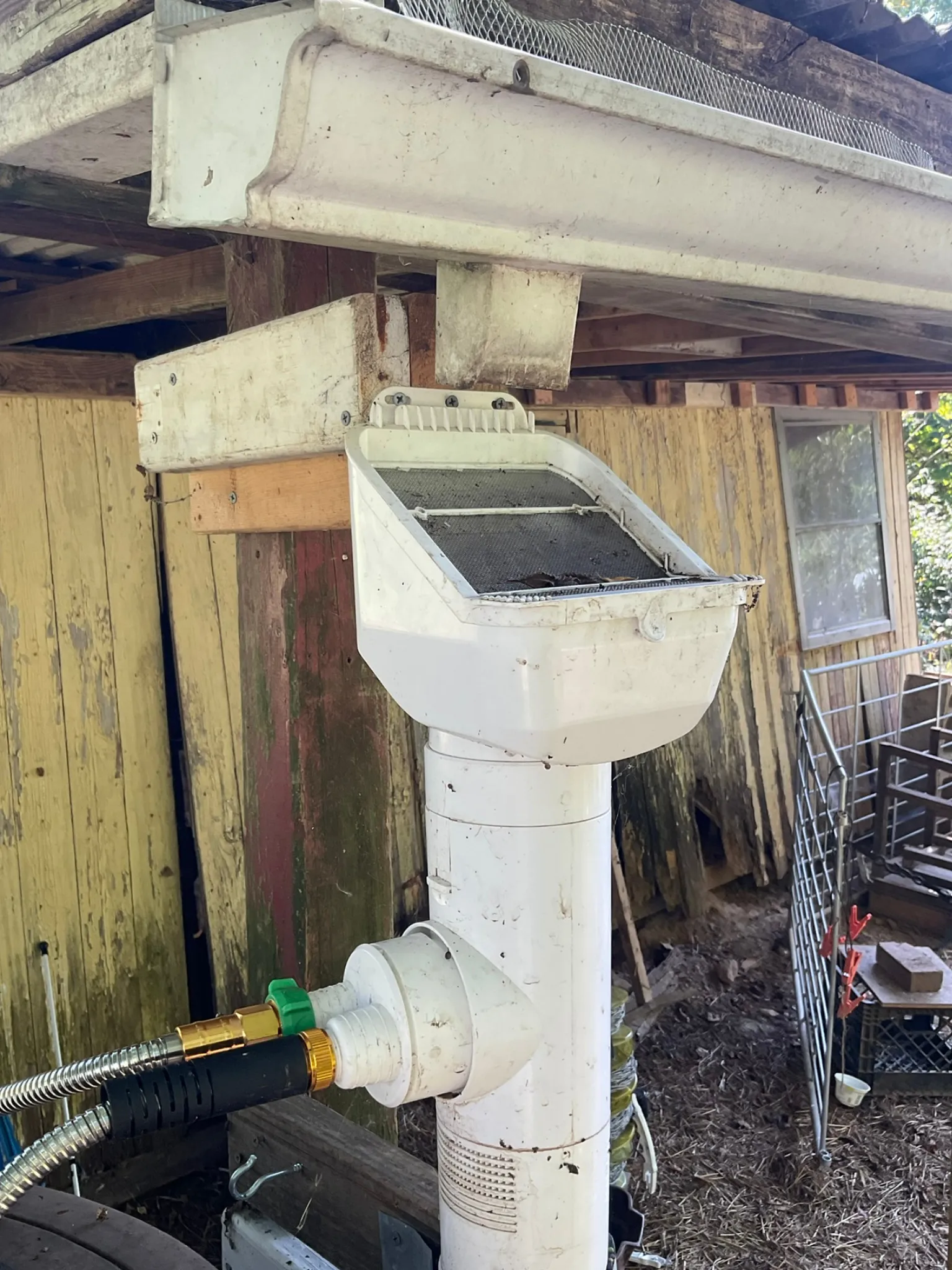 Our first flush diverter catches the dirtiest roof water first. It does need cleaning out now and then.
Here's the first flush kit we bought: the downspout filter and the first flush diverter kit. And the short hoses we used: short garden hose 3ft, female to male connector. These are Amazon affiliate links to the products we purchased and used.
Good fit if: You're moving up to a larger tank, or you want cleaner water for things like washing tools or topping off animal waterers.
Skip it if: You're just starting with one barrel for the garden. It's one more thing to maintain, and plants don't mind a little roof dust.
Quick comparison of downspout diverter options
- Open downspout: Spills over the rim or out the overflow port when full, and can overshoot in a downpour. Your job is aiming the overflow away from the house. Lowest cost.
- Manual flap: Spills over unless you close it. Your job is opening and closing it. Low cost.
- Automatic diverter: Sends extra water back down the downspout. Your job is getting the height right once. Low to medium cost.
- First flush plus tank: The tank's overflow outlet does the work. Your job is cleaning the first flush and routing the overflow hose. Medium cost and effort.
Where the water comes from matters too
Diverters get all the attention, but the roof you collect from matters just as much, especially if the water is going on food plants.
When we started, we collected from the asphalt shingle roof on our house. As we learned more, we got uneasy about it. Shingles are often treated with additives that keep moss and algae from growing, and we didn't want that runoff on our vegetable garden. We no longer collect or use any water from the house roof.
Since then, we've collected from smaller roofs we built ourselves:
- A plastic roof on our quail pen (more on that below)
- A metal roof on our rabbit pen
- The metal roof on our shed, which now feeds our rain tanks
The shed turned out to be a better spot in another way, too. It sits more centrally, near the garden and the animals, so the water starts out closer to where we actually use it.
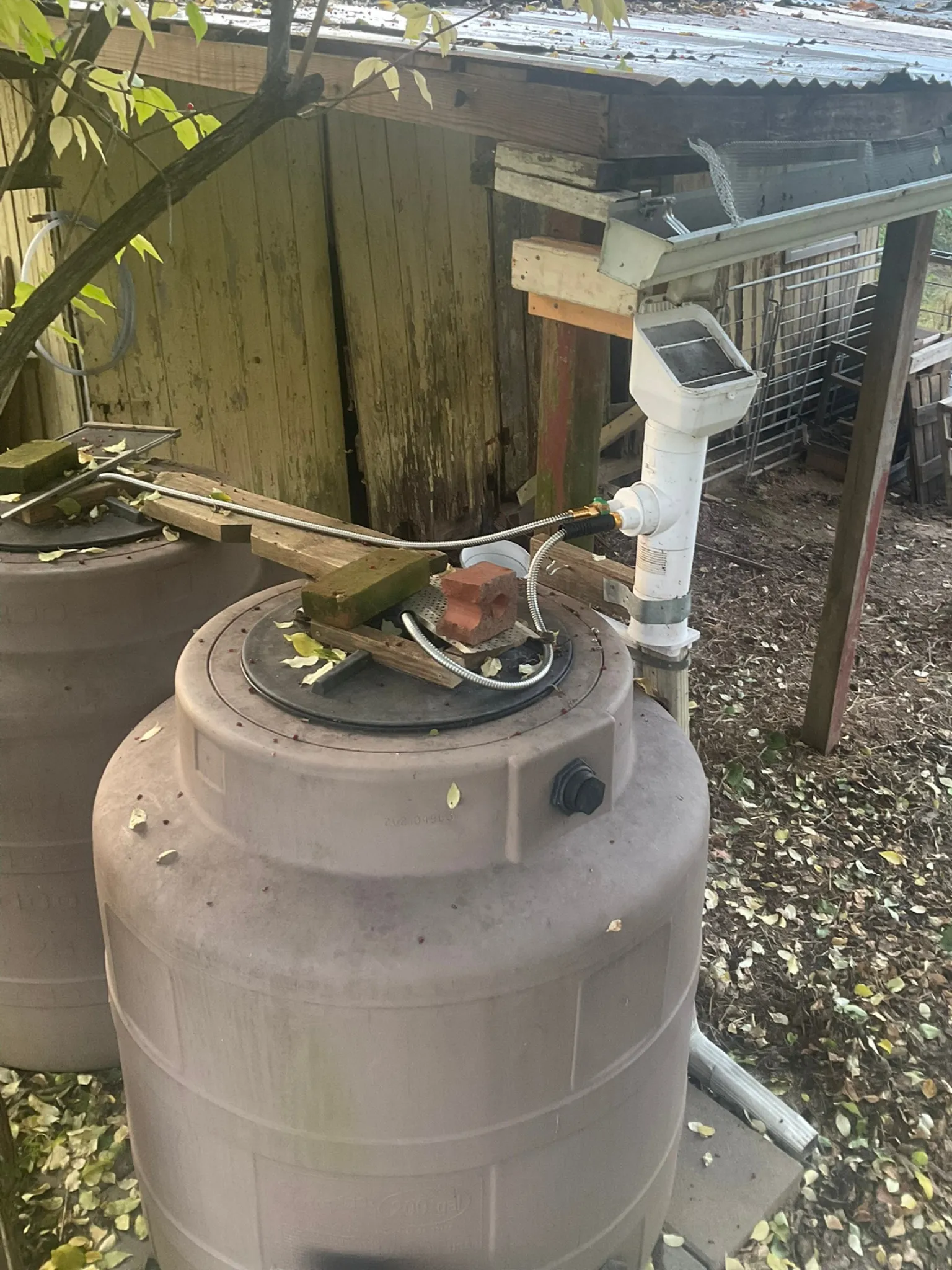 We switched to collecting from the shed's metal roof. It sits closer to the garden and the animals, too.
If your only option is a shingle roof, that water can still work for ornamental plants and rinsing tools. For a food garden, find out what your roof is made of before you decide.
What you can realistically do with the water
Here's the second thing I wish someone had told me: A rain barrel has very little water pressure. And it will decrease as the amount of water in the rain barrel decreases. There's no pump. The only push comes from gravity, so where the barrel sits matters as much as which diverter you pick.
Downhill is easy, uphill is jugs
With our first barrels at the house downspout, a hose could only reach the raised beds on the lower side of the yard. For the beds on the higher side, we filled jugs and carried them.
That's not a failure. It's just how gravity works. But it's worth planning for.
The lesson we learned the hard way: When we redid the roof, we should have run the gutters toward the downspout at the top of the hill. Instead, they drain to the end near our walkout basement door, at the low side. If you have any say in where your downspout is, pick the high spot. Moving our collection to the centrally located shed solved a lot of this for us.
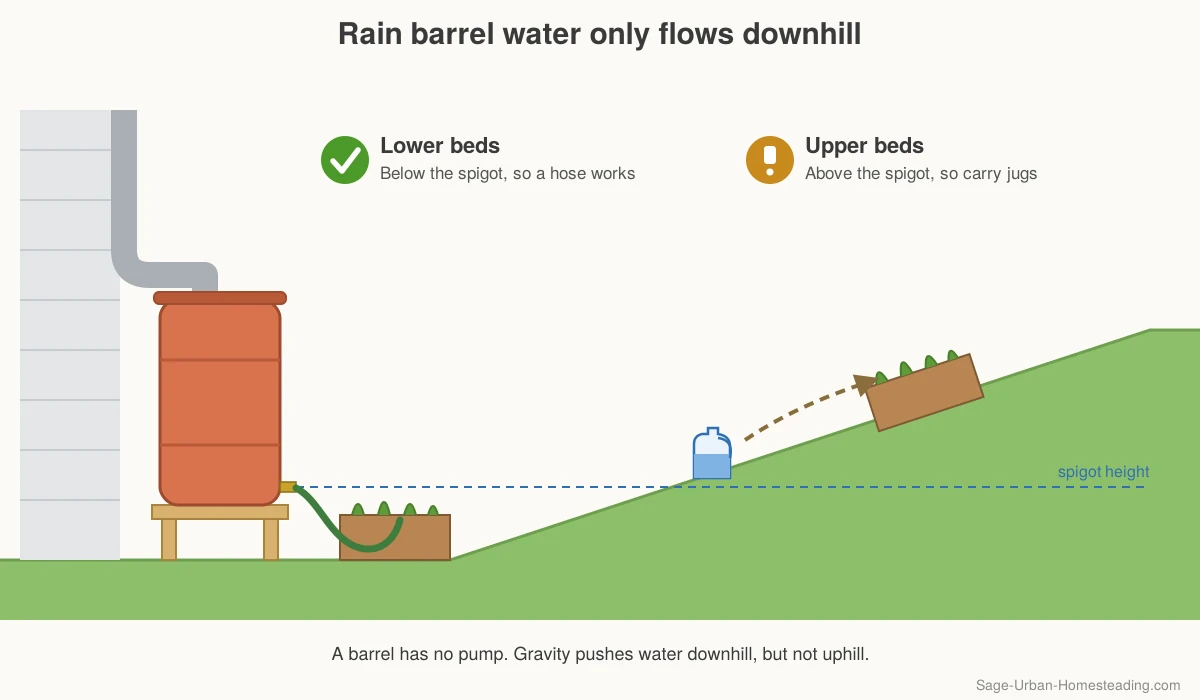
If you can't move the downspout, raising the barrel helps. A sturdy stand gives you a little more pressure and room for a watering can under the spigot. See Rain Barrel Stand Designs for options.
Realistic uses for barrel water
- Garden beds and containers. The classic use, and the best one. A watering can or a short hose works well for beds that sit lower than the barrel.
- Filling watering cans and jugs. Slower than a hose, but it works anywhere in the yard.
- Rinsing tools, pots, and muddy boots. Low pressure is fine for this.
- Topping off animal waterers. This is more advanced. See below.
What it's not great for: Long hose runs, sprinklers, and anything uphill. And barrel water isn't drinking water for people unless you do some serious filtering for bacteria and protozoa.
A more advanced idea: catch water right where you need it
Once you get the hang of it, you don't always need a barrel in the middle. We put a short gutter on the back of our quail pen, under the plastic roof we built for it. The water ran straight into their automatic waterer bucket.
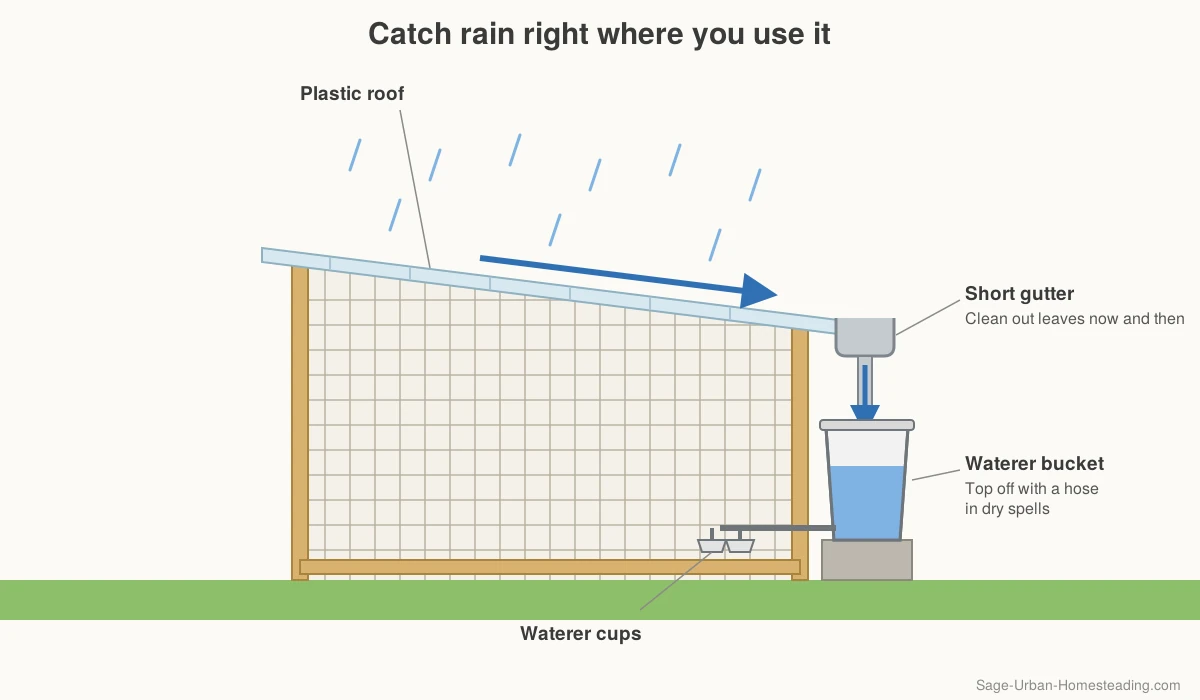 A short gutter on the quail pen fed their waterer directly. It wasn't hands-off, but it saved water and trips with the hose.
It wasn't hands-off. We had to clean leaves and debris out of it sometimes, and we often topped it off with a hose. But it saved water, and it saved carrying water to the pen.
The same idea works for a shed, a greenhouse, or a garden-bed area. A small roof plus a short gutter can feed a container that sits right where the water gets used.
Which setup fits what you want to do?
You don't need the "best" diverter. You need to look at the downspout diverter options and chose one that fits your goal and the amount of checking you're willing to do.
- You want to water a few containers or one bed as cheaply as possible. Start with an open downspout and one barrel. It's the simplest setup, as long as overflow and downpour splash can drain away from the house.
- You want a barrel that doesn't need babysitting. Try an automatic diverter. Extra water goes back down the downspout on its own.
- You want to decide when the barrel fills. A manual flap diverter gives you control, but you have to remember to use it.
- You want cleaner water or a bigger tank. Add a first flush diverter and a long overflow hose. You get less roof gunk in exchange for more upkeep.
- You want water right where you use it, like at a coop or shed. Run a short gutter into a container. No carrying, but you'll clean it and top it off.
If you're still unsure, start with one barrel on the downspout nearest your garden. Live with it for one season. You'll learn more from a few storms than from another week of research on downspout diverter options.
Make an overflow plan, whichever setup you choose
Every setup overflows somewhere eventually. Plan where it goes before the first big storm:
- Away from your foundation. Send overflow at least a few feet from the house. A longer overflow hose is a cheap fix. It's what we did with our tanks.
- Toward something that wants water. A garden bed, a lawn area, or a rain garden can soak it up.
- Not onto your neighbor's yard, or across a walkway where it can freeze.
Ready for a bigger project later? We eventually buried one of the overflow hoses near a walkway, aiming it away from the house, and ran it to a French drain, which is a gravel-filled trench underground that lets the water soak in slowly. It keeps the yard tidy and dry, but it's a weekend of digging. For a first barrel, an above-ground hose aimed at a garden bed works just fine.
Don't forget winter
In places with freezing winters, water left in a barrel or hose can freeze and crack things. Before the first hard freeze, drain the barrel and close or remove the diverter. Send the downspout back to its normal route until spring.
Start small and build from there
Rainwater collection is one of my favorite first systems, because you can start with one barrel and grow it later. But it isn't the right first step for everyone.
If you're not sure rainwater should be your first project, grab my free guide, Which Urban Homestead System Should You Start First? It helps you pick one system that fits your space, time, and energy.
If you're ready to build a real plan, the Small-Space Self-Sufficiency Starter Map helps you choose your first 3 systems. It includes a 30-Day Action Map that walks you through setting up System 1 without overbuilding. Simple rainwater catchment is one of the paths inside. Buy the Starter Map in the shop.
Want more on water collection? Head back to Water Collection for stands, setup, and more ways to save water at home.
Downspout Diverter Options FAQ
What happens when a rain barrel is full?
What happens when a rain barrel is full?
It depends on your setup. With an open downspout or a manual flap left open, water spills over the top or out the overflow port. With an automatic diverter, extra water backs up and flows down the downspout as usual.
Do I need a downspout diverter for a rain barrel?
Do I need a downspout diverter for a rain barrel?
No. Plenty of people start with an open downspout over a screened barrel. A diverter mostly helps with overflow. It's worth it if your barrel sits close to the house or you don't want to watch it during storms.
Is a first flush diverter worth it for one rain barrel?
Is a first flush diverter worth it for one rain barrel?
Usually not for a beginner barrel that's only watering the garden. It's more useful for bigger tanks, or when you want cleaner water. Just know it needs regular cleaning.
Why is my rain barrel overflowing even with a diverter?
Why is my rain barrel overflowing even with a diverter?
The most common reason is height. If an automatic diverter is mounted too high above an open-top barrel, the barrel can fill past its rim before water backs up. Check your kit's instructions, then lower the diverter if needed.
Why won't my rain barrel hose reach my garden?
Why won't my rain barrel hose reach my garden?
Rain barrels run on gravity, so pressure is low. Water flows well to beds lower than the barrel, but poorly uphill or through long hoses. Raising the barrel on a stand helps a little, and so do watering cans.
What should I do with rain barrels in winter?
What should I do with rain barrels in winter?
In freezing climates, drain the barrel, disconnect the hose, and close or remove the diverter. Let the downspout run normally until spring.
Can you collect rainwater from an asphalt shingle roof for a garden?
Can you collect rainwater from an asphalt shingle roof for a garden?
Many people do, but opinions differ. Shingles are often treated with additives that discourage moss and algae. We chose not to use shingle-roof water on our vegetable garden, and now collect from metal and plastic roofs instead. If you're unsure, find out what your roofing is made of, or save that water for non-food plants.
Why does water shoot past my rain barrel in heavy rain?
Why does water shoot past my rain barrel in heavy rain?
In a downpour, water can leave an open downspout with enough force to overshoot the barrel opening. Lowering the drop, angling the end straight down with a flexible elbow, or switching to a diverter that feeds the barrel through a hose keeps the water where you want it.

Amy DeVries helps beginner urban homesteaders learn by doing. A lifelong gardener, she has grown food in spaces that expanded to 16 raised beds, patio containers, dwarf fruit and nut trees, and gravity-fed rainwater systems. She shares practical lessons shaped by real experience. Amy homeschools her children and teaches the same hands-on skills that guide her work.
You might like these
Rain Barrels: A Beginner's Guide
How to choose, place, and set up your first rain barrel, with real lessons from our own rain barrels and links to every next step.
Rain Barrel Stand Designs for Real Yards and Setups
Choose the best rain barrel stand designs for your yard, barrel, and skill level, with practical guidance on height, base prep, materials, and safety.
Water Collection for Beginners: Simple Home Systems
Start collecting rainwater at home with one barrel. Find every water collection step here, from stands and diverters to overflow, and drip watering.


More Information
Disclosure
All information found on this website is editorial in nature and intended to motivate and inspire rather than be used as medical advice or legal advice.
As an Amazon Associate, I earn from qualifying purchases. I also use Google Ads and cookies as described in the Privacy Policy.
Thank you for your support!
By Amy DeVries, Copyright © 2011-2026 Sage-Urban-Homesteading.com All rights reserved.
