FYI: This website contains affiliate links. As an Amazon Associate I earn from qualifying purchases.
- Home
- Home Efficiency
- Turn the Heat Down at Night
Should You Turn the Heat Down at Night? Our Thermostat Schedule
By Amy DeVries
Short answer: Should you turn the heat down at night? For most homes, yes. With a furnace, a drop of several degrees while you sleep saves the most. With a heat pump, keep the drop small, so its backup heat doesn't have to switch on to warm the house back up. Ours is a heat pump, so we drop just 2 to 3 degrees at 10 pm and go back up at 6 am.
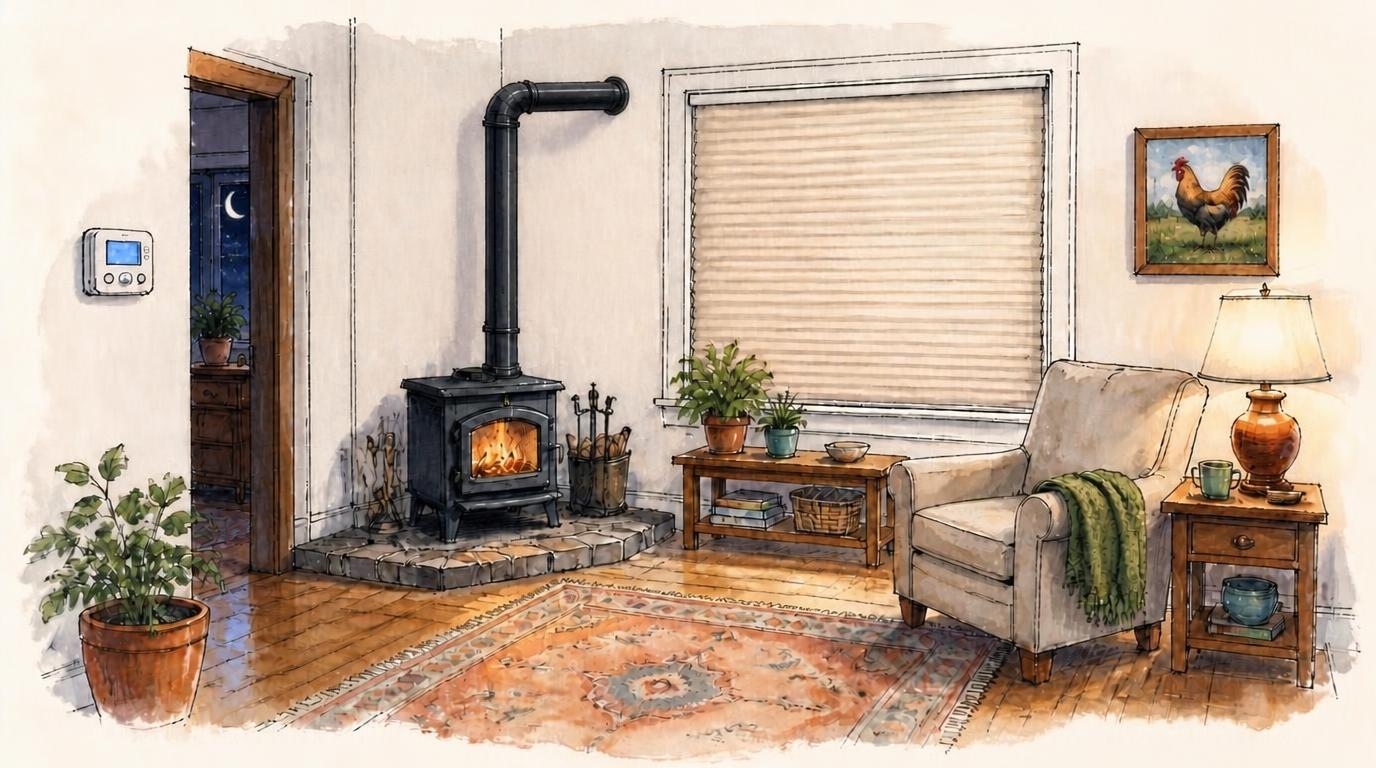 You don't need a new thermostat to save on heat. Start with the schedule on the one you have.
We've set thermostats in two houses now: the 1960s house we owned on a quarter acre inside the Baltimore Beltway, which had a gas furnace, and the 1920s house we rent now, with enough land for roosters (they're worth it). This one has a heat pump, and that changed how I think about turning the heat down.
We homeschool, so we're home most days. A schedule built around leaving for work and school didn't fit us. What fits is one simple day and night schedule, set once, that we hardly ever touch.
You don't need a smart thermostat or an app to do this. You need to know what kind of heat you have, and a few numbers you can live with.
Our schedule: Set it once, then leave it alone
Our house has two heating and cooling units, one for downstairs and one for upstairs, and each has its own thermostat. Both follow the same simple pattern: a daytime temperature that starts at 6 am, and a slightly cooler nighttime temperature that starts at 10 pm. In winter, that looks like this:
- Downstairs: 68° from 6 am, 65° from 10 pm
- Upstairs: 67° from 6 am, 65° from 10 pm
That's it. Same times every day, weekends included. Because we're home most days, there's no separate "away" setting in the schedule. On the days we'll be gone all day, I turn it down by hand before we leave. Our schedule changes too much to program around, and turning it down myself takes a few seconds.
If you're figuring out your own numbers, start with what feels comfortable during the day, then try a night setting a few degrees lower. Live with it for a week before you change anything else.
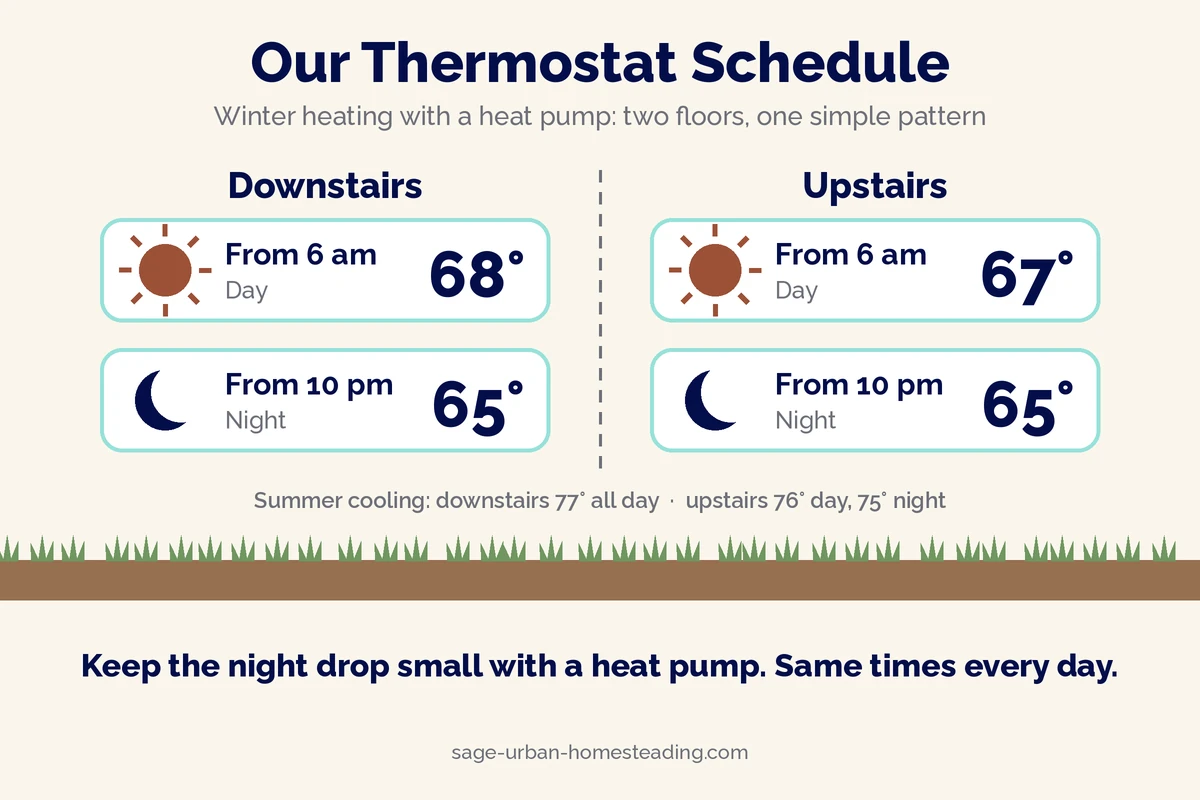 Two floors, two thermostats, one simple pattern. The night drop is small on purpose, because we heat with a heat pump.

Why turning the heat down saves money
You may have heard that turning the heat down doesn't help, because the house has to work harder to warm back up. The U.S. Department of Energy says that's a misconception. Once your house is cooler, it loses heat to the cold outside more slowly, so the longer it stays cooler, the more energy you save.
The same page says you can save as much as 10% a year on heating and cooling by turning your thermostat back 7 to 10 degrees for 8 hours a day. That's the classic advice, and it fits a furnace well. But it comes with an exception that most thermostat advice skips.
Heat pumps: Keep the night drop small
With a heat pump, a big drop at night can backfire. The Department of Energy explains that setting back a heat pump in heating mode can make it run inefficiently, which can cancel out the savings. For a heat pump, a moderate, steady setting is usually the better choice, unless your thermostat is made to handle heat pump setbacks.
The reason is the backup heat. Many heat pumps have backup electric heat, often labeled "Aux" on the thermostat. When you ask the house to warm up fast, like jumping several degrees at 6 am, the backup heat can switch on to help, and it costs more to run.
That's why our night drop is only 2 or 3 degrees. Even so, we still see "Aux" come on during very cold mornings, and the heat pump struggles to warm the house. On those days, we light our woodstove so the heat pump isn't working as hard. If you see "Aux" most cold mornings, try a smaller night drop first, or ask your heating and cooling technician whether your thermostat is set up for a heat pump.
A woodstove is a big, permanent piece of equipment, and it's not where anyone needs to start. If you have one, or any fuel-burning appliance, my renter page covers the safety basics we follow. See Draft Fixes for Renters.
Not sure what kind of heat you have?
If your thermostat has an "Aux" light or an "Em Heat" setting, you very likely have a heat pump. If you're still not sure, ask your landlord or whoever services your system. It's worth knowing before you choose how far to turn the heat down.
Two floors, two schedules
Having separate upstairs and downstairs thermostats lets each floor have its own numbers. Ours are only a degree apart during the day and match at night, so it isn't complicated.
If your home has one thermostat for everything, a simple day and night schedule is still the place to start. You can also close the doors to rooms you aren't using, so the heat stays where you actually spend your time.
Our basement has only one vent, so it gets just a little of the heat, and part of it isn't insulated. The door to that part of the basement is our worst draft, and it has cardboard stapled to it now. See How to Find Drafts.
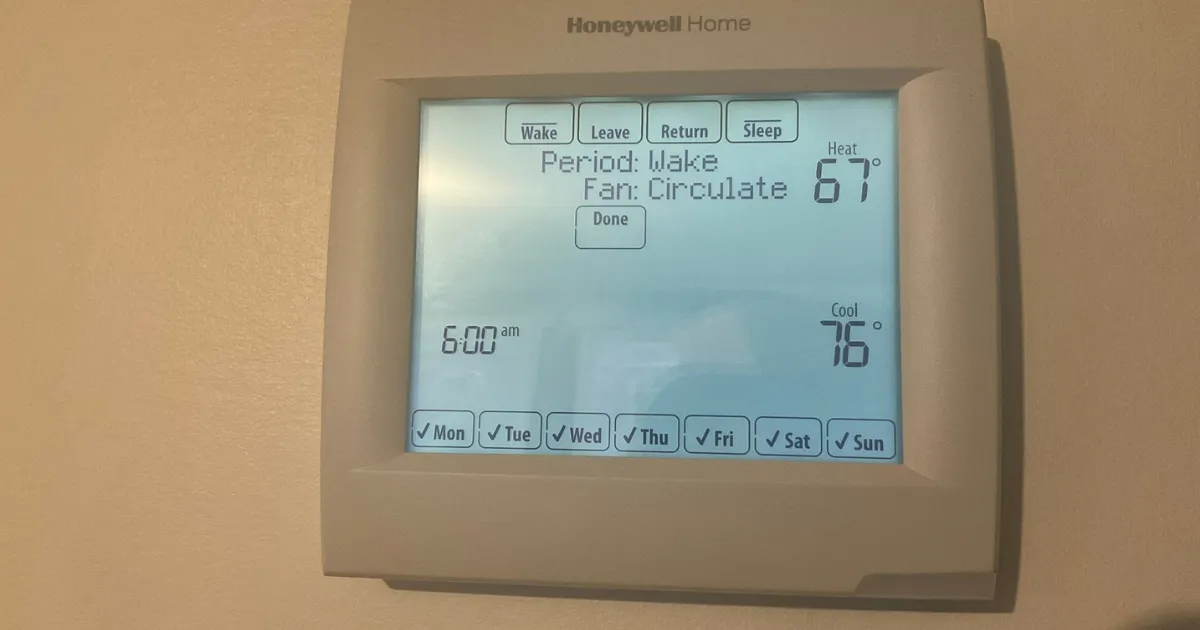 Our thermostat programs with buttons on the wall. No phone or app needed.
The fan setting we leave on
Our thermostats are set so the fan circulates the air every so often, even when the heat or air conditioning isn't running. It helps keep mold down, which matters to us in an old house. The fan does use some electricity, so it's a trade-off you can decide on for your own home.
Our system also has filters and a light inside the unit meant to cut down on dust mites and mold. Our landlord has the heating and cooling company come out to maintain the system about twice a year, so we don't handle that part ourselves.
Summer: Same thermostats, cooling mode
We switch the thermostats to heating for winter and cooling for summer, rather than letting them switch on their own. In summer, the settings barely change between day and night:
- Downstairs: 77° day and night
- Upstairs: 76° from 6 am, 75° from 10 pm
At the Beltway house, we had the same type of programmable thermostat, but it only ran the heat. For years, we cooled with window air conditioners. When the old furnace needed replacing, we chose one that could also run central air, and the same thermostat started handling both.
Let your shades help
Thermostat settings work better alongside a free habit: shades up in the morning to let the sun in, and down in the evening to hold the heat. Our cue for lowering them is simple. When the lamps go on, the shades go down. See Should You Close Blinds?
Should you buy a programmable or smart thermostat?
Not as a first step. Try turning the heat down by hand at bedtime and back up in the morning for two weeks. If you remember most nights, you may not need anything new.
If you keep forgetting, or nobody wants to be the one who gets up to a cold house, a programmable thermostat solves a real problem. Ours is a Honeywell Home thermostat that programs with buttons on the wall. The installer set it up, and it's easy to understand and use. I didn't want a smart one that needed a phone and an app. The only upkeep is replacing the battery that powers the screen, about once a year.
If you have a heat pump, look for a thermostat made to work with heat pumps. The Department of Energy notes that some are designed to keep backup electric heat to a minimum, which is what makes turning the heat down worth it.
We rent, and in our situation, we're allowed to adjust the thermostat. Replacing it would be a different conversation. If you rent, check before you change anything that's wired into the house. See Draft Fixes for Renters.
You can buy a Honeywell Home programmable thermostat on Amazon (affiliate link). This isn't our exact model, but it looks similar. Skip it if you'll remember to turn the heat down by hand, if you rent and the thermostat isn't yours to replace, or if you have a heat pump and the model you're looking at doesn't list heat pump support. If you do buy one, ask your landlord or heating and cooling company to install it, the way ours was.
What to try next
Once your schedule feels automatic, pick the next small step that fits your house.
- You want a free habit that works alongside your thermostat. See Should You Close Blinds?
- One room still feels chilly, even at the daytime setting. See How to Find Drafts.
- A window feels cold at night. See How to Make Window Quilts.
- You rent and want draft fixes you can take with you. See Draft Fixes for Renters.
A thermostat schedule is one small system. If you're wondering what your next one should be, whether it's home comfort, water, or food, my free 2-page guide helps you pick one place to start. It's called Which Urban Homestead System Should You Start First?, and it's built for small spaces and busy lives.
Should you turn the heat down at night? FAQ
Should I turn the heat off completely when we go away?
Should I turn the heat off completely when we go away?
Turn it down, not off. In freezing weather, a house with no heat can get cold enough to freeze pipes. Think about anything you have that might be sensitive to temperature changes: houseplants, pets, medications, etc. We turn ours down by hand on days we'll be gone and bring it back up when we get home.
Does turning the thermostat way up warm the house faster?
Does turning the thermostat way up warm the house faster?
No. The heat comes on the same either way, and with a heat pump, a big jump is what can bring on the backup heat. Set it to the temperature you actually want and give it time.
What if someone in the house is always cold?
What if someone in the house is always cold?
Try one degree at a time, a few days apart, instead of a big change all at once. A warm layer and a throw on the favorite chair help, too. You don't have to match anyone else's numbers. The right setting is one your household can live with.
Is a space heater cheaper than heating the whole house?
Is a space heater cheaper than heating the whole house?
Sometimes, for one room, but it needs care every time you use it. My home efficiency page has a short space heater safety checklist. See Home Energy Efficiency for Beginners.
Your thermostat checklist
- Find out whether you heat with a furnace or a heat pump.
- Pick a daytime temperature that feels comfortable.
- Try a night setting a few degrees lower. With a heat pump, keep the drop small.
- Choose two times to switch, like 6 am and 10 pm, and keep them the same every day.
- Turn it down, not off, on days you'll be away.
- If you see "Aux" on most cold mornings, try a smaller drop.
- Live with it for two weeks before buying a new thermostat.
Want help deciding which small system to set up next, for the space you actually have? My Small-Space Self-Sufficiency Starter Map ($12) lays out your next steps.

Amy DeVries helps beginner urban homesteaders learn by doing. A lifelong gardener, she has grown food in spaces that expanded to 16 raised beds, patio containers, dwarf fruit and nut trees, and gravity-fed rainwater systems. She shares practical lessons shaped by real experience. Amy homeschools her children and teaches the same hands-on skills that guide her work.
More Information
Disclosure
All information found on this website is editorial in nature and intended to motivate and inspire rather than be used as medical advice or legal advice.
As an Amazon Associate, I earn from qualifying purchases. I also use Google Ads and cookies as described in the Privacy Policy.
Thank you for your support!
By Amy DeVries, Copyright © 2011-2026 Sage-Urban-Homesteading.com All rights reserved.
