FYI: This website contains affiliate links. As an Amazon Associate I earn from qualifying purchases.
- Home
- Home Efficiency
- Window Blinds
Should You Close Blinds? Our Morning and Evening Shade Routine
By Amy DeVries
Short answer: Should you close blinds? At night, yes, almost always. In winter, open them in the morning to let the sun warm the room, and close them in the evening to hold that heat in. In summer, keep them partway down on the hottest days. Our cue is simple: when it's dark enough to turn on a lamp, the shades go down.
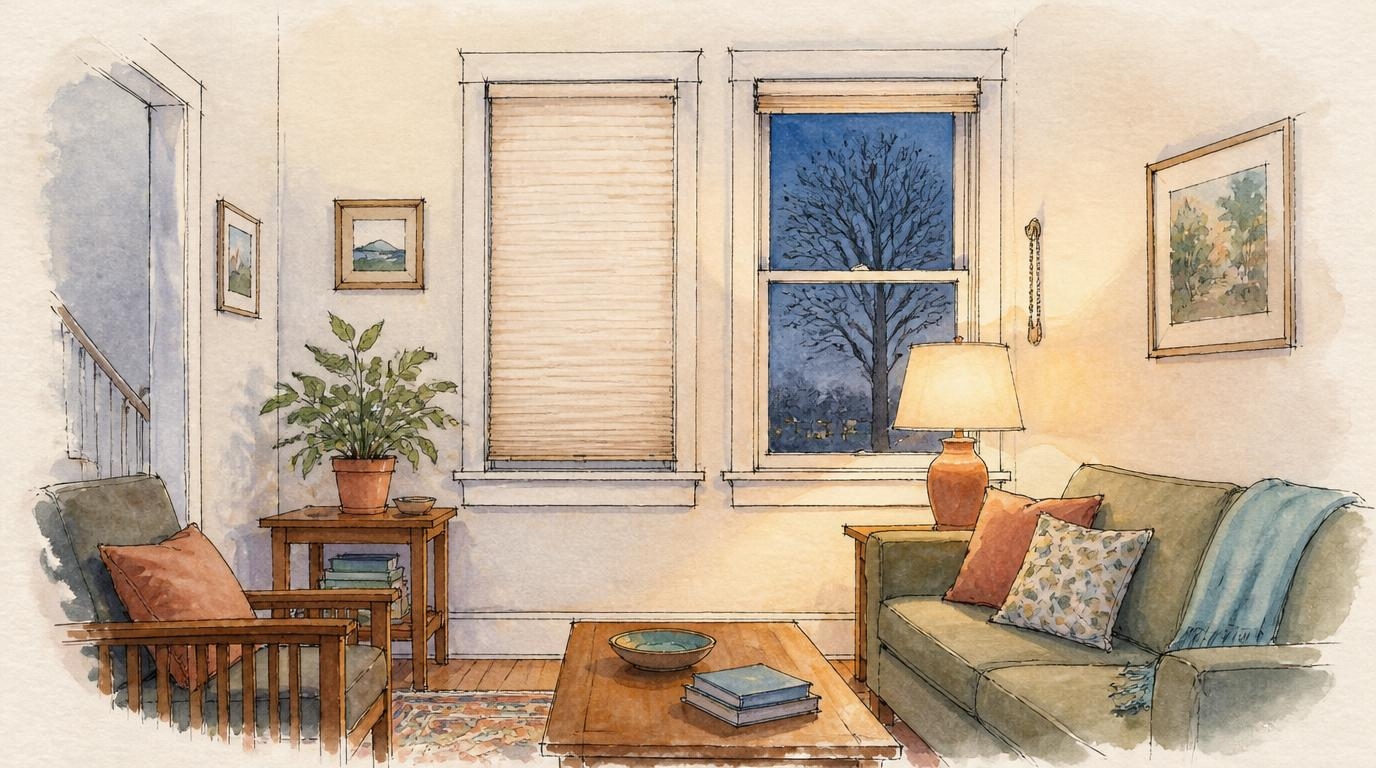 When the lamps go on, the shades go down. That's the whole cue.
We've lived with cellular shades in two houses now: the 1960s house we owned on a quarter acre inside the Baltimore Beltway, and the 1920s house we rent now, with enough land for roosters (they're worth it). In both, the shades go up in the morning and down in the evening, every day.
Most advice about blinds and energy ends with buying something new. This page starts with the shades or blinds you already have. Opening and closing them on a schedule is free, it takes a couple of minutes, and you can start tonight.
You don't need the perfect window coverings to do this. You only need a cue that tells you when.
Our cue: When the lamps go on, the shades go down
We don't go by the clock or look up sunset times. In the evening, if a room is dark enough that we'd turn on a light, it's time to put the shades down. That works all year, because it moves with the seasons on its own.
In the morning, the cue is the window itself. Before it's light out, a dark window acts like a mirror and you see the room reflected back at you. Once it's light enough that the mirror effect is gone, the shades go up.
It's just part of our daily routine now. Whoever gets up first usually starts putting the shades up. In the evening, we split it: one of us takes the upstairs and one takes the downstairs. If we get home after dark, we start putting them down as soon as we walk in the door.
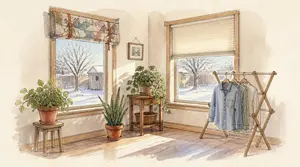
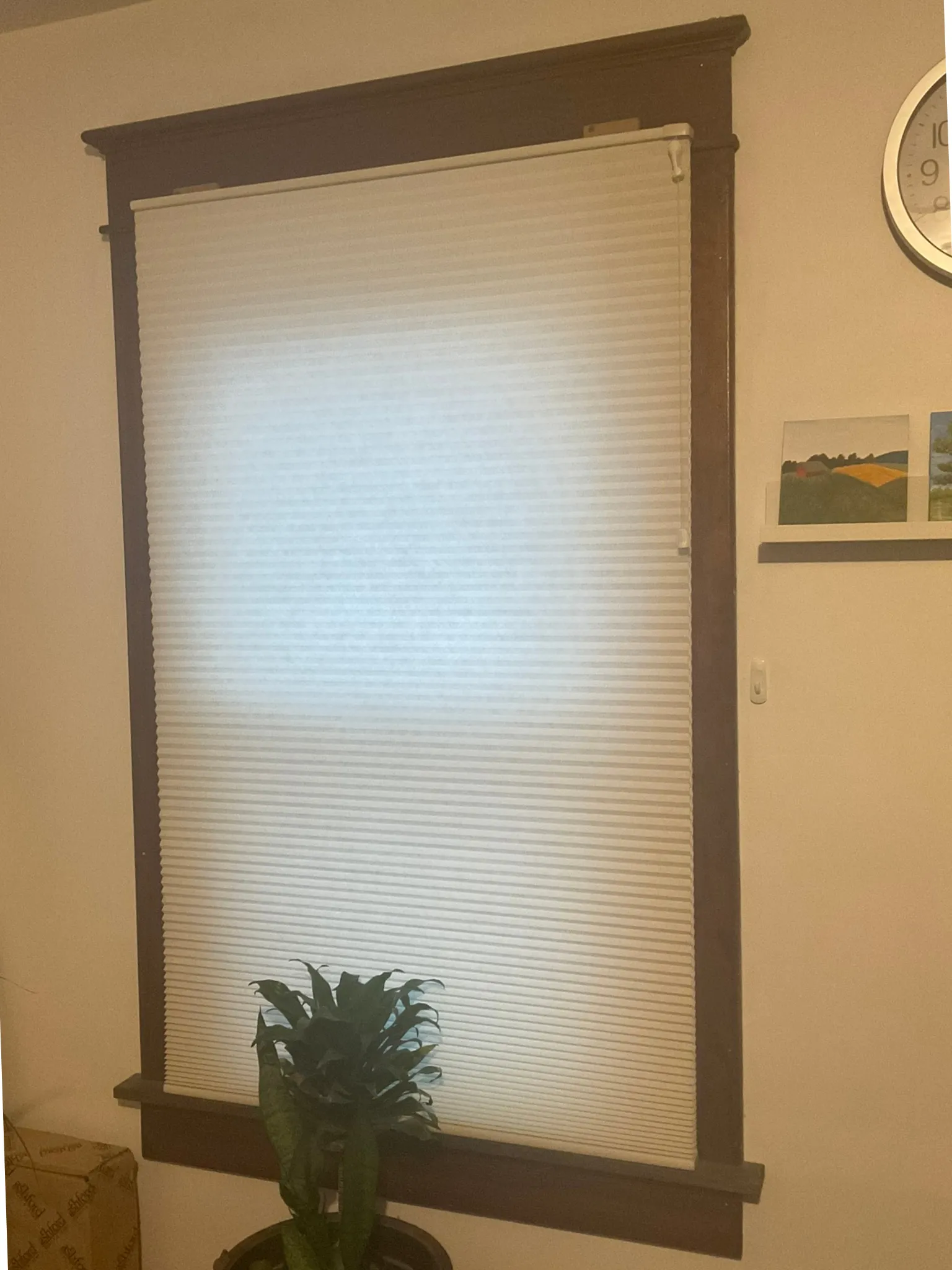 Our cellular shades go up when the windows stop looking like mirrors and come down when the lamps go on.
Why closing your blinds at night helps
On a sunny winter day, sunlight coming through the glass warms the room for free. After dark, the same window works the other way. The glass gets cold, and the room's heat drains toward it.
A closed shade puts a layer of trapped air between you and that cold glass. The U.S. Department of Energy says cellular shades reduce nighttime heat loss through windows and cut down on cold drafts near them. Regular blinds help less, because they block some sun but don't insulate much, but closing whatever you have is still a free place to start.
The part you'll feel first isn't on your bill. It's sitting near a window in the evening without that chill on one side of you.
Winter and summer: When to open and close your blinds
In winter
- Morning: Shades up once it's light, to let the sun in.
- Evening: Shades down when the lamps go on, to hold the heat.
- Especially cold days: We sometimes leave the shades only halfway up, as a middle ground between light and warmth.
In summer
We still put the shades up in summer, mostly so the houseplants get their light. On especially hot days, we only raise them halfway. In the evening, they still come down when the lamps go on.
At the Beltway house, we cooled with window air conditioners for years. We kept one daytime "cold room" cool and ran a unit in the bedroom at night, and the shade routine worked right alongside that. To keep the bedroom dark around the window unit, I cut a black trash bag into a summer cover. It was a single layer, so it didn't insulate anything, but it kept the room dark enough to sleep.
If you're figuring out your own house, start with the windows that get the strongest afternoon sun. Those are the ones worth lowering first on a hot day.
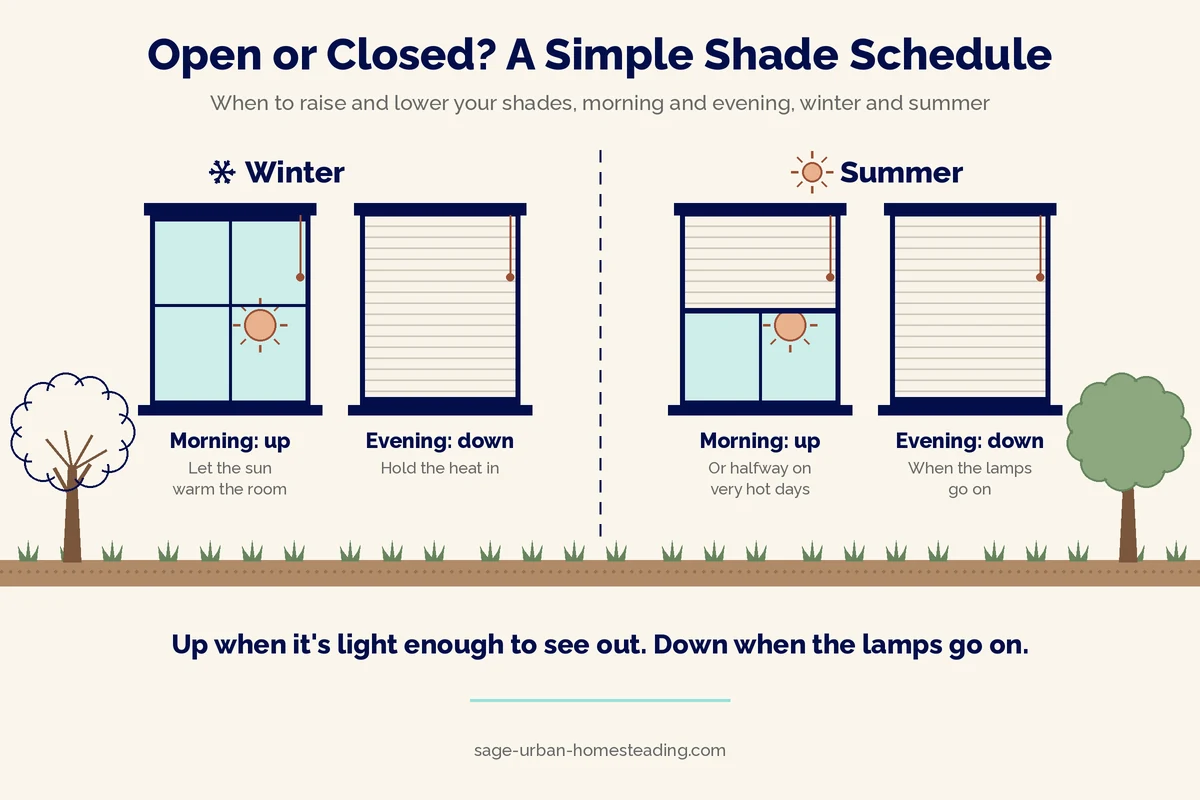 Up when it's light enough to see out, down when the lamps go on. Especially hot or cold days get the halfway setting.
Shades, window quilts, or both?
At our house, each window gets one cover, either a cellular shade or a window quilt, never both. At the Beltway house, I sewed window quilts for the north-side windows and used cellular shades on the south side, where we wanted the light.
The two fit into a daily routine differently. A shade can stop halfway. A quilt can't, so it's either up or down. We still rolled our quilts up for at least part of each day, so the window and the fabric could dry out and the air could move. If you have cold windows that don't get much sun, a quilt may be the better fit. See How to Make Window Quilts.
Bedrooms: Shades help you sleep, too
Our bedrooms have blackout cellular shades, and the rest of the house has regular ones. When we moved, we lived for a couple of months with no window coverings at all, and the neighbors' outdoor lights made it hard to sleep. Closing the shades at night does more than hold in heat.
If you rent and need to ask before mounting shades, my renter page covers how we asked and how we mounted them on old trim. See Draft Fixes for Renters.
Should you buy new shades?
Not as a first step. Try the routine for two weeks with whatever you have, even plain blinds or curtains. If you find you're doing it every day, and a window still feels cold, that's when better shades are worth a look.
The shades we use
We bought our cellular shades online from EcoSmart Shades for both houses, so we've used them for over 15 years (non-affiliate). We installed them ourselves. Only one has ever broken, and we were able to order a replacement part. My husband fixed it.
Ours have cords. They have the safety clasps, and we hang each cord on a small adhesive hook beside the window to keep it up and out of the way. Blackout shades cost more, so we only bought them for the bedrooms.
One safety note: if young children live with you or visit, the U.S. Consumer Product Safety Commission says cordless window coverings are the safest choice, since children can become tangled in cords quickly and silently. If you keep corded ones, keep the cords short and out of reach, and move cribs and beds away from windows.
Here are the exact small adhesive hooks for shade cords that we bought on Amazon (affiliate link). Skip it if your shades are cordless, or if your cords already have a cleat mounted by the window.
What about smart shades?
You can buy shades that open and close on a timer. We've skipped them. They're expensive, and in our experience, the more high-tech something is, the more likely it is to break and the more it costs to repair. A lamp for a cue and two people splitting the stairs works fine for us.
Shades near a woodstove
We have shades in the room with our woodstove, hung a safe distance from it. Carroll County's wood stove safety sheet says to keep anything that can burn at least 3 feet from the stove. Shades and curtains count.
What to try next
Once the routine feels automatic, pick the next small step that fits your house.
- A window still feels cold at night, especially on the north side. See How to Make Window Quilts.
- You can feel cold air moving near the window or somewhere else. See How to Find Drafts.
- Some rooms are too warm while others are too cold. See Should You Turn the Heat Down?
A shade routine is one small system. If you're wondering what your next one should be, whether it's home comfort, water, or food, my free 2-page guide helps you pick one place to start. It's called Which Urban Homestead System Should You Start First?, and it's built for small spaces and busy lives.
Should you close blinds? FAQ
What if nobody's home during the day?
What if nobody's home during the day?
If you leave before it's light and get home after dark, leaving the shades down is fine. If you leave after sunrise, raise the ones on your sunniest windows on the way out, so the sun can warm the room while you're gone.
Should blinds stay closed on cloudy winter days?
Should blinds stay closed on cloudy winter days?
There's less sun to gain on a cloudy day, so it's fine to leave the shades down in rooms you aren't using. Open the ones where you want the light.
Does this work with curtains?
Does this work with curtains?
Yes. The same cues work for curtains, window quilts, or plain blinds: open when it's light enough to see out, closed when the lamps go on.
What if I forget?
What if I forget?
Then close them when you notice. One missed evening doesn't undo anything. Tying the routine to something you already do, like turning on the first lamp, is what makes it stick.
Your shade routine checklist
- Pick your evening cue: the first time you reach for a lamp.
- Pick your morning cue: when the windows stop looking like mirrors.
- Decide who does which floor or which rooms.
- On hot or very cold days, try the shades halfway.
- Keep shades and curtains at least 3 feet from a woodstove or space heater.
- Live with it for two weeks before buying anything new.
Want help deciding which small system to set up next, for the space you actually have? My Small-Space Self-Sufficiency Starter Map ($12) lays out your next steps.

Amy DeVries helps beginner urban homesteaders learn by doing. A lifelong gardener, she has grown food in spaces that expanded to 16 raised beds, patio containers, dwarf fruit and nut trees, and gravity-fed rainwater systems. She shares practical lessons shaped by real experience. Amy homeschools her children and teaches the same hands-on skills that guide her work.
You might like these
How to Make Window Quilts
Learn how to make homemade window quilts the quick and easy way for more window insulation and the health benefits of sleeping in the dark.
Home Efficiency for Beginners: Start Small, Stay Warm
Home efficiency for beginners: small habits and removable fixes that make your home warmer and cheaper to run, even if you rent.
Draft Fixes for Renters: How to Stop Drafts in a Rental
Easy draft fixes for rentersl, sorted by how removable each fix is: no-trace fixes, small-hole fixes, and what to ask your landlord about first.

More Information
Disclosure
All information found on this website is editorial in nature and intended to motivate and inspire rather than be used as medical advice or legal advice.
As an Amazon Associate, I earn from qualifying purchases. I also use Google Ads and cookies as described in the Privacy Policy.
Thank you for your support!
By Amy DeVries, Copyright © 2011-2026 Sage-Urban-Homesteading.com All rights reserved.
