FYI: This website contains affiliate links. As an Amazon Associate I earn from qualifying purchases.
- Home
- Home Efficiency
- Finding Drafts
How to Find Drafts in Your House: Finding Drafts and Cold Spots
By Amy DeVries
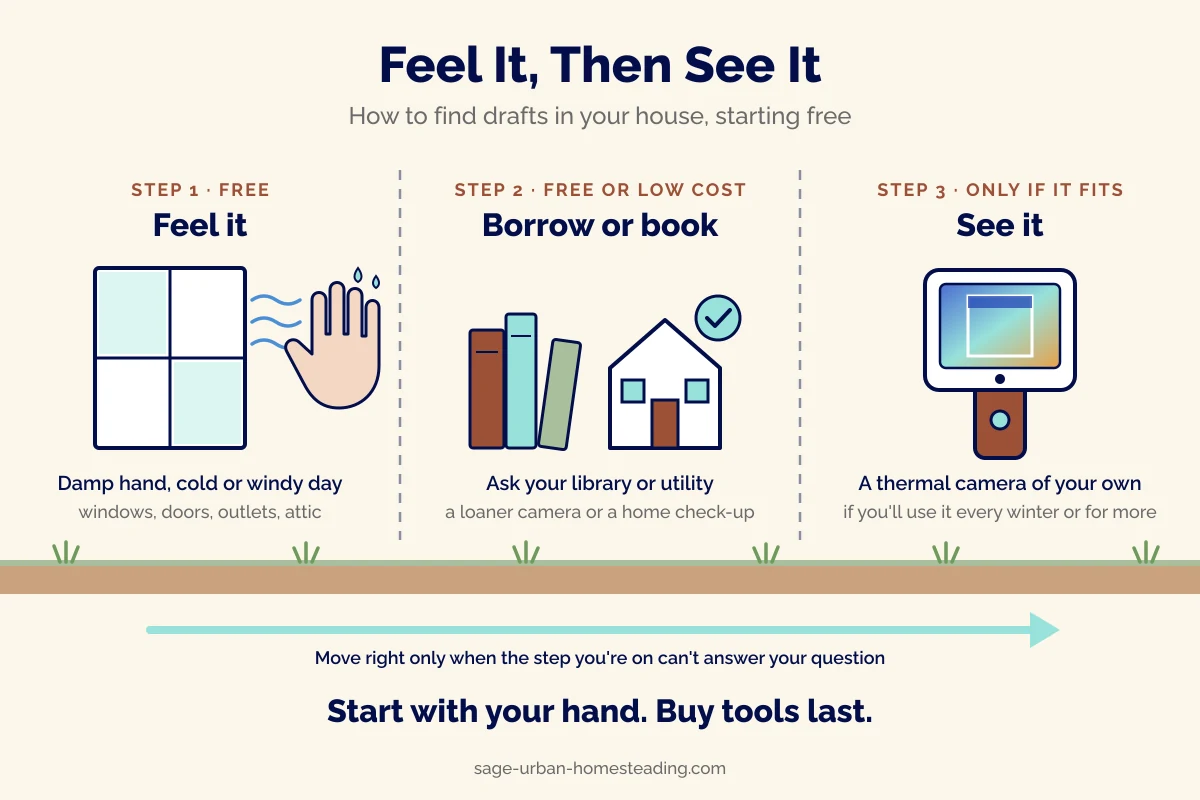
Short answer: If you are wondering how to find drafts, start free. On a cold or windy day, hold a damp hand near window edges, the bottoms of exterior doors, outlets on outside walls, and attic or basement doors. If you feel moving air, you've found a draft. Still not sure where the cold is coming from? Borrow a thermal camera or ask your utility about a home check-up before you buy anything.
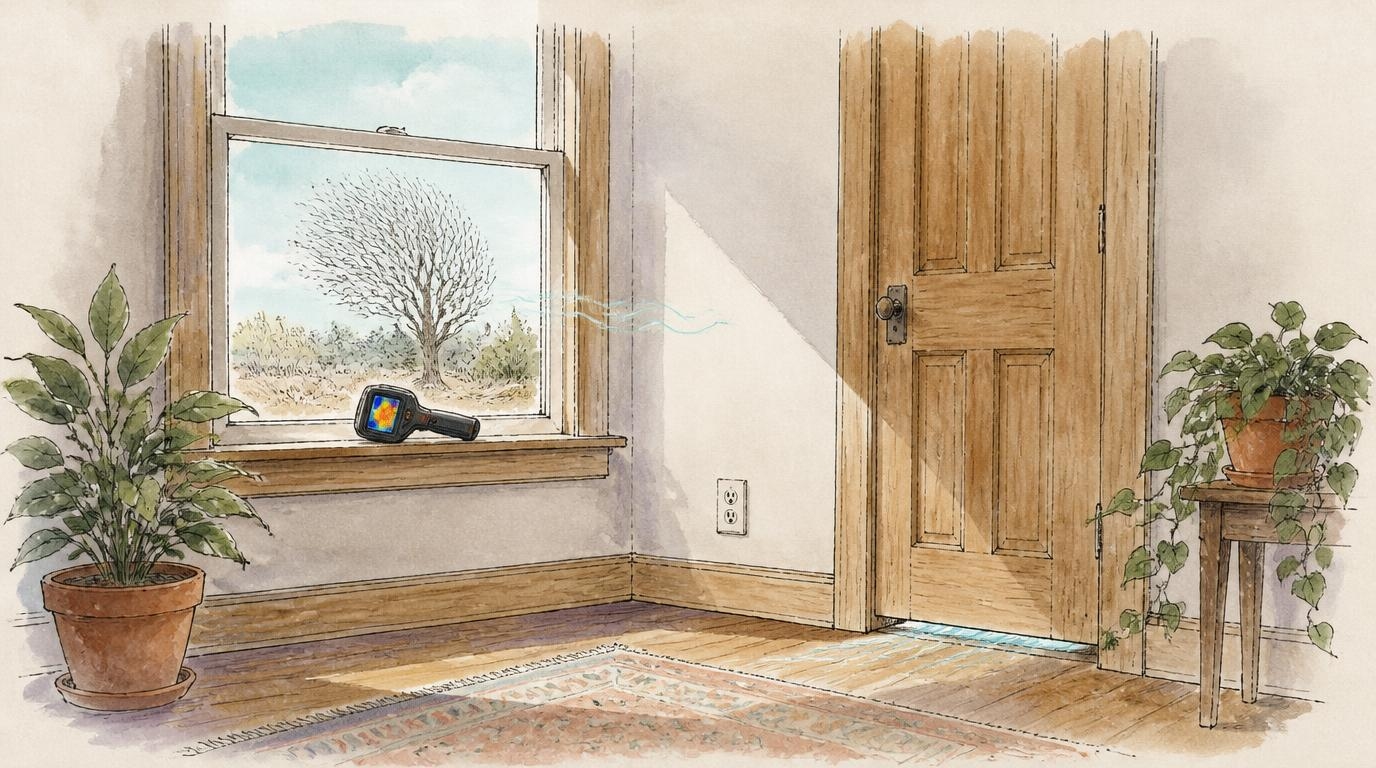 Most drafts give themselves away to a damp hand. A thermal camera can come later, if ever.
Maybe it's one chair that's always chilly, or a hallway that sends you back for socks. You know cold air is getting in somewhere. You just don't know where. That's a normal place to be stuck, and it's where every draft fix starts.
We've hunted drafts in two houses: the 1960s house we owned on a quarter acre inside the Baltimore Beltway, and the 1920s house we rent now, with enough land for roosters (they're worth it). In both, the most useful tool has been a damp hand. I do own a thermal camera, but I didn't buy it for drafts, and you don't need one to start.
This page is the step before any fix: finding the problem. Once you know where the cold is coming from, choosing what to do about it gets much simpler. See Home Energy Efficiency for Beginners.
Start with the spot you already notice
Your body has been collecting clues all winter. Before you test anything, jot down your coldest chair, your coldest room, any door that whistles, and any floor that feels icy. Those are your first places to check.
You don't have to test the whole house in one afternoon. One room is a fine start, and it counts.
The damp hand test: Start here
This is the method I use, and it costs nothing.
- Wait for a cold or windy day. Wind pushes outside air through gaps, so drafts are easier to feel.
- Wet your hand and shake off the drips. Damp skin notices moving air much better than dry skin.
- Move your hand slowly along the edges of a window, then the bottom and sides of an exterior door.
- Check outlets and switches on outside walls by holding your hand near the cover plate.
- Check doors that lead to cold spaces, like the attic, basement, or garage.
- When you feel cool, moving air, mark the spot with a piece of painter's tape or a note on your phone.
One safety note on outlets: only hold your hand near the cover. Never poke anything into an outlet. And if an outlet or switch feels warm, that isn't a draft. The Massachusetts Department of Fire Services lists unusually warm outlets or switches as a reason to call a licensed electrician soon.
Where to check
These are the spots worth a pass with your hand:
- Window edges, where the sash meets the frame
- The bottom and sides of exterior doors
- Outlets and switches on outside walls
- The attic door or hatch
- The basement door
- Anywhere pipes, cables, or wires come through a wall
- Around a window or wall air conditioner
- Fireplace dampers
You can also look for clues without feeling for them. Daylight showing around a closed door or window means air can get through. So does a window or door that rattles when you push on it.
What we found in our houses
At the 1920s house we rent now, the worst draft didn't take any searching. It's the old wooden slat door to the uninsulated part of the basement, and you can feel the cold easily. That door has cardboard stapled to it now.
The attic door gave itself away a different way. It has a full stairway, and the door doesn't latch. When someone opens a door somewhere else in the house, the change in air pressure pops it open. A door that moves on its own is telling you air is moving, too. For now, the vacuum lives against it.
What surprised me here was the windows. The windows and exterior doors in this house have been replaced, and they aren't nearly as cold as the originals. So don't assume your windows are the problem. Check them, but check everything else, too.
At the Beltway house, the thermal camera turned up something we had no idea was there: a hole in the living room wall. It was probably an old cable hole that had only been lightly covered over. The regular outlets had all been insulated, so this one covered-up spot was the gap. We filled it with thick insulation. A damp hand might never have found it, because nothing about that wall looked or felt wrong.
Other free ways to find drafts
The damp hand test finds most drafts you can feel. If you're stuck, these are other free options to try.
- Incense or smoke. Hold a lit incense stick near a suspected leak. If the smoke wavers or gets pulled in one direction, there's a draft. The U.S. Department of Energy pairs this with steps that make leaks easier to find, including turning off fuel-burning appliances like gas furnaces and water heaters first. If your home has anything that burns gas, oil, or wood, read their full steps before you try it, and never do it while a woodstove or fireplace is burning. [EXTERNAL LINK: https://www.energy.gov/node/366823 — link text: U.S. Department of Energy — open in new tab]
- A flashlight at night. One person shines a flashlight along the edges of a door or window while someone outside watches for light. This only shows bigger gaps.
- A dollar bill. Close a door or window on a dollar bill. If it slides out without any drag, the seal isn't tight there.
When a cold spot isn't a draft
Not every cold spot is moving air. A wall can feel cold because there's little insulation behind it, and glass can feel cold even when nothing is leaking. A damp hand finds moving air. It can't tell you what's going on inside a wall.
That's where a thermal camera earns its keep. It shows the temperature of surfaces, so cold patches show up as color. At the Beltway house, I checked our bedroom window with and without its window quilt. The images also showed gaps in the wall insulation up near the roofline, something I never would have felt with my hand. See How to Make Window Quilts.
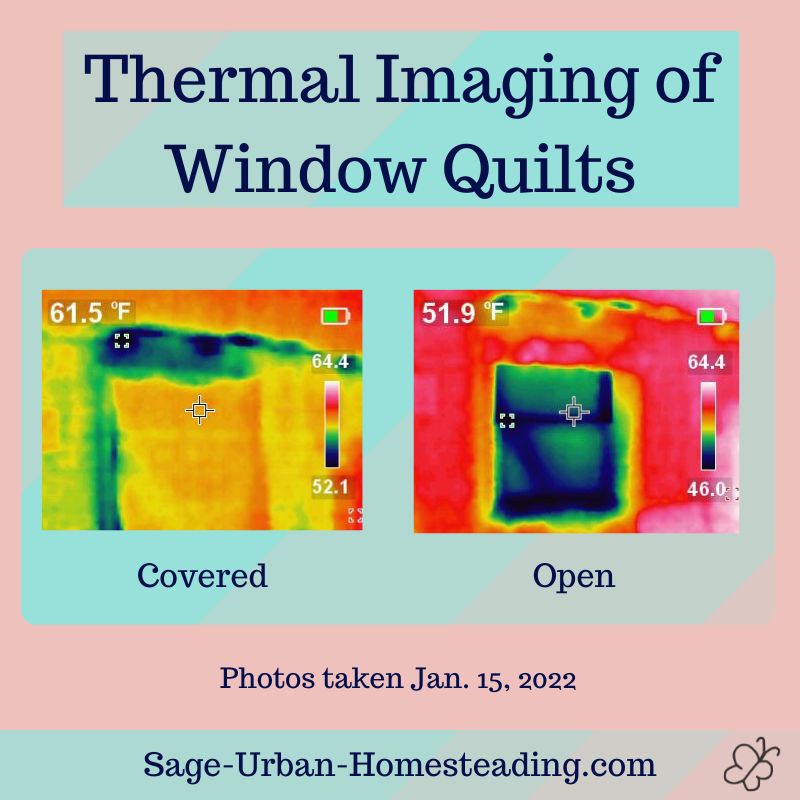 Our Beltway house bedroom window with the window quilt down and up. Look near the roofline for the insulation gaps the camera found.
Is a thermal camera worth it?
For most people, not as a first step. Try the free and borrowed options first, then buy one only if you'll keep using it.
Try free or borrowed options first
Some libraries lend thermal cameras, so it's worth asking yours. Ours didn't have one the last time I checked, but programs change.
Your power company may also offer a home check-up. In Maryland, BGE customers can get a Quick Home Energy Check-up at no additional cost. It's about an hour-long walk-through that looks at things like insulation, air leakage, windows, and doors.
To be honest, we had a BGE check-up at the Beltway house several years ago, and it wasn't very helpful for us. It costs nothing extra, though, so it may be worth trying, especially if you've never had one. If you're not a BGE customer, check your own utility's website for something similar.
The thermal camera we use
We bought ours on Amazon for our freeze dryer. Now we use it more for finding cold spots than for anything else.
What I like most is that it doesn't need a phone. It's a handheld camera that saves photos to an SD card, and it shows the lowest and highest temperature in the frame. The only annoyance is that if you move it too fast, it pauses for a moment to recalibrate. It's not a big deal, and overall we're happy with it.
It has also turned out to be handy for things I never expected:
- Finding a clog. When the kitchen sink drains slowly, we run hot water, then look at the long drain pipe in the basement. The camera shows where the warm water stops, so we know where to start working on the clog.
- Checking the woodstove. I was surprised how hot ours gets, and it's useful to see which spots get the hottest. Even so, the camera is no substitute for clearance. Carroll County's heating safety handout says to keep a wood stove 3 feet from anything that can burn.
Here is the exact thermal camera we bought on Amazon (affiliate link). Skip it if your only plan is a one-time check for drafts. Ours cost over $300, so borrow one if your library lends them, or start with the damp hand test. It's most worth it if you'll check your house every winter or have other uses for it, like tracking down a slow drain.
Getting useful pictures
If you do borrow or buy one, a few habits help:
- Use it on a cold day. The bigger the difference between inside and outside, the clearer the cold spots.
- Move slowly, so the camera can keep up.
- Take a picture of the same spot before and after a fix. That's how we saw what our window quilts were doing.
- Remember that it shows surfaces. A cold patch on a wall is a clue, not a diagnosis.
Found a draft? Here's what to do next
You don't have to fix every draft you find. Pick the one that bothers you most and start there.
- If you rent, or want fixes you can take with you, start with my renter-friendly fixes, sorted by how removable they are. See Draft Fixes for Renters.
- If your windows are the cold spot at night, a window quilt can help. See How to Make Window Quilts.
- If you'd like a free habit to start today, try opening and closing your shades on a schedule. See Morning and Evening Shade Routine.
- If something is broken, like a door that won't latch, a cracked window, or an open hole in a wall, report it to your landlord or get it repaired.
Finding drafts often turns up a longer list than you expected. If you're not sure whether to start with home comfort, water, or food, my free 2-page guide helps you pick one place to begin. It's called Which Urban Homestead System Should You Start First?, and it's built for small spaces and busy lives.
FAQ for How to Find Drafts
When is the best time to look for drafts?
When is the best time to look for drafts?
A cold or windy day, when there's a big difference between inside and outside. Fall is a good time, before the worst of winter. You can feel hot air sneaking in on a summer day, too, but it's harder to notice.
Can I use my phone as a thermal camera?
Can I use my phone as a thermal camera?
Not with the regular camera. It can't see heat. There are thermal add-ons that plug into a phone, and some libraries lend that kind. Ours is a standalone camera, which I prefer.
I found a lot of drafts. Where do I start?
I found a lot of drafts. Where do I start?
With the one you feel from your favorite chair or from bed. Fix one, live with it for a week, and then decide if the next one is worth doing. Small counts here.
Your draft-finding checklist
- Write down your coldest chair, room, or door.
- Do the damp hand test there on a cold or windy day.
- Mark each draft you feel with painter's tape.
- Check outlets with your hand near the cover only. Warm ones are a job for an electrician.
- Ask your library or utility before buying a thermal camera.
- Pick one draft and find its fix.
Want help deciding which small system to set up next, for the space you actually have? My Small-Space Self-Sufficiency Starter Map ($12) lays out your next steps.

Amy DeVries helps beginner urban homesteaders learn by doing. A lifelong gardener, she has grown food in spaces that expanded to 16 raised beds, patio containers, dwarf fruit and nut trees, and gravity-fed rainwater systems. She shares practical lessons shaped by real experience. Amy homeschools her children and teaches the same hands-on skills that guide her work.
You might like these
How to Make Window Quilts
Learn how to make homemade window quilts the quick and easy way for more window insulation and the health benefits of sleeping in the dark.
Home Efficiency for Beginners: Start Small, Stay Warm
Home efficiency for beginners: small habits and removable fixes that make your home warmer and cheaper to run, even if you rent.
Draft Fixes for Renters: How to Stop Drafts in a Rental
Easy draft fixes for rentersl, sorted by how removable each fix is: no-trace fixes, small-hole fixes, and what to ask your landlord about first.

More Information
Disclosure
All information found on this website is editorial in nature and intended to motivate and inspire rather than be used as medical advice or legal advice.
As an Amazon Associate, I earn from qualifying purchases. I also use Google Ads and cookies as described in the Privacy Policy.
Thank you for your support!
By Amy DeVries, Copyright © 2011-2026 Sage-Urban-Homesteading.com All rights reserved.
