FYI: This website contains affiliate links. As an Amazon Associate I earn from qualifying purchases.
- Home
- Reduce Food Waste
- Freezer Organization
Upright Freezer Organization: Why We Waste Less Now
By Amy DeVries
Short answer: Upright freezer organization comes down to keeping food where you can see it. In our upright freezer, each main shelf holds two labeled bins, so food stays sorted and nothing slides out onto the floor. Once a week, when I take out meat to thaw, I check what's there. You don't need a second freezer to start. The same ideas work in the freezer on top of your fridge.
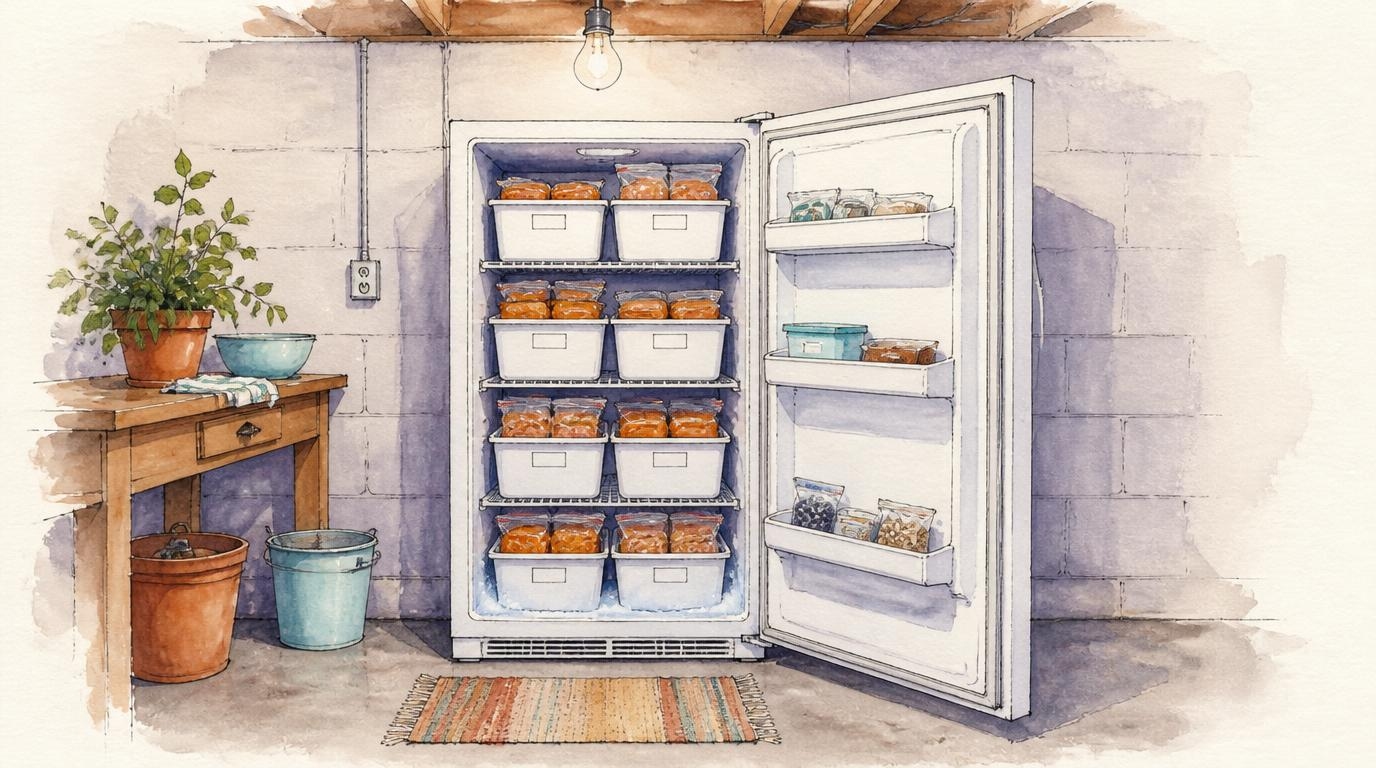
If food goes into your freezer and comes out freezer-burned a year later, you're not careless. Most freezers stack food on top of food, and whatever ends up on the bottom disappears.
That's what happened in our chest freezer for years. When we moved, we sold it and switched to an upright freezer in the basement. Now food is easier to see, and we waste less. This page covers what changed, how ours is set up, and what I'd do with just the freezer in your fridge.
Picked Waste-Reduction Habits in my free guide or Starter Map? This page is the freezer version of pantry rotation. The goal is the same as a use-first shelf: food you can see is food you eat.
Chest vs. upright: What changed for us
A chest freezer holds a lot, but it's a deep box. Food goes in on top, and older food sinks out of sight. Here's some of what we found at the bottom of ours over the years:
- A package of salmon nobody remembered buying.
- A tub of butter that was several years old.
- Deerskin hides we meant to process and never did.
The freezer also caught things that weren't food. My husband once put honeycomb frames in it to deal with hive pests. He set them on top of everything, so we couldn't reach the food underneath, and sticky bits of wax got on the packages. Another time, a bag of elderberries fell down through the stuff and made a mess on everything below.
When we moved, we sold the chest freezer. The upright in our basement has shelves, so I open the door and see what we have. Nothing gets buried under ten other things. That one change is why we waste less now.
Our freezer isn't just for food
The freezer still does more than hold dinner. When carpet weevils got into my wool, it went in the freezer. The kids' popsicle molds stand in it, where nobody bumps them. Our refrigerator's freezer is a drawer at the bottom, and things get jostled there every time it opens. Souper Cubes trays of broth freeze in it, and so does our homemade Ninja Creami ice cream. A freezer that's easy to see into is easier to share with all of that.
What went wrong with the upright
Our biggest problem has been the door. It's been left open by accident, and the freezer is down in the basement, out of sight. Now we have a door alarm, and we can hear it upstairs if the door stays open too long. If your freezer ever warms up, check USDA: Freezing and Food Safety before you decide what to keep.
Do you need an upright freezer?
No. For us, the upright was an upgrade, not a first step. You don't need a second freezer to start. If you already have a chest freezer that works, try bins you can lift out before you replace it. If all you have is the freezer in your fridge, skip ahead to that section. The habits on this page matter more than the freezer.
How to organize an upright freezer: Our bins and zones
Each main shelf in our upright freezer holds two bins. They're plain bus trays, the same kind I use for thawing meat in the fridge, and each one has a label. The bins do two jobs. They keep like things together, and they keep packages from sliding out onto the floor when I open the door.
Here's how ours is set up, top to bottom:
- Top shelf: vegetables, and pork. The vegetable bin is new. It holds cooked squash, corn we cut off the cob, peeled chestnuts, and riced cauliflower. (In the photo, that bin still says hot dogs and sausage. I'm switching it to vegetables and haven't gotten around to changing the label yet.)
- Second shelf: chicken, and beef.
- Third shelf: chicken bones and chicken liver, and beef bones and ham hocks. The bones wait here until broth day.
- Fourth shelf: pre-cooked food, including our bags of broth blocks, and turkey.
- Bottom: a wire basket for rabbit hides, with a Souper Cubes tray on the shelf just above it.
- Door shelves: small snacks, like ice pops and pemmican sticks.
The open space at the front of the fourth shelf, in front of the bins, is for anything that has to sit flat while it freezes: our aqua Souper Cubes trays, popsicle molds, and Ninja Creami pints.
It isn't picture-perfect. When a bin fills up, extra bags ride on top until we eat our way down. That's fine. The point isn't my exact categories or a tidy photo. It's that every kind of food has one home, so you know where to look and you can see when a bin is getting full.
Here's the same layout as a picture you can pin:
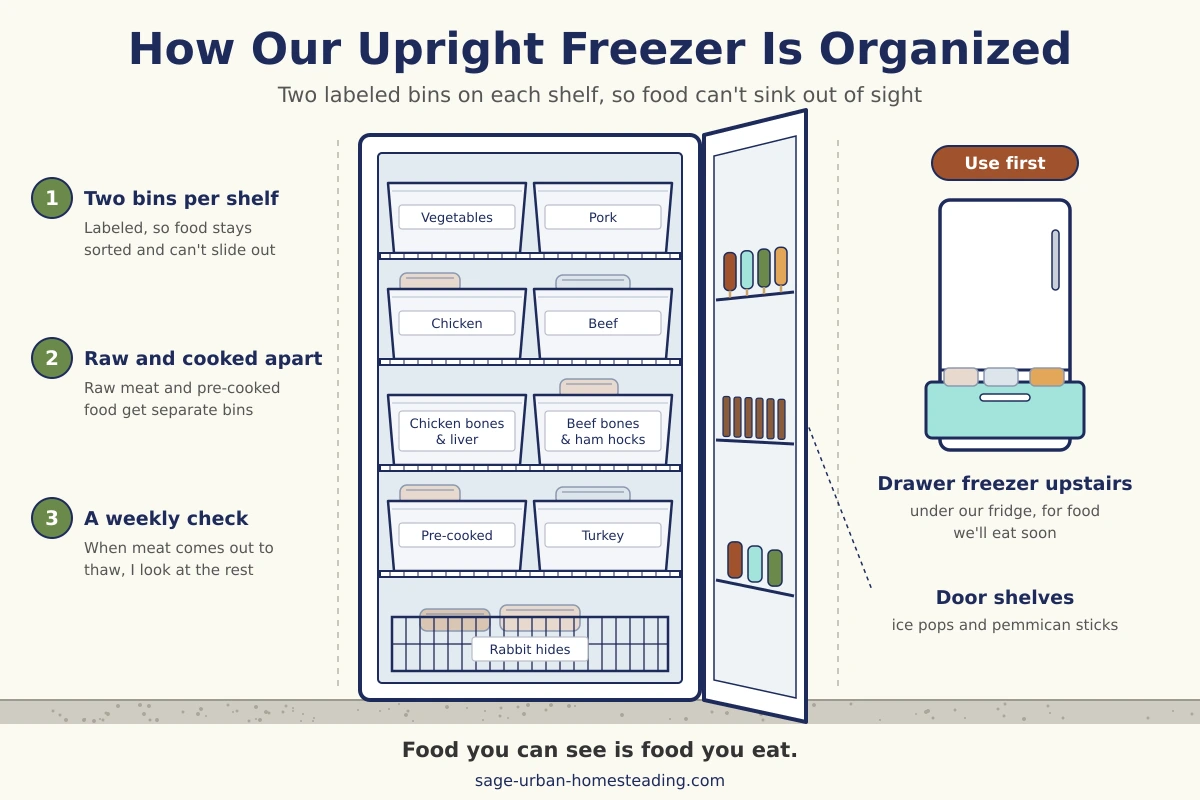 How our upright freezer is set up: two labeled bins on each shelf, snacks on the door, and a use-first spot in the drawer freezer upstairs, stocked with muffins for easy breakfasts.
Our use-first spot is upstairs
Our use-first spot isn't in the basement at all. It's the drawer freezer under our refrigerator upstairs, in the kitchen. Food we'll eat soon goes there, and so do muffins. We keep it stocked so breakfast is easy to grab, right there in the kitchen. The basement freezer holds the rest. If you only have one freezer, pick one spot in it instead, like the front of one bin or one corner of a shelf. It works the same way as a use-first shelf in the pantry: the next time you need something, look there first. See Eat Me First Bin.
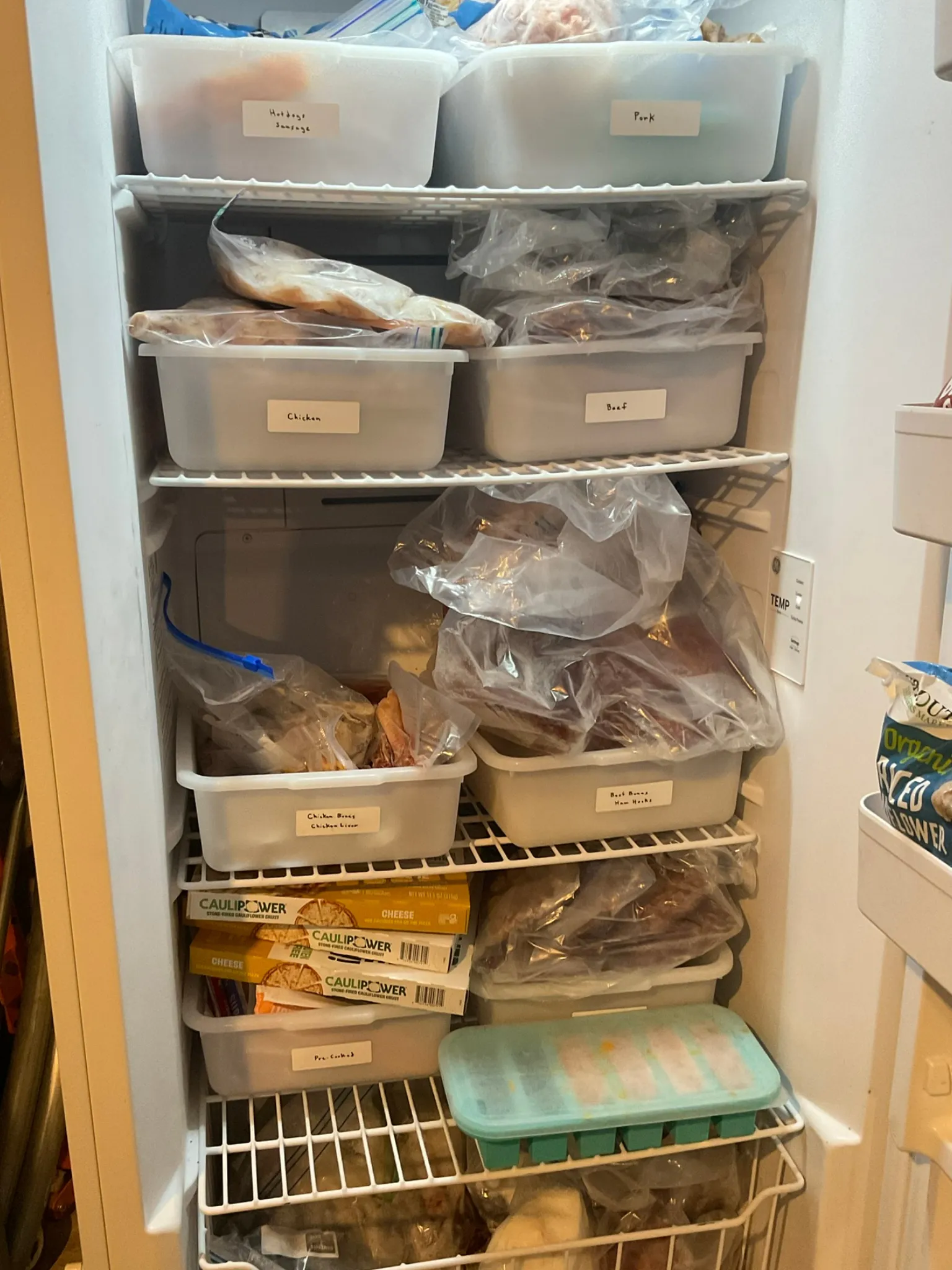 Our upright freezer on a normal week. Every bin has a label, and when one fills up, the extra bags ride on top.
Labels and a weekly check
Bins only help if you know what's in them. Everything that goes into our freezer gets a label written with a marker: what it is and the month and year. Bags of broth and squash blocks get labeled, and so does meat.
I check the freezer once a week, at the same time as two other weekly jobs:
- Thawing the week's meat. I pull out what we'll need and move it to a bin in the fridge set aside just for thawing. The bin catches drips. And if I open the fridge and that bin is empty, I know I forgot.
- Making the grocery list. While the freezer door is open, I look at what we already have, so I don't buy more of it.
That's the whole check. It hardly feels like an extra job, because I'm already standing at the freezer.
If bones are piling up: I sometimes keep chicken carcasses in the freezer until I'm ready to make broth. It's easy to end up with a backlog. When I had too many, I stopped saving them for a while. Saving fewer bones is fine. See Slow Cooker Chicken Bone Broth.
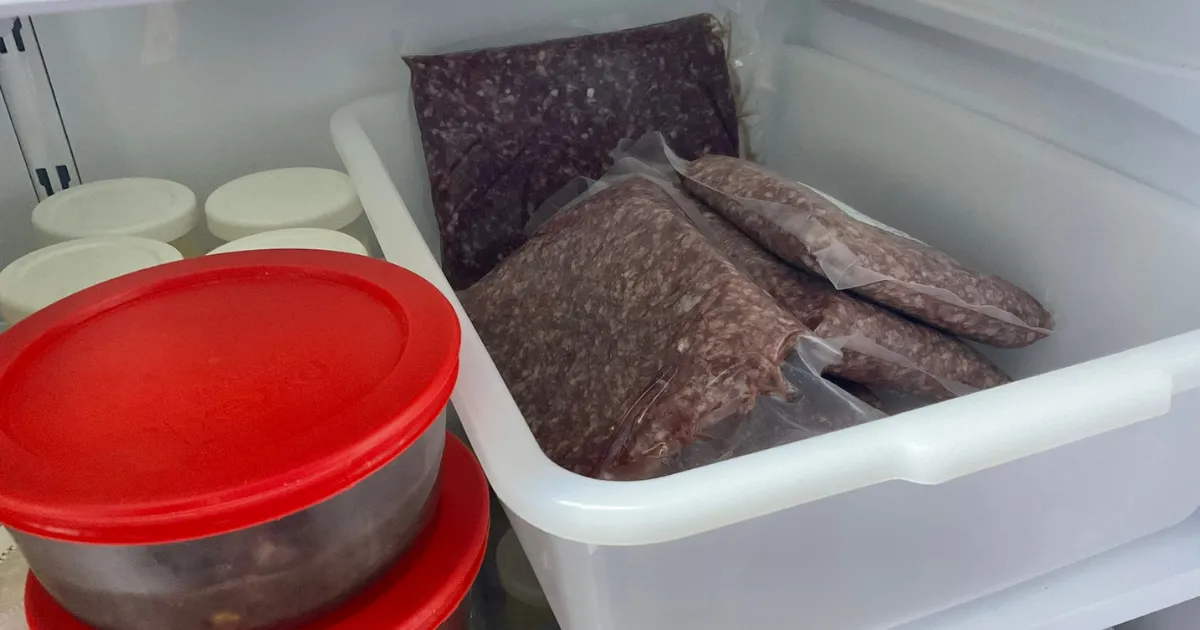 This week's ground meat thawing in its fridge bin. The bin catches drips, and an empty bin reminds me to thaw.
Only have the freezer on top of your fridge?
I've used the small kind of freezer too. Our refrigerator at the Beltway house had a drawer freezer at the bottom, and so does the one we have now. A small fridge freezer, on top or in a drawer, has the same problem as a chest freezer: food piles up, and the bottom layer gets forgotten.
I once tried keeping our drawer freezer organized with different colored plastic bags. It helped some, but the bags on the bottom still got buried and forgotten. What I'd do now is borrow the habits from our upright:
- Give each kind of food one home. A small bin, a shoebox-size container, or a bag for each kind of food, so you lift out one thing instead of digging.
- Freeze flat, then stand bags up. A flat bag of broth or leftovers takes up less room and can stand on its edge like a file folder, so you can read every label.
- Freeze small portions in ice cube trays. I've frozen sofrito and herbs this way, so I can drop a little into whatever I'm cooking. Once they're frozen, the cubes go into one labeled bag.
- Label everything, even if you're sure you'll remember.
- Look in it once a week, when you make your grocery list.
A small freezer doesn't hold much, and that's good news. There's less room for food to get lost.
How I freeze food so it gets used
Organizing starts before food goes in the freezer. These habits make packages easier to stack, easier to find, and easier to use up.
- Portion bulk meat first. When I buy a big package of meat, I split it into meal-size portions before freezing. Then I only thaw what we'll eat.
- Use freezer bags or freezer containers. Regular storage containers can lose their lids in the cold, and then food leaks or dries out.
- Squeeze the air out. Air is what gives food freezer burn. A vacuum sealer works, but I've found a freezer bag and a straw do the job just as well. Seal the bag almost all the way, suck out the air through the straw, then close it.
- Freeze in blocks, then bag them. Broth and cooked kabocha squash go into Souper Cubes trays (1-cup and 1/2-cup for broth, 1/2 cup for squash). Broth chills in the fridge first, then goes in the freezer. Once the blocks are frozen, I pop them into a large zipper bag and label it, so the tray is free for the next batch.
- Skip glass canning jars. I don't freeze in them. Things shift around in a freezer, glass doesn't like quick temperature changes, and you have to leave room for food to expand.
Over the years I've also frozen muffins, waffles, and peas. If you're not sure how something will freeze, freeze one portion and taste it before you freeze a whole batch.
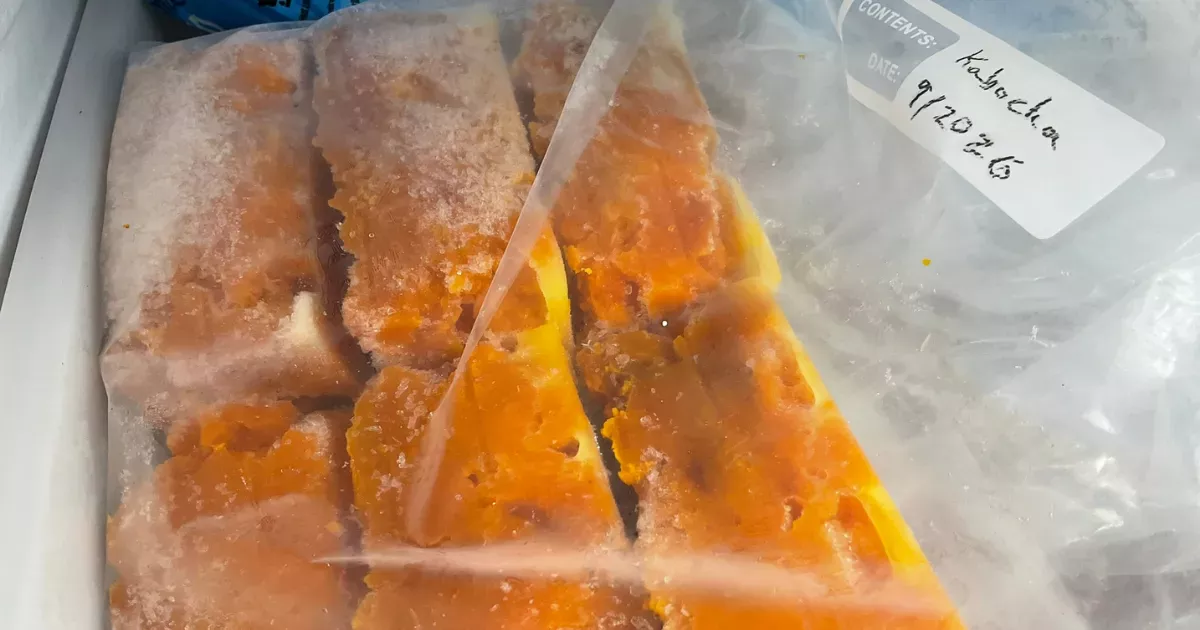 Squash from our fall bulk buy, frozen in blocks and bagged, so the tray is free for the next batch.
Blanching vegetables and corn off the cob
We still freeze summer corn every year. I blanch it on the cob, cut the kernels off, and freeze them in bags. Most other vegetables need blanching before freezing too. It's a quick dip in boiling water, then cold water to stop the cooking.
Blanching times are different for each vegetable, so I don't use one number for everything. The National Center for Home Food Preservation's blanching guide has a chart.
Freezing leftovers safely
The freezer is where our cook-once, eat-twice leftovers go when the second meal is more than a few days away. I'm not going to give you my own numbers for how long food keeps. USDA's pages are the place for that, and they're easy to read:
- How long leftovers keep, and how to cool and reheat them: USDA: Leftovers and Food Safety
- Freezer basics, quality vs. safety, and refreezing food that thawed: USDA: Freezing and Food Safety
One thing USDA makes clear: food that's safe isn't always food that still tastes good. That's where labels and the weekly check come in. A dated label tells you what to eat next, before it's past its best. See Cook Once, Eat Twice.
What I use, if you're shopping
You can start with nothing new. Cardboard boxes, the bags in your drawer, and an ice cube tray will do a lot. If something keeps getting in the way, these are what we use that I bought on Amazon, each with a reason to skip it (affiliate links).
- Freezer bins (bus trays). Two of these bus tubs on every shelf of our upright freezer, plus one in the fridge for thawing meat. They keep food sorted and stop packages from sliding onto the floor. Skip it if cardboard boxes or the shelves your freezer came with already keep things sorted.
- Souper Cubes trays. I use the 1-cup Souper Cubes and 1/2-cup Souper Cubes sizes for broth, and they work for cooked squash too. The frozen blocks stack neatly in a bag. Skip them if you're happy freezing flat in bags, or an ice cube tray covers the small portions you need.
- Freezer door alarm. Our FRIGGI 3-in-1 door alarm goes off if the door stays open too long, and we can hear it upstairs. Skip it if your freezer already has a built-in alarm, or it's in your kitchen where you'd notice an open door.
Where to go next
- Food going bad before you get to it? Start a use-first spot in the pantry or fridge. See Eat Me First Bin.
- Want leftovers worth freezing? Cook a double batch and give the second half a job. See Cook Once, Eat Twice.
- Bones waiting in the freezer? Turn them into broth. See Slow Cooker Chicken Bone Broth.
- Packing frozen leftovers for lunch? See Waste Free Lunch.
- Freezer full of fruit? Dehydrating is another way to keep extras. See Dehydrating Food.
- Containers that always have a lid? See Reusable Kitchen Swaps.
- Found something too far gone? Give it somewhere to go besides the trash. See Kitchen Compost Bin.
- More small food habits: See Reduce Food Waste at Home.
Upright freezer organization FAQ
Is a chest freezer or an upright freezer better?
Is a chest freezer or an upright freezer better?
It depends on how you use it. A chest freezer holds a lot, but food sinks to the bottom and gets forgotten. That's what happened in ours. An upright has shelves, so you can see what you have, and that's why we waste less now. If you already own a chest freezer, try bins you can lift out before you replace it.
How long can leftovers stay in the freezer?
How long can leftovers stay in the freezer?
USDA covers this, including the difference between food that's still safe and food that still tastes good: USDA: Leftovers and Food Safety. A label with the month and year makes it easy to eat the oldest first.
Can I refreeze food that thawed?
Can I refreeze food that thawed?
It depends on how it thawed. USDA explains when it's safe and how it affects quality: USDA: Freezing and Food Safety. I thaw meat in a bin in the fridge, so it's easy to plan ahead.
Your upright freezer organization checklist
- Give every kind of food one home: a bin, a box, or a bag.
- Keep raw meat and cooked food in separate bins.
- Label everything with what it is and the month and year.
- Portion bulk meat before freezing, and squeeze the air out of bags.
- Freeze broth and leftovers in blocks or flat bags so they stack.
- Check the freezer once a week, when you thaw meat or make your grocery list.
- Pick a use-first spot for food that needs eating soon.
- Only have a fridge freezer? Use the same habits on a smaller scale.

Amy DeVries helps beginner urban homesteaders learn by doing. A lifelong gardener, she has grown food in spaces that expanded to 18 raised beds, patio containers, dwarf fruit and nut trees, and gravity-fed rainwater systems. She shares practical lessons shaped by real experience. Amy homeschools her children and teaches the same hands-on skills that guide her work.
You might like these
Eat Me First Bin? Try a Use-First Shelf Instead
An eat me first bin helps you eat food before it spoils. Here's the no-bin version our family uses: a use-first shelf and a weekly fridge check.
Cook Once, Eat Twice: Our Routine for Busy Nights and Lunch
Cook once eat twice is how our family handles 4-H and sports nights: double-batch dinners, plus extras warmed up for lunch. Here's our simple routine.
Kitchen Compost Bin: Where Scraps Go Without a Yard
A kitchen compost bin is the easy part. Here's how to pick where your scraps go first, keep the bin from smelling, and skip the gear you don't need.

More Information
Disclosure
All information found on this website is editorial in nature and intended to motivate and inspire rather than be used as medical advice or legal advice.
As an Amazon Associate, I earn from qualifying purchases. I also use Google Ads and cookies as described in the Privacy Policy.
Thank you for your support!
By Amy DeVries, Copyright © 2011-2026 Sage-Urban-Homesteading.com All rights reserved.
