FYI: This website contains affiliate links. As an Amazon Associate I earn from qualifying purchases.
Square Foot Gardening for Beginners
By Amy DeVries
Short answer: Square foot gardening for beginners starts with one 4x4 bed your hose can reach. Divide it into 16 one-foot squares, plant each square according to the size of the crop, and pull the little weeds whenever you water. Add another bed only if watering still feels easy in July.
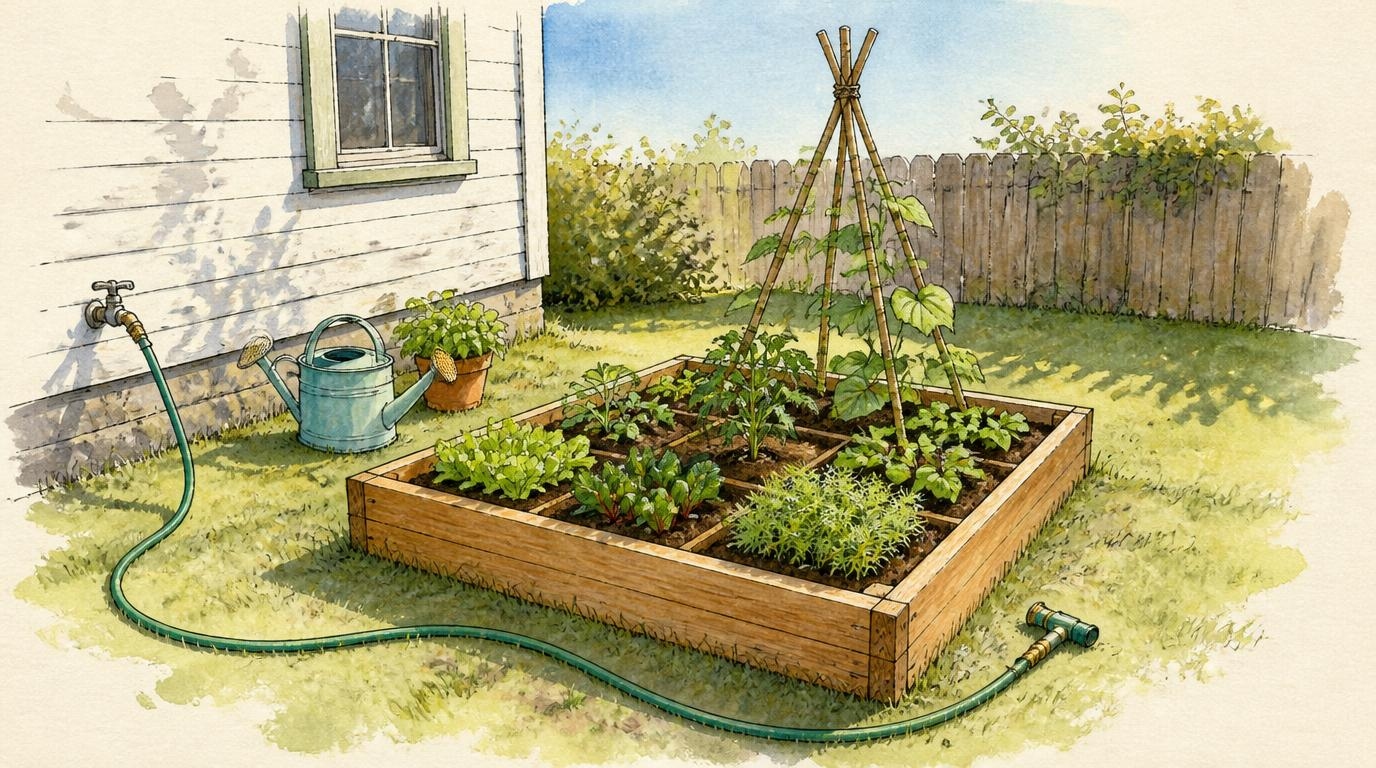 One small bed your hose can reach is a real garden.
If you have one small sunny spot and you're wondering how to fit real food into it without ending up with a weedy mess, you're in good company. You don't need a yard full of beds or a perfect plan. One bed counts, even if it only gives you a few good salads this year.
I learned square foot gardening before I ever moved to the city, because my dad was reluctant to share his garden space. Our first raised beds on a quarter acre inside the Baltimore Beltway were wooden 4x4s, and I still plant by the square today, at the 1920s house we rent on 3 acres.
Over the years, I've let go of a lot of the official method, including the special soil recipe and the grid on top. Here's the version I actually use, and what I'd skip if I were starting over.
Will square foot gardening fit your space?
It fits a tiny yard, or a patio with a patch of ground beside it. If you rent, ask before you build.
It doesn't fit a balcony. A bed full of soil is very heavy, so if you're up off the ground, start with pots instead. See Container Gardening for Beginners.
Square foot gardening for beginners: Start with one 4x4 bed
A 4x4 bed gives you 16 one-foot squares, and you can reach the middle from either side without stepping on the soil. It's small on purpose. You can plant it in an afternoon, and if this turns out not to be for you, you haven't lost much.
Our beds grew along with us. The wooden 4x4s came first. When they deteriorated, we upgraded to metal beds that were 4x12. Now we have Vego Garden's 17-inch tall modular metal beds, set up at about 4x8. I'd start with the smallest one and let the garden earn the next.
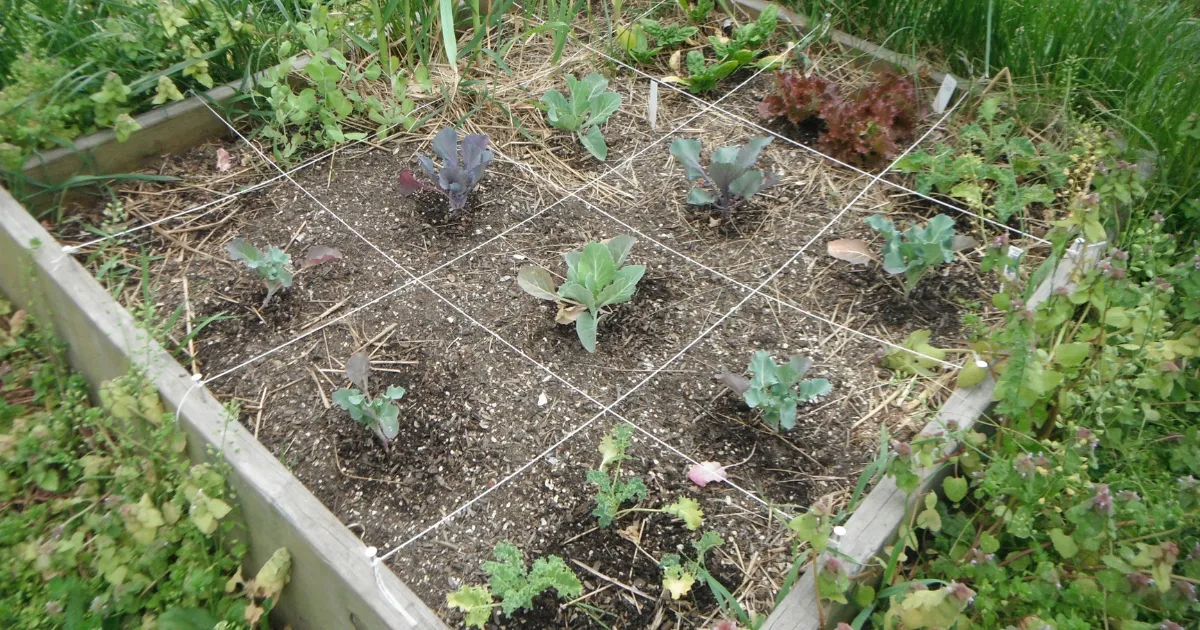 Lettuce, cabbage, and kale, planted by the square. Each block gets its own space.
Put the bed where you can water it
Before you think about soil or seeds, find your water. My first year at this house, I planted 50-foot rows in a big sunny area the hose didn't reach. Watering took an hour or more before breakfast, and by the end of the season we couldn't even get into the garden.
So here's how I'd choose your spot:
- Start at your water. That's an outdoor spigot, a rain barrel, or the kitchen sink if you'll be carrying a watering can.
- Find your easy reach. Stretch the hose as far as it goes without dragging it around corners.
- Pick the sunniest spot inside that reach. Choose plants that fit the light you have.
- Look for a level place. Our Beltway yard sloped, so we put our beds on the level spots at the top and the bottom.
A small bed that gets watered will always grow more than a bigger one you can't keep up with. See How to Save Time Watering Your Garden.
If you'd like free water close to the bed, a rain barrel can help. Plan where it goes before you build. See the Water Collection hub.
What to fill the bed with
You don't need a special recipe. Native soil at both of our houses has been clay, so I've always filled my beds with added soil, and plain raised bed soil has worked fine.
Mel's Mix: What we found
The official square foot gardening soil is Mel's Mix: equal parts peat moss, coarse vermiculite, and blended compost. See the Mel's Mix recipe from the Square Foot Gardening Foundation. A 4x4 bed filled 6 inches deep takes 8 cubic feet of it, and buying three separate ingredients adds up.
We tried it in some of our Beltway beds, after a consultation with a woman who had helped Mel with one of his books. She told us it would help the beds hold moisture better. We didn't notice much of an improvement. We didn't use it in any of the beds we added later, or in any of the beds at our 1920s house.
Plenty of gardeners love it, and if you already have the ingredients, go ahead. I just wouldn't let it stop you from starting.
What I fill a bed with now
- Wire mesh on the bottom. It keeps voles and chipmunks from coming up through the bed.
- Rotting logs next. They fill up the bottom of the bed, so you need less bought soil.
- Organic raised bed soil on top. I buy mine at our local gardening shop.
- Rabbit manure every year. That's how I refresh the beds. Aged manure is best. We've also added some biochar. If you don't keep rabbits, compost is the usual choice.
For one small bed, you can skip the logs and just fill it with raised bed soil. The University of Maryland Extension's guide walks through more options, including what to do on heavy clay and what to ask before you buy topsoil.
If your bed will sit on pavement instead of soil, it needs to be deeper. That same guide suggests at least 8 inches for leafy greens, beans, and cucumbers, and 12 to 24 inches for peppers, tomatoes, and squash.
One warning about rotting logs
The soil sinks more when there's a large rotting log underneath, because the log keeps breaking down. For vegetables you replant every year, that just means topping off the bed. It was a problem when I put logs under our perennial herbs. It's difficult to add more soil around perennials. That's when I moved the herbs to our GreenStalks. [LINK: GreenStalk Review]
What about lead in city soil?
I've never tested our soil for lead at either house. At the Beltway house, we looked into the history of the land instead. From talking with older neighbors, and from a local strawberry festival and a historic house near BWI, we learned the land had been used for strawberry farming. The slope in our yard came from scraping away topsoil to build the houses. We know the history of the land at our 1920s rental, too. If I'd learned that either place had been used for anything industrial or questionable, I would have wanted to test.
That's what we did, but land history only tells you part of the story. The EPA says to keep gardens away from old painted buildings and roads with heavy traffic, because those can be sources of lead. Neither one shows up in a story about old strawberry fields. University of Maryland Extension goes further than I did and says vegetable gardens, regardless of location, should be tested for lead.
If you're starting in a city, near a busy road, or beside an older painted house, a test is a small step that can answer the question:
- A basic soil test typically costs $11 to $30, plus mailing. Lead can add to that, depending on the lab.
- The University of Delaware's basic test includes lead, and it's on the University of Maryland Extension's list of labs.
- Take your sample from where the bed will go, and follow the lab's directions.
If your results come back high, you likely still have options. The EPA calls raised beds filled with clean soil one of the best ways to protect yourself while gardening, ideally on top of a visible barrier like garden fabric. Our wire mesh stops voles, but it isn't that kind of barrier. The EPA's page on Healthy Gardening Practices to Reduce Exposure to Lead-Contaminated Soil explains what to grow at each lead level, and why children and women who are pregnant or breastfeeding need extra care.
How to plant by the square
Instead of rows, you plant blocks. Each square foot holds one kind of crop, and the size of the grown plant decides how many fit.
How many plants go in a square
- 1 per square: the biggest plants, like tomatoes, peppers, potatoes, broccoli, and cabbage
- 4 per square: leafy plants, like lettuce (head) and chard
- 9 per square: smaller plants, like spinach, onions, and bush beans
- 16 per square: the tiniest, like carrots and radishes
Charts vary a little from one source to the next, so don't worry about being exact. The Square Foot Gardening Foundation has a free chart and a blank bed to sketch your plan on.
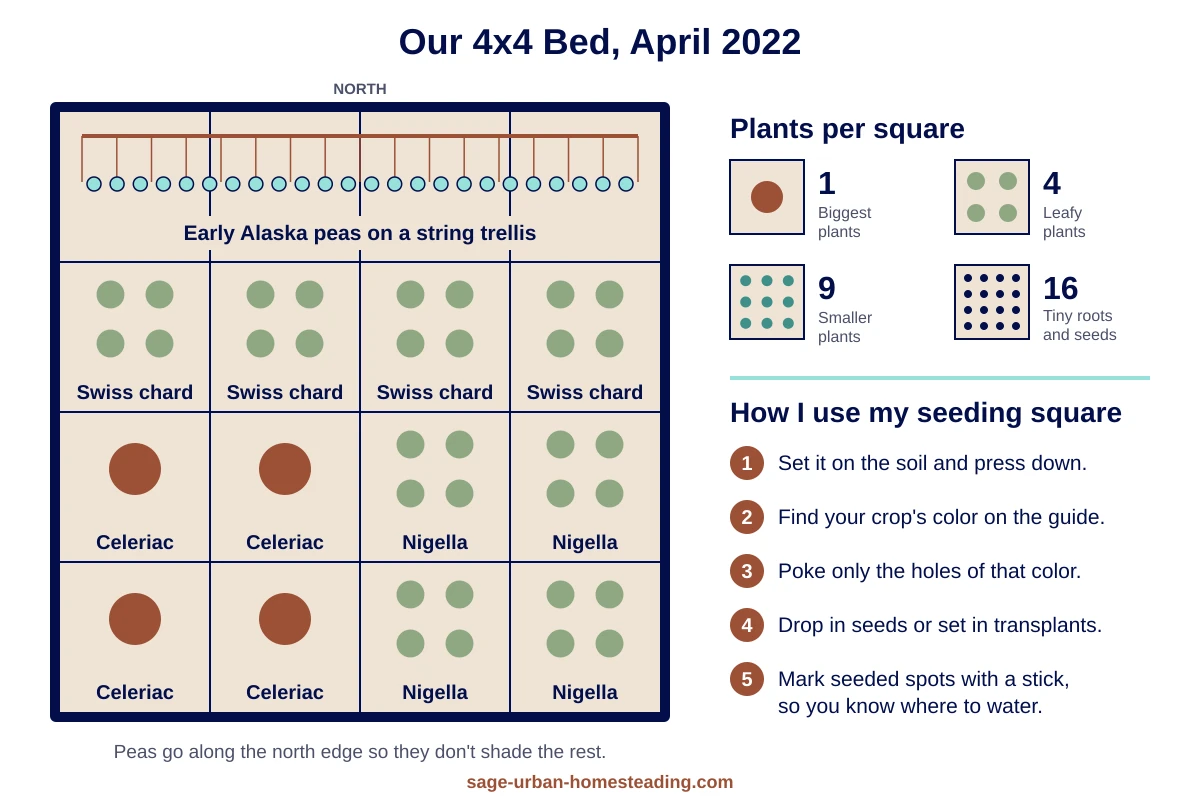 One of our real plantings, from April 2022. Plant what you actually like to eat, or just like to look at.
As our beds got bigger, I started planting several squares of the same vegetable in different varieties. I also think about which plants to put near each other, like nasturtiums near cucumbers, and marigolds and basil near tomatoes.
How I use my Seeding Square
The Seeding Square is a green plastic template, one foot across, with color-coded holes. It's the tool I reach for every time I plant.
- Set the square on the soil and press it down.
- Find your crop on the planting guide, and note its color.
- Poke only the holes of that color, which marks the soil at the right spacing.
- Drop in your seeds, or set in your transplants.
- Lift the square and move on to the next foot.
I keep the planting guide in a sheet protector and store it with the tool, so it's there when I need it.
Once the seeds are in, I mark anything I need with a stick, so I know where to water until they come up. Transplants don't need a marker, because I can see where they are.
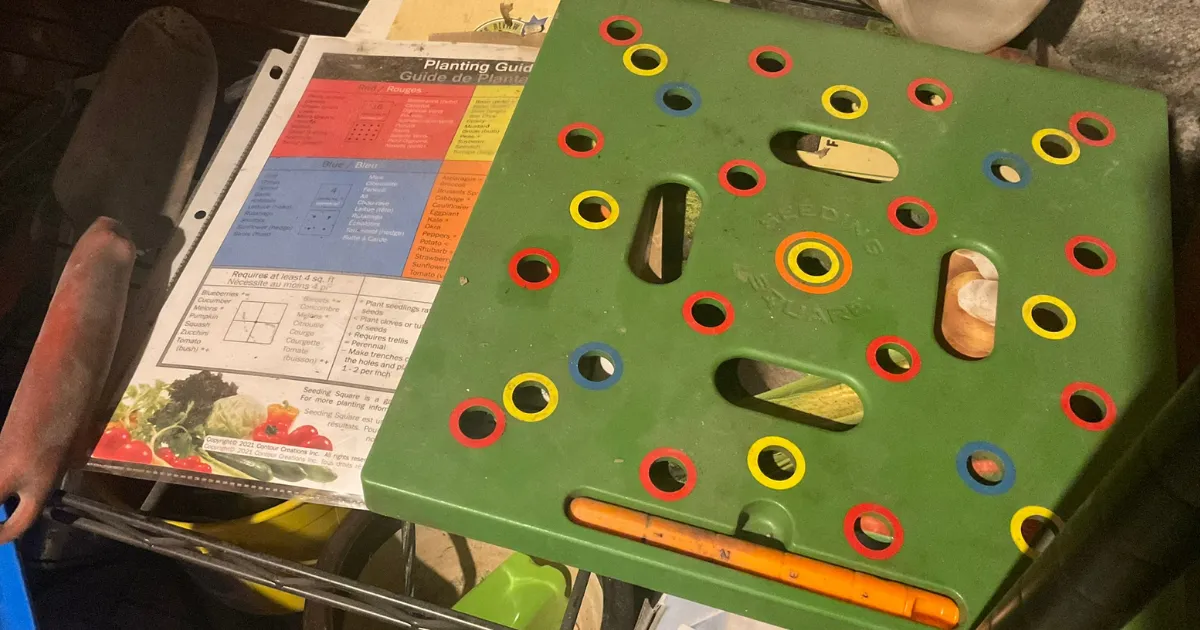 My Seeding Square lives on a basement shelf, with its planting guide tucked in a sheet protector so I can find both at planting time.
Do you need a grid on top?
No. A grid on top of the bed is part of the classic method, and we tried it. We started with a wooden grid on our old raised beds, and then found that a grid made of string worked even better. After I got the Seeding Square, and had less time because we were busy raising a family, I didn't even bother with the string.
If you don't want to buy a tool, string is the cheap way to go and easier for managing weeds.
What I wouldn't put in one 4x4
I've grown a lot of different crops in raised beds, and some are easier to fit than others:
- Pumpkins and sweet potatoes: I wouldn't put either one in a single 4x4. They need more room.
- Watermelon and cantaloupe: These are okay if you give them a way to grow up.
- Sweet corn: This is okay as long as the whole 4x4 is corn, and keep an eye on it so you can hand pollinate and help it along.
- Tomatoes: Plant 1 per square. Determinate types will be easier to manage. Indeterminate ones keep growing all season, taller and taller, until they run out of tall and bend over.
Not sure what you'd like to grow? Start a few from seed, buy the rest as plants, and don't feel bad about either one. See How to Start Seeds (and When to Just Buy Plants).
Growing up instead of out
Vertical crops let a small bed hold more. Put them on the north side of the bed, so they don't shade everything else.
I've tried many different types of trellises, and for a single small bed I'd start with an easy homemade teepee of bamboo poles.
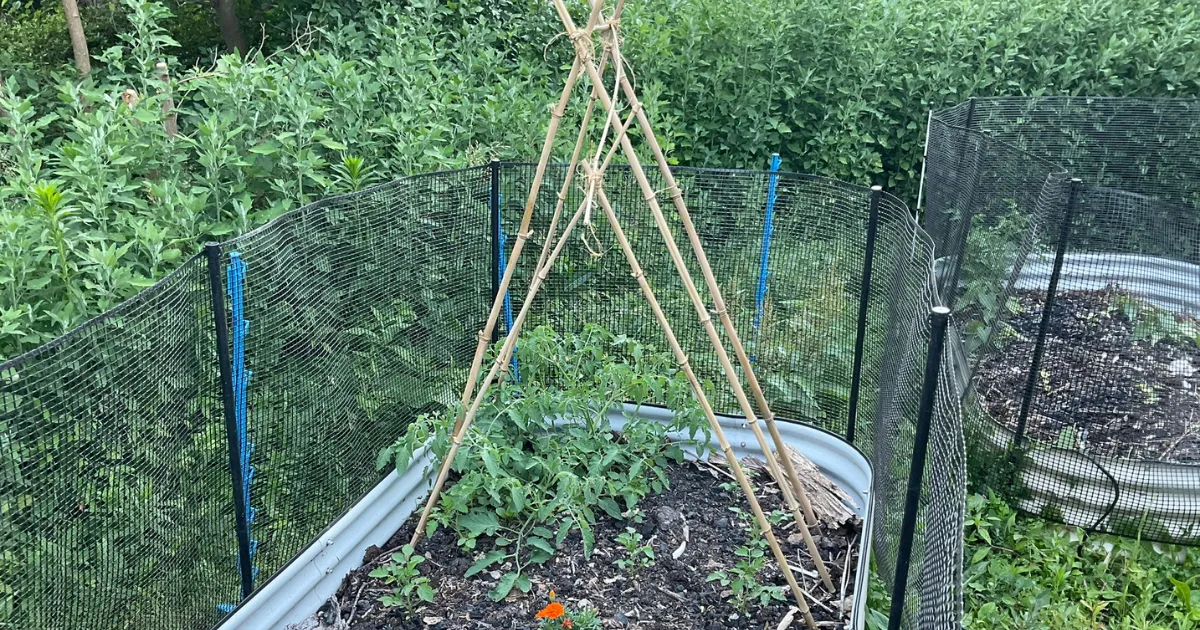 An easy homemade teepee of bamboo poles. The tomatoes quickly overgrew it, but it probably would have worked ok for a cucumber plant.
My favorite trellis is a cattle panel held up with T-posts, but it's more of a step-up project. The ones we bought are 16 feet long. We don't have a truck, so we had a friend help us bring them home. Cattle panels also come in 8-foot lengths, if you can find them near you.
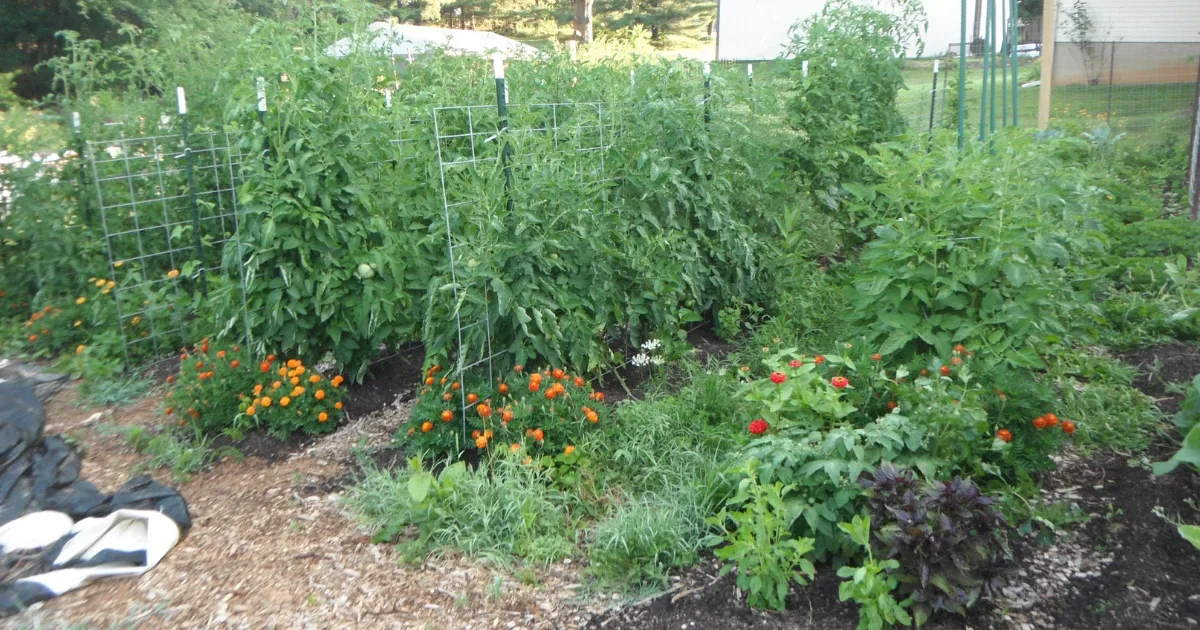 My favorite trellis: a cattle panel and T-posts. Getting the 16-foot panels home took a friend's help.
How to keep weeds from taking over
The weedy mess you're worried about is mostly a timing problem. I pull any little weed shoots as I check on things and water each day, so they never get big. A small bed makes that possible, because you can see every square from where you're standing.
The hard stretch comes after a series of rainy days, when you haven't been out and everything has sprung up at once. The good news is that weeds pull out of damp soil easily. Shake off the roots before you toss them, so you can keep your precious soil in the bed.
Most weeds aren't a big deal. These are the ones I'd treat differently:
- Hard to touch: poison ivy, stinging nettle, berry brambles, and multiflora rose. If poison ivy is growing there, I wouldn't put a garden near it at all.
- Won't pull up: honeysuckle, wisteria, and Japanese knotweed.
Some weeds are even worth keeping. We eat chicory, plantain, dandelion, violets, chickweed, and purslane, and most weeds make good food for rabbits, chickens, quail, or ducks. Only eat what you can identify for sure, and only from soil you trust and an area you know has not been sprayed with anything toxic.
Why succession planting doesn't work for me
You'll read that you can replant a square two or three times in a season. That sounds perfect for a small bed. For me, it mostly doesn't work, because my spring crops aren't done by the time my summer crops need to go in.
So I stopped trying to fit it all into one bed. Now I try to have spring-and-fall beds and summer beds. One set starts with spring crops, which stay in place into summer while they mature, and then grows fall or winter crops. The other set holds summer crops.
If you only have one 4x4, you can use the same idea with your squares: give part of the bed to summer crops, and leave the rest for spring and fall.
If you'd like to keep something growing into winter, I've grown a winter harvest garden under row cover. See Row Covers for Vegetables.
What I use
One tool I've bought on Amazon and use all the time is the Seeding Square (affiliate link). It's what lets me skip the grid, and the planting guide that comes with it means I don't need a book in the garden. Skip it if you'd rather measure with a ruler or a scrap of wood marked in inches. That works too.
The book All New Square Foot Gardening was useful for understanding the concepts behind the method, but if you just want to dive in, I'd buy the square instead. Skip it unless you enjoy reading the why behind a method. Also, I have not read the 2025 updated edition. It might have something useful.
What to try next
Pick the next small step that fits your space.
- You only have a patio, steps, or a balcony. [LINK: Container Gardening for Beginners — placeholder, not built yet]
- You're not sure you can keep up with watering. [LINK: How to Save Time Watering Your Garden]
- You'd like free water for the garden. See the Water Collection hub.
- You want to start your plants yourself. [LINK: How to Start Seeds (and When to Just Buy Plants)]
- You want to turn scraps and yard waste into something for your bed. [LINK: Compost Pile for Beginners — placeholder, not built yet]
- Bugs or frost keep wiping out your plants. [LINK: Row Covers for Vegetables — placeholder, not built yet]
One 4x4 bed is one small system. If you're wondering what your next one should be, whether it's food, water, or home comfort, my free 2-page guide helps you pick one place to start. It's called Which Urban Homestead System Should You Start First?, and it's built for small spaces and busy lives.
Square foot gardening for beginners FAQ
Is square foot gardening good for beginners?
Is square foot gardening good for beginners?
Yes, if you have a spot of ground and a way to water it. One 4x4 bed is small enough to keep up with, and planting by the square takes the guessing out of spacing.
Do I need Mel's Mix?
Do I need Mel's Mix?
No. We tried it in some of our beds and didn't notice much of an improvement. I fill beds with organic raised bed soil from a local shop now, and refresh them every year with rabbit manure.
Do I need a grid on top of the bed?
Do I need a grid on top of the bed?
No. We tried wood and then string, and I stopped using either one once I got a Seeding Square. If you'd rather not buy a tool, a string grid and nails work well.
How deep should a square foot garden be?
How deep should a square foot garden be?
The classic method uses a bed 6 inches deep, set on the ground. Our current beds are 17 inches tall. If your bed will sit on pavement, go deeper: University of Maryland Extension suggests at least 8 inches for leafy greens, and 12 to 24 inches for tomatoes and peppers.
Can I do square foot gardening on a balcony?
Can I do square foot gardening on a balcony?
I wouldn't. A bed full of soil is very heavy. Pots are the better place to start if you're up off the ground. [LINK: Container Gardening for Beginners — placeholder, not built yet]
Should I test my soil for lead?
Should I test my soil for lead?
University of Maryland Extension says vegetable gardens should be tested, regardless of location. I didn't test at either of our houses, but we did look into the history of the land. A lab test is the only way to know what's in your soil, especially near busy roads or older painted buildings.
What shouldn't I plant in a 4x4 bed?
What shouldn't I plant in a 4x4 bed?
I wouldn't put pumpkins or sweet potatoes in a single 4x4. Melons are okay if they can grow up a trellis, and determinate tomatoes are easier to manage than indeterminate ones.
Your square foot garden checklist
- Find your water first, and see how far the hose reaches easily.
- Pick the sunniest level spot inside that reach.
- Find out what you can about your soil, and test it for lead if you're near a busy road or an older painted building.
- Build or buy one 4x4 bed.
- Add wire mesh on the bottom if voles or chipmunks are around.
- Fill it with raised bed soil.
- Plant by the square, with tall crops on the north side.
- Mark seeded squares so you know where to water.
- Pull small weeds whenever you water.
- Add another bed only if watering still feels easy in July.
Amy DeVries helps beginner urban homesteaders learn by doing. A lifelong gardener, she has grown food in spaces that expanded to 18 raised beds, patio containers, dwarf fruit and nut trees, and gravity-fed rainwater systems. She shares practical lessons shaped by real experience. Amy homeschools her children and teaches the same hands-on skills that guide her work.
You might like these
How to Garden and Love It
Learn how to garden and grow your own food through easy urban farming techniques.
Composting Worms and How They Can Help You Save the World
EGrow even more in your garden when you raise composting worms to turn your food waste into a rich soil supplement.
Compost Bins and How to Use Them
Learn about the different types of compost bins and decide on the best way to use composting as part of your urban farming.

More Information
Disclosure
All information found on this website is editorial in nature and intended to motivate and inspire rather than be used as medical advice or legal advice.
As an Amazon Associate, I earn from qualifying purchases. I also use Google Ads and cookies as described in the Privacy Policy.
Thank you for your support!
By Amy DeVries, Copyright © 2011-2026 Sage-Urban-Homesteading.com All rights reserved.
