FYI: This website contains affiliate links. As an Amazon Associate I earn from qualifying purchases.
Knitting Needles
By Amy DeVries
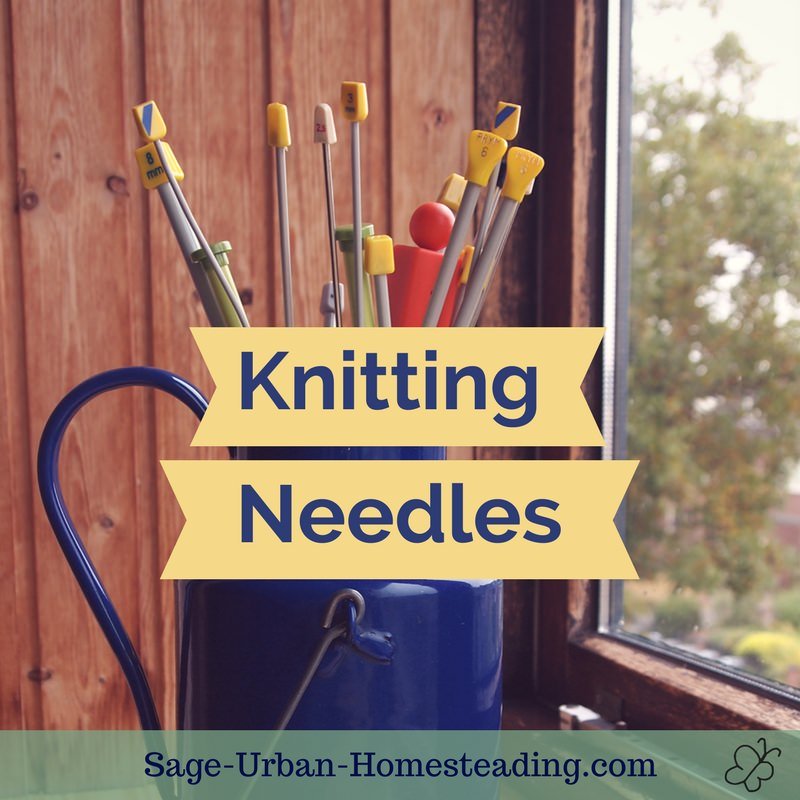
As a beginning knitter, I was confused by the different types of knitting needles. There are straight needles, circular needles, and double-sided needles! The type you use depends on the project.
Needle Shapes
Sewing needles have an eye for threading, but that isn't the case with knitting. These look more like chopsticks!
There are three basic needle shapes:
- Straight Needles
- A standard needle is tapered to a point at one end and has a stop at the other end to keep stitches from falling off.
- Circular Needles
- Picture a pair of straight needles with a plastic string running between the two ends. This allows you to work in a continuous circle. Just slide the stitches around and keep going in the same direction.
- They are also good for larger projects that would not fit on average straight needles. You can still flip to change sides for each row.
- Double pointed Needles
- Before circular needles were around, items like socks had to be knit on a triangle of straight double-sided needles. These are tapered at each end because you continuously work in the same direction, around and around. I have tried them. They're nice for something small and round like a knit toy.
- There is also a cable needle that looks like a double-sided needle with a hook. It's used to pull stitches aside and give the twisted cable appearance.
Needle Materials
I experimented with different shapes and materials.
Don't use acrylic needles with acrylic yarn since it tends to stick.
Bamboo feels nice to hold, but I also discovered that acrylic reverse tapered needles are a huge help since I tend to hold the stitch tension too tight.
Knitting Needle Sizes
In the system for knitting needle sizes, a larger number means a larger needle, which means fewer stitches per inch.
| US | Metric |
|---|---|
| 0 | 2 mm |
| 1 | 2.25 mm |
| 2 | 2.75 mm |
| 3 | 3.25 mm |
| 4 | 3.5 mm |
| 5 | 3.75 mm |
| 6 | 4 mm |
| 7 | 4.5 mm |
| 8 | 5 mm |
| 9 | 5.5 mm |
| 10 | 6 mm |
| 10 1/2 | 6.5 mm |
| 11 | 8 mm |
| 13 | 9 mm |
| 15 | 10 mm |
In the old UK system, it was reversed so that a smaller number meant a larger needle. If you are using vintage patterns, you might not have any clue about what size needle to use. That's why it's so important to make a swatch and test the knitting gauge before you dive into any pattern!
More to Explore

Amy DeVries helps beginner urban homesteaders learn by doing. A lifelong gardener, she has grown food in spaces that expanded to 16 raised beds, patio containers, dwarf fruit and nut trees, and gravity-fed rainwater systems. She shares practical lessons shaped by real experience. Amy homeschools her children and teaches the same hands-on skills that guide her work.
FYI: This website contains affiliate links. As an Amazon Associate I earn from qualifying purchases.

 Homesteading and homeschooling near Baltimore, Maryland
Recent Articles


-
Monthly Sensory Bins
Oct 03, 26 07:43 AM
 Exploring monthly sensory bins is a fun way to help young children develop their senses and imagination.
 -
Traditional Quilt Blocks for Elementary Math
Sep 13, 26 09:16 AM
 Use traditional quilt blocks to teach geometry, fractions, and patterning with coloring pages, pattern block activities, and creative classroom ideas.
 -
Raising Silkworms for Beginners | Urban Homestead
Sep 13, 26 09:04 AM
 Raising silkworms for beginners: learn what they eat, how to care for them, and when they spin cocoons so you can grow silk at home successfully.
More Information
Disclosure
All information found on this website is editorial in nature and intended to motivate and inspire rather than be used as medical advice or legal advice.
As an Amazon Associate, I earn from qualifying purchases. I also use Google Ads and cookies as described in the Privacy Policy.
Thank you for your support!
By Amy DeVries, Copyright © 2011-2026 Sage-Urban-Homesteading.com All rights reserved.
