FYI: This website contains affiliate links. As an Amazon Associate I earn from qualifying purchases.
- Home
- More Topics
- How to Start Weaving
- Weaving Terms
Weaving Terms: A Beginner's Guide in the Order You'll Use Them
By Amy DeVries
Short answer: The weaving terms to learn first are warp, weft, shed, shuttle, and beat. Warp is the set of threads held tight on the loom. Weft is the yarn you weave across them. Everything else you can pick up as you meet it at the loom.
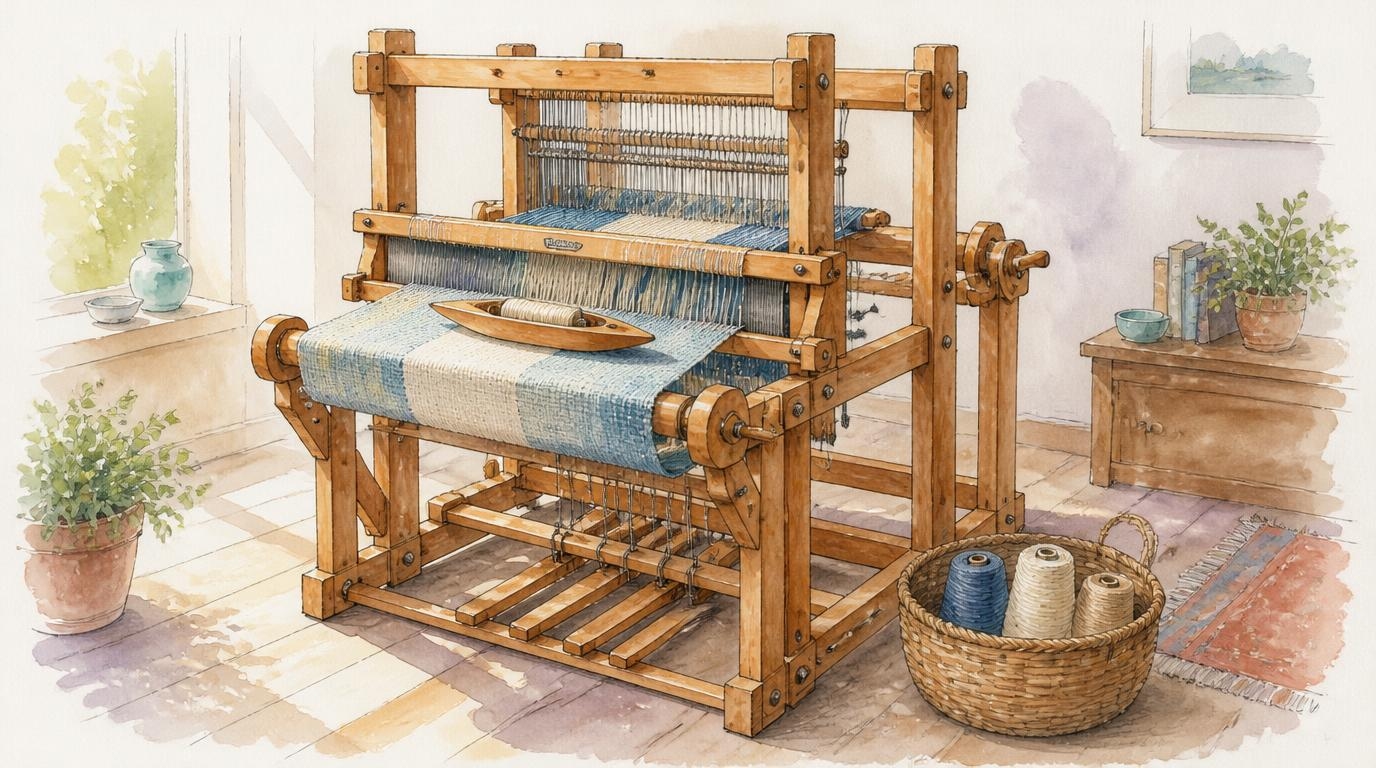 Every part of a loom has a name, but you only need a handful to start.
Weaving has a whole vocabulary of its own, and a lot of it is ordinary words that mean something else at the loom. Beam, reed, cross, shot, fell. Some parts even have two names, so one book says harness and the next says shaft.
If that feels like a wall, you're not behind. Before my first weaving class with Gwen Handler at Common Ground on the Hill, I read up on the terms. Then I kept Deborah Chandler's Learning to Weave open during and after the class, because hearing the words while doing the steps is when they finally stuck (Amazon affiliate link).
You don't have to memorize this page. I've put the terms in the order you'll use them, from planning a project to cutting it off the loom, so you can come back to the section you need. Most of my examples come from my 4-shaft Baby Wolf floor loom. Further down there's a short section on which words matter on simpler looms.
The first five weaving terms to learn
If you only learn five words before you sit down at a loom, make it these. I teach my kids the first two with little rhymes, and they still work for me.
- Warp: the threads stretched tight on the loom, running away from you. Warp goes up and down, like a harp.
- Weft: the yarn you weave across the warp, over and under. Weft goes right and left. You'll also see it called the pick or filling.
- Shed: the opening between the raised and lowered warp threads. The weft travels through it.
- Shuttle: the tool that carries the weft through the shed. On a floor loom it's usually a boat shuttle with a bobbin inside. On small looms it's often a flat stick shuttle.
- Beat: pushing each new row of weft snugly against the last one. On a floor loom, the beater does this. On a small loom you might use a fork or a comb.
Weaving terms in the order you'll use them
These are grouped by when they show up in a project, not alphabetically. That's how I wish I'd learned them.
Planning the project
- Draft: a chart showing how to thread the loom, tie up the treadles, and in what order to press them. It's the recipe for a pattern. (Link: How to Read a Weaving Draft.)
- Sett: how closely the warp threads are spaced. It's written as EPI.
- EPI (ends per inch): the number of warp threads in one inch. Each warp thread is called an end.
- PPI (picks per inch): the number of weft rows in one inch.
- Take-up: length the yarn loses by bending over and under the other threads. You plan extra warp for it.
- Draw-in: how much narrower the cloth gets as the weft pulls the edges in.
- Loom waste: warp at each end that you can't weave because it's tied to the loom. You plan for it too.
Measuring the warp
- Warping board: a frame with pegs for measuring many warp threads to the same length.
- Cross: a figure 8 the threads make between two pegs on the warping board. It keeps every thread in order, and it's the one thing you really don't want to lose.
- Warp chain: the warp after you take it off the board, chained loosely like a giant crochet chain so it doesn't tangle.
- Umbrella swift: an expanding reel that holds a skein of yarn while you wind it into a ball or onto a bobbin.
- Bobbin winder: a hand crank (or electric) tool that winds weft yarn onto bobbins for your boat shuttle.
Putting the warp on the loom
Putting the warp on is called warping the loom or dressing the loom. I learned to warp front to back, so that's the order here.
- Lease sticks: two flat sticks that hold the cross while you work, so the threads stay in order.
- Sleying the reed: threading warp ends through the slots in the reed, using a sley hook. My class tip: tape the draft to the front of the loom with masking tape, right where you can see it while you sley and thread.
- Dents: the slots in the reed. A 10-dent reed has 10 slots per inch.
- Threading the heddles: pulling each warp end through the eye of a heddle, in the order the draft shows, with a heddle hook.
- Apron rod: the rod you tie the warp to at the back (and later the front). It's attached to the beam by cords or a canvas apron.
- Beaming on: winding the warp onto the warp beam at the back. I roll corrugated cardboard in between the layers so the warp winds on evenly and the tension stays the same all the way through.
- Tying on: tying the warp ends to the front apron rod in small bundles, with even tension across the whole width.
- Raddle: a comb-like tool that spreads the warp when you warp back to front. I own one that came with my loom, but front to back is how I learned. You'll see it in other instructions.
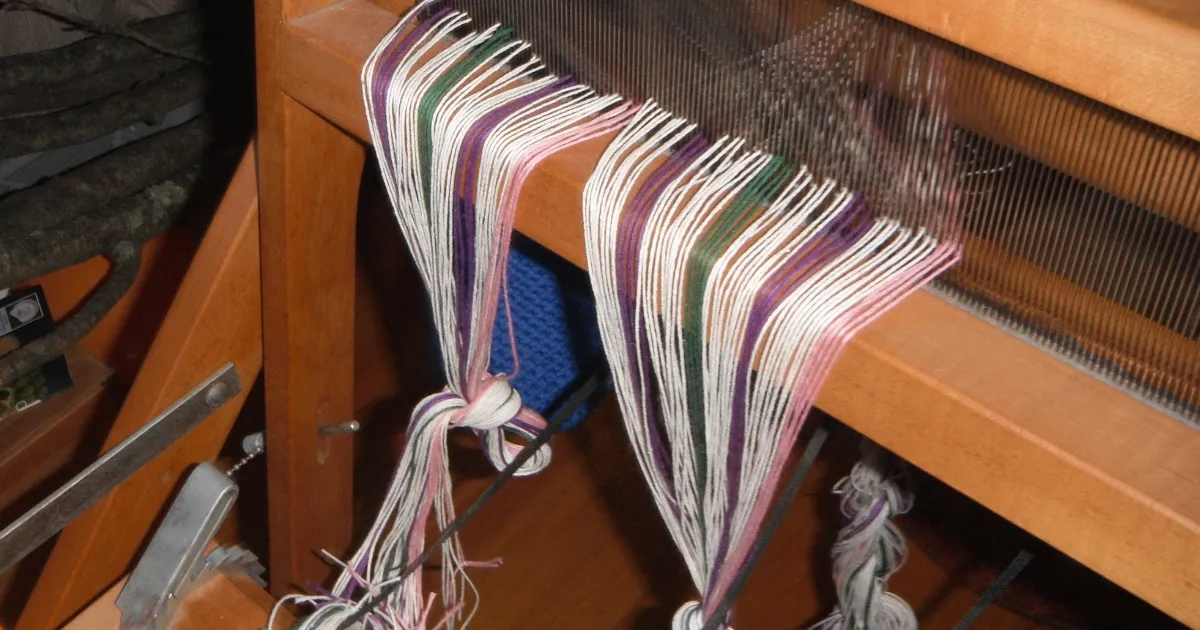 Warping my Baby Wolf for a rag rug. The reed is sleyed, and the ends hang in knotted bundles until it's time to tie on.
Weaving
- Treadles: the foot pedals on a floor loom. Each one raises a set of shafts to open a shed.
- Tie-up: which treadle connects to which shafts. The draft shows it.
- Shot or pick: one pass of the weft through the shed.
- Header: the first few rows you weave to spread the warp out evenly. I weave a few passes of toilet paper here, another trick from my class. It spreads the warp cheaply, and a few passes between pieces leaves room for fringe.
- Fell: the edge of the cloth where you last beat.
- Selvedge (selvage): the side edges of the cloth, where the weft turns around to go back.
- Temple: an adjustable stretcher that holds the cloth at its full width to cut down on draw-in.
- Brake: the catch that holds the warp beam still. You release it to advance the warp, winding woven cloth onto the cloth beam so you can keep weaving.
- Float: a thread that skips over more threads than it should. Sometimes it's part of the pattern. Sometimes it's a mistake, like mine below.
- Repair heddle: a temporary heddle you tie from string when one is missing or out of place.
Here's how I learned that last one. I once missed a heddle while threading, and didn't notice until I saw a floating thread in the cloth. I had to go back and restart my weaving. Then came the bigger question: what do you do about the heddle? Every heddle on that shaft was in use, the spares were pushed to the sides, and my mistake was two thirds of the way across. So I tied my own temporary string heddle around that warp end. The Weaver's Companion walked me through it (Amazon affiliate link). These things happen to every weaver, and they're fixable.
Taking it off the loom
- Thrums: the leftover warp ends you cut off after weaving. Some weavers save them for small projects or stuffing.
- Fringe: loose warp ends left at the ends of a piece, often knotted, twisted, or braided. On my rag rugs, I knotted the ends and sewed them.
- Wet finishing: washing a finished piece so the threads relax and settle into cloth.
Parts of a floor loom
These are the parts you'll hear named in a class or a book, using my 4-shaft Baby Wolf as the example. It's a jack loom, which means the shafts rise when you press a treadle.
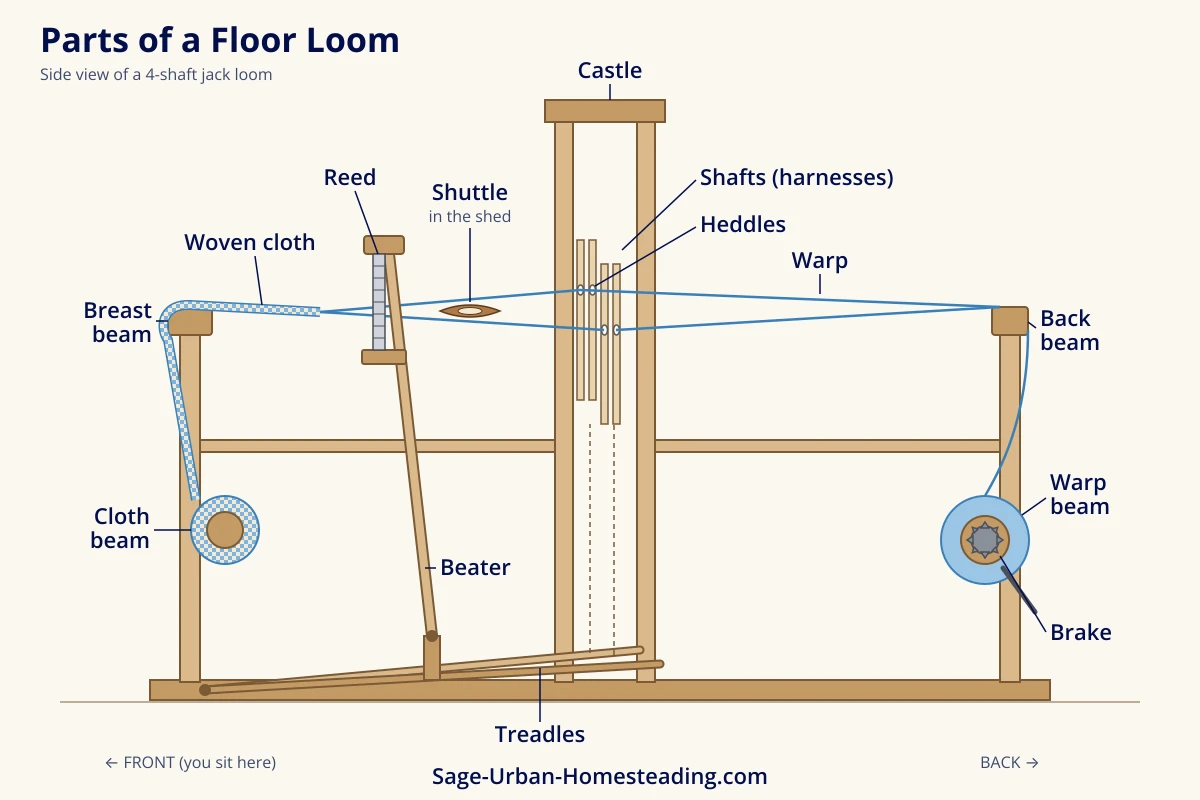
Here's what each part does, from the middle of the loom out:
- Castle: the tall frame in the middle that holds the shafts.
- Shaft (harness): a frame that holds a row of heddles and lifts them together. Most handweaving books treat the two words as the same thing. A 4-shaft loom has four.
- Heddle: a wire or string with an eye in the middle. One warp end goes through each eye. Mine are flat steel.
- Reed: the comb-like piece with dents that spaces the warp and sits in the beater.
- Beater: the swinging frame that holds the reed. You pull it toward you to beat in each pick.
- Breast beam: the front bar the woven cloth passes over, near your lap.
- Cloth beam: the roller below the breast beam where the finished cloth winds on.
- Back beam: the back bar the warp passes over on its way to the shafts.
- Warp beam: the roller at the back that holds the unwoven warp.
- Treadles and brake: the foot pedals that open each shed, and the catch that holds the warp beam (both described above).
Heddles, reeds, and shuttles up close
These three get mixed up a lot, because they all handle the yarn. Heddles hold each warp thread and move with their shaft (harness) to open the shed and make the pattern. The reed spaces the warp and beats the weft into place. The shuttle carries the weft.
Types of heddles
On a shaft loom, like a table loom or floor loom, you'll run into five kinds of heddles. A rigid heddle loom works differently, with one heddle doing the job of both the heddles and the reed.
- Wire heddles: metal and flexible. They slide along the heddle bar, so they adjust themselves as you thread.
- Inserted-eye heddles: metal and self-adjusting, with a ring in the center that reduces friction. That helps with textured yarns.
- Flat steel heddles: metal and self-adjusting, but heavy and noisy. These are what I use on my Baby Wolf.
- String heddles: positioned by hand and hard to thread, but the cheapest. You can also make them yourself in an emergency.
- Texsolv heddles: nylon, positioned by hand, quiet, and easy to thread, but expensive.
A tip if you use string heddles: give each harness its own color. You can even dye homemade string heddles so the colors are easy to tell apart.
I've had my own warping emergency with heddles, too. Partway through threading one project, I ran out of metal heddles. Instead of stopping, I made string heddles for the last few threads and kept going.
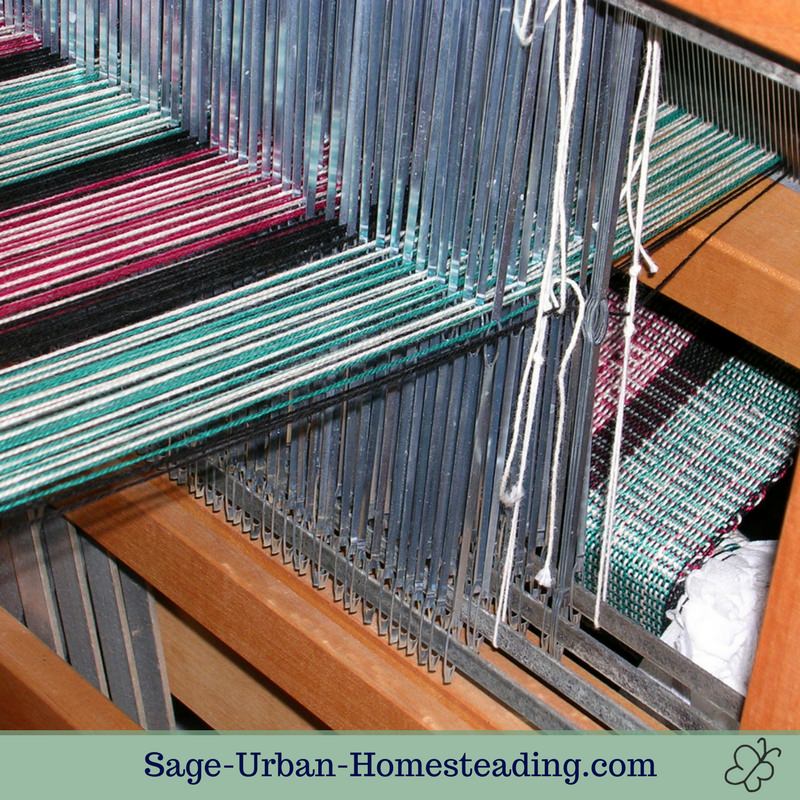 I had to make my own string heddles when I ran out of the metal kind on this project. Not quite enough heddles, so I improvised.
Reeds
The reed is the large, hard metal comb that sits in the beater. It spaces the warp and beats the weft against the fell of the cloth.
I had to learn about reeds fast. My Baby Wolf started out as a borrowed loom. My mom's co-worker lent it to me from her barn when I took my weaving class, and I later bought it. When I looked it over, the reed was rusted, so reeds were the first thing I had to figure out. (I'm still curious how antique reeds were made.)
- Reed size: the number of dents per inch, usually stamped on the end of the reed. Common sizes are 6, 8, 10, 12, and 16.
- Matching the sett: a pattern tells you the sett in ends per inch (EPI), and you choose a reed and a sley order that give you that spacing.
- Doubling up or skipping dents: a reed you can put two threads in each dent of, or skip dents on, lets one reed cover more patterns. A 10-dent reed can give you 20 EPI with two threads per dent, or 5 EPI if you skip every other dent.
- Reed marks: more than one thread per dent can leave visible lines in the cloth. That's why a reed with more dents per inch is often the better choice.
The Weaver's Companion is handy for working out the sett and sley order (Amazon affiliate link).
Types of shuttles
Different shuttles suit different yarns. A rag rug, for example, needs a shuttle with room for strips of cloth.
- Boat shuttle: the most common and the fastest. Yarn unwinds from a bobbin, quill, or pern inside it as it slides across. It can be side-fed or end-fed.
- Rag shuttle: has room for rags and is smooth on all four sides.
- Ski shuttle: has room for rags but is smooth on one side only.
- Stick shuttle: holds rags and thick yarns. It isn't smooth, but it's cheap and easy to make.
I mostly use a boat shuttle, for both wool yarn and cotton thread. LeClerc and Schacht shuttles have different shapes and weights, and which one you like is personal preference.
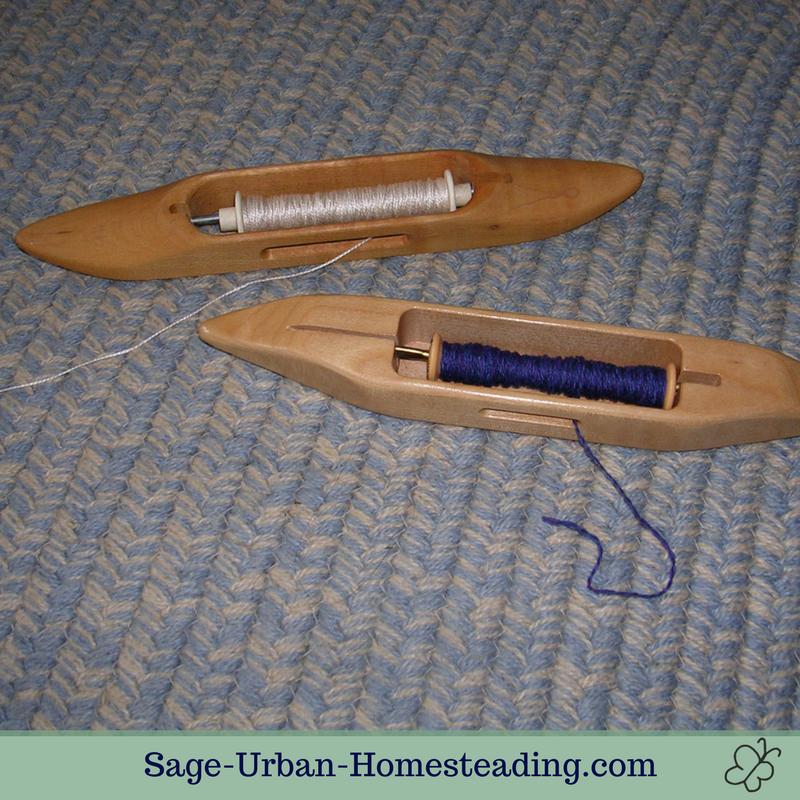 Here are my two boat shuttles. They're slightly different shapes, but they work the same way.
Floor loom styles: Jack, counterbalance, and countermarche
Floor looms differ in how the treadles move the shafts. You'll see these three names when you shop for a loom or read a pattern.
- Jack loom (rising shed): pressing a treadle lifts the shafts tied to it, while the rest stay put. It takes a bit more effort to treadle, but it makes changing the tie-up easy. My Baby Wolf is a 4-harness jack loom.
- Counterbalance loom: the shafts are linked, so some rise as others lower, for example two up and two down. It's good for balanced weaves, quiet, and easy to use.
- Countermarche loom: large and heavy, and each shaft moves up or down independently. It's harder to tie up, but easy to weave on.
If you're weighing 4 harnesses against 8, I cover that on Types of Weaving Looms. I weave on a 4-harness and don't feel limited.
Which weaving terms matter on simpler looms
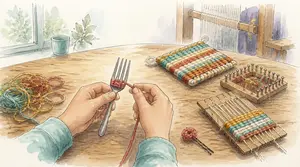
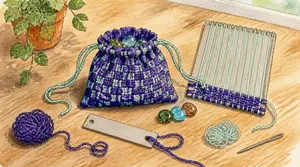
You don't need a floor loom to weave, and you don't need half of this vocabulary to start. My own first weaving was a paper place mat. My kids start with fork weaving, move on to a potholder loom, and later make a Cardboard Loom Pouch.
On those simpler looms, these are the words that matter:
- Warp, weft, shed, and beat: the same on every loom.
- Selvedge: you'll still be trying to keep your edges straight.
- Shuttle or tapestry needle: whatever carries your weft across.
- Rigid heddle: if you move up to a rigid heddle loom, its one heddle does the job of both the heddles and the reed. Its slots and holes open the shed and space the warp at the same time.
Everything else on this page you can learn when you need it. If you're still deciding which loom to start with, Types of Weaving Looms walks through the options.
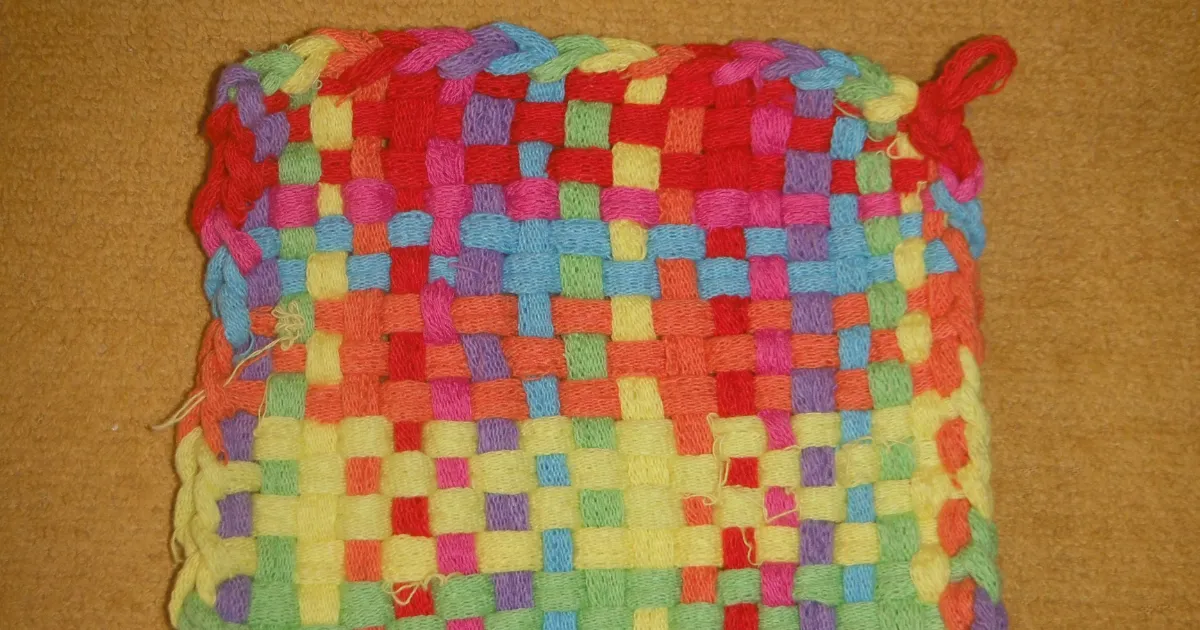 One of my kids made this on a potholder loom. It uses the same warp, weft, and over-under as a floor loom. It's just much quicker to warp.
If you're shopping: the two books I keep by my loom
Before you buy any weaving tools, I'd take a class or visit a local fiber guild. You'll learn the words by using them, and you'll find out which kind of loom you actually enjoy. Books are a different story. These two earn their shelf space (Amazon affiliate links).
- Learning to Weave by Deborah Chandler: my study book during and after my first class. It explains the terms and the steps of dressing a floor loom in plain language.
- The Weaver's Companion: a small, sturdy reference I reach for when I need a knot for the apron, a fix for a mistake, or help working out the sett and sley order. It's the book that got me through my missing-heddle problem.
I do own every tool on this page, including the warping board, bobbin winder, heddle hook, sley hook, lease sticks, raddle, temple, and umbrella swift. But I'd wait to buy tools until you know what loom you're weaving on. Some come with a loom, and a class may let you borrow them.
Where to go next
- How to Start Weaving: the main weaving page, with where to begin based on your space and budget.
- How to Read a Weaving Draft: what the draft and tie-up actually tell you, once these terms make sense.
- Cardboard Loom Pouch: a small first project that uses warp, weft, shed, and beat with no loom to buy.
- How to Weave a Blanket: what my first floor-loom project taught me.
- Make a Rag Rug: a way to turn old clothes into something you'll use every day.
- Types of Weaving Looms: the main kinds of looms and how to choose which loom to start with.
- Rigid Heddle Loom: a loom with one heddle that also works as the reed, and a common next step after a cardboard or potholder loom.
Weaving is one of the slower crafts on this site, and that's part of what I love about it. If you're also looking for a small, practical place to start building a more self-sufficient home, my free guide below helps you pick your first system.
Weaving terms FAQ
What's the difference between warp and weft?
What's the difference between warp and weft?
Warp is the set of threads held tight on the loom, running away from you. Weft is the yarn you weave across them, right and left. If you mix them up, try the rhymes: warp goes up and down like a harp, and weft goes right and left.
Are a harness and a shaft the same thing?
Are a harness and a shaft the same thing?
In most handweaving books, yes. Both mean the frame that holds a row of heddles and lifts them together. Older books tend to say harness, and many newer ones say shaft.
What's the difference between sett and EPI?
What's the difference between sett and EPI?
They describe the same thing. Sett is how closely you space the warp, and EPI (ends per inch) is how you write it down. A draft might say "sett: 12 EPI."
What does sleying the reed mean?
What does sleying the reed mean?
It means threading the warp ends through the dents (slots) in the reed, usually with a sley hook. The draft tells you how many ends go in each dent.
Do I need to know all these weaving terms before my first class?
Do I need to know all these weaving terms before my first class?
No. Knowing warp, weft, shed, shuttle, and beat will help you follow along. The rest makes more sense once you're standing at a loom and someone points to the part.
Do I need a floor loom to learn weaving?
Do I need a floor loom to learn weaving?
No. A cardboard loom, a potholder loom, or a rigid heddle loom uses the same basic ideas with far fewer parts. Floor loom terms can wait until you know you love weaving. Types of Weaving Looms can help you choose a first loom.

Amy DeVries helps beginner urban homesteaders learn by doing. A lifelong gardener, she has grown food in spaces that expanded to 18 raised beds, patio containers, dwarf fruit and nut trees, and gravity-fed rainwater systems. She shares practical lessons shaped by real experience. Amy homeschools her children and teaches the same hands-on skills that guide her work.
You might like these
How to Weave a Blanket: What I'd Tell You Before Your First One
How to weave a blanket without wasting money: try a loom first, plan for uneven edges, and care for wool right. What my first prize-winning blanket taught me.
Types of Weaving Looms: Which One to Start With
Types of weaving looms explained, from a fork to a floor loom: what each one is good for, and when an upgrade actually solves a real problem.
How to Start Weaving: From a Fork to a Floor Loom
How to start weaving with a fork, a potholder loom, or cardboard before you buy a loom, plus when a class, guild, or floor loom makes sense.

More Information
Disclosure
All information found on this website is editorial in nature and intended to motivate and inspire rather than be used as medical advice or legal advice.
As an Amazon Associate, I earn from qualifying purchases. I also use Google Ads and cookies as described in the Privacy Policy.
Thank you for your support!
By Amy DeVries, Copyright © 2011-2026 Sage-Urban-Homesteading.com All rights reserved.
