FYI: This website contains affiliate links. As an Amazon Associate I earn from qualifying purchases.
- Home
- More Topics
- How to Start Weaving
- How to Read a Weaving Draft
How to Read a Weaving Draft (Start With Tabby and Twill)
By Amy DeVries
Short answer: Learning how to read a weaving draft comes down to four small charts: the threading (how the warp goes through the heddles), the tie-up (which shafts each treadle lifts), the treadling (the order you press the treadles), and the draw-down (a picture of the cloth). Start with a plain weave draft, then a simple twill. Those two show you how every other draft works.
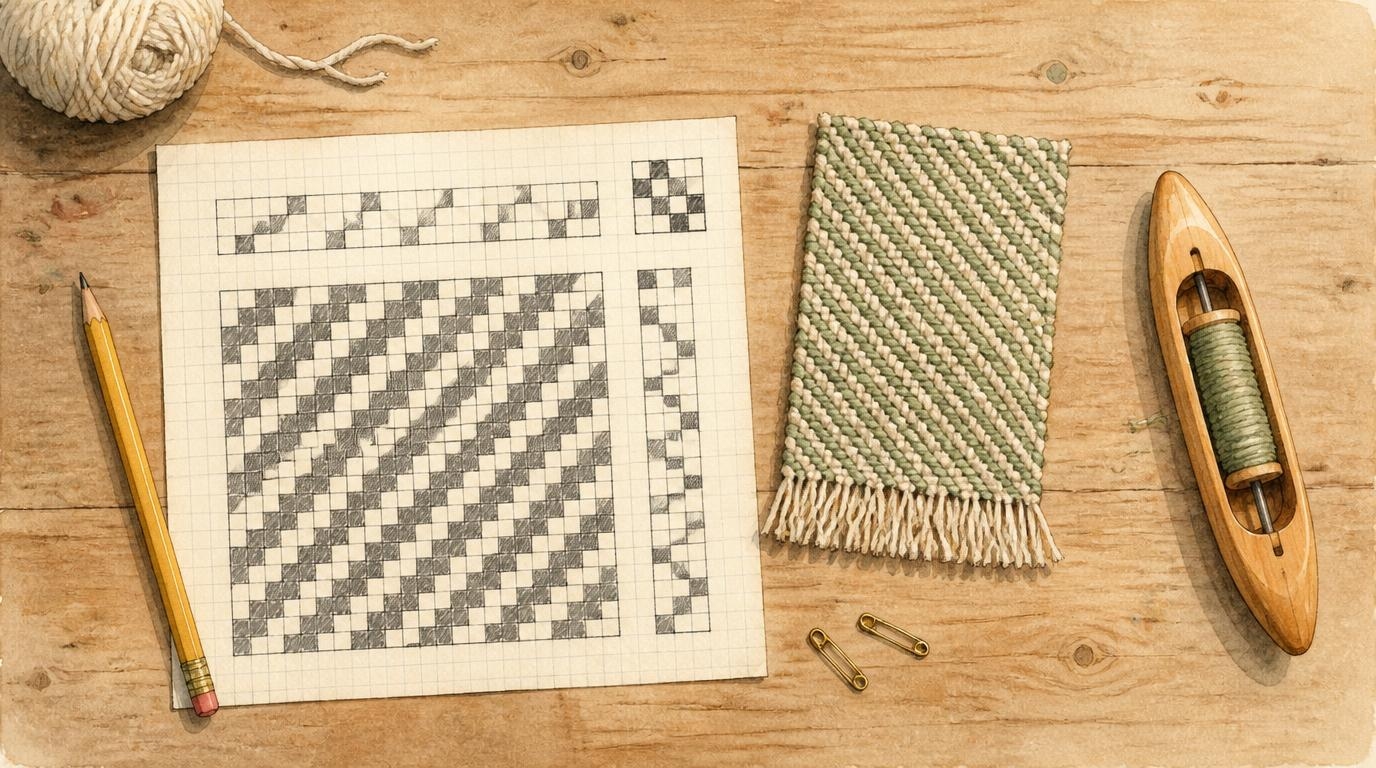 A draft is a weaver's recipe card: once you can read one, you can weave from any pattern book.
The first time I opened a weaving pattern book, the drafts looked like a page of crossword puzzles. Little black squares everywhere, numbers along the edges, and no clue which way to read them. Once I learned that a draft is just four small charts working together, it clicked, and the whole book opened up.
You don't need drafts to start weaving. If you're weaving on a fork, a potholder loom, or a cardboard loom, start with How to Start Weaving instead. Drafts start to matter when you sit down at a loom with four or more shafts.
Here's how I learned to read them, using the two structures I wove most: tabby and twill.
A 2/2 twill draft for a 4-shaft loom. Read the threading from right to left and the treadling from top to bottom. Filled squares in the draw-down show where the warp is on top.
What a weaving draft shows you
A draft is a weaver's recipe card. It tells you how to thread the loom and what to do with your feet, row by row. Weavers can read each other's drafts across languages, because the squares mean the same thing everywhere.
A draft shows the weave structure, which is the way the warp and weft cross. It usually doesn't show color. The same draft woven in two colors can look completely different, which is part of the fun (more on that below).
Why the number of shafts matters
Every draft is written for a certain number of shafts, also called harnesses. Check that number first, before you fall in love with a pattern.
- Rigid heddle loom: One heddle makes two sheds, so it works like a 2-shaft loom. That gives you plain weave and all its color patterns. Pick-up sticks or a second heddle add more options, including twill-like patterns. See Rigid Heddle Weaving.
- 4-shaft table or floor loom: Plain weave, twills, and most beginner pattern-book drafts. My Baby Wolf floor loom is a 4-shaft loom.
- 8 shafts and up: More complex structures. An 8-shaft draft usually can't be woven on 4 shafts without redesigning it. I explain the 4-shaft vs. 8-shaft choice on Types of Weaving Looms.
The four parts of a weaving draft
Threading
The threading is the long grid across the top (in some books, the bottom). Each column is one warp thread. Each row is one shaft, counted from the bottom up. A mark shows which shaft's heddle that thread goes through. Many drafts are read from right to left, so check the book's key before you start.
Tie-up
The tie-up is the small grid in the corner. Columns are treadles (my loom has six), and rows are shafts. A mark means that treadle lifts that shaft. Some drafts mark the shafts that sink instead of the ones that lift, so check the key again.
On a table loom without treadles, you lift shafts with levers. Read the tie-up and treadling together as a list of which shafts to lift for each row.
Treadling
The treadling is the long grid down the side. Each row is one pick, or one pass of the weft. The mark shows which treadle to press. Work down the grid, one row at a time.
Draw-down
The draw-down is the big grid where the other three meet. It's a picture of the finished cloth's structure. A filled square usually means the warp is on top, and an empty one means the weft is on top. Not every draft includes a draw-down; weaving software can draw one for you.
Tabby vs twill: your first two drafts
Every weave grows out of three basic structures: plain weave (tabby), twill, and satin. Most 4-shaft handweaving patterns are plain weave or twill, so those are the two drafts to learn first.
Plain weave (tabby)
Plain weave is over one, under one. "Tabby" is another name for the same thing. It's the simplest draft there is: on a 4-shaft loom threaded straight across (1, 2, 3, 4), you lift shafts 1 and 3 together, then 2 and 4. That's a two-row repeat.
Plain weave is the firmest, stiffest structure, and it looks like a tiny grid. Because the threads cross as often as possible, it also has the most take-up. That means it loses more length to bending around other threads, so plan a little extra warp.
If you've woven on a cardboard loom, a potholder loom, or a rigid heddle loom, you've already woven plain weave.
Twill
In twill, the weft goes over two or more warp threads, then under, and each row steps over by one thread. Those steps line up into a diagonal. Twill can use the same straight threading as tabby. Only the tie-up changes: for 2/2 twill, the treadles lift shafts 1 and 2, then 2 and 3, then 3 and 4, then 4 and 1.
Twill is softer than tabby and drapes better. Most denim is twill. With the same yarn, twill needs a slightly closer sett than tabby.
- Even twill (2/2) looks the same on both sides.
- Uneven twill (1/3 or 3/1) shows one thread more on one side. That's how I made the reversible colors on my wool ruana: the color that passes over three threads shows more on that side. I wove it in two panels and sewed them together.
- Point and undulating twills reverse or stretch the threading to make zigzags, diamonds, and waves. My first blanket is undulating twill.
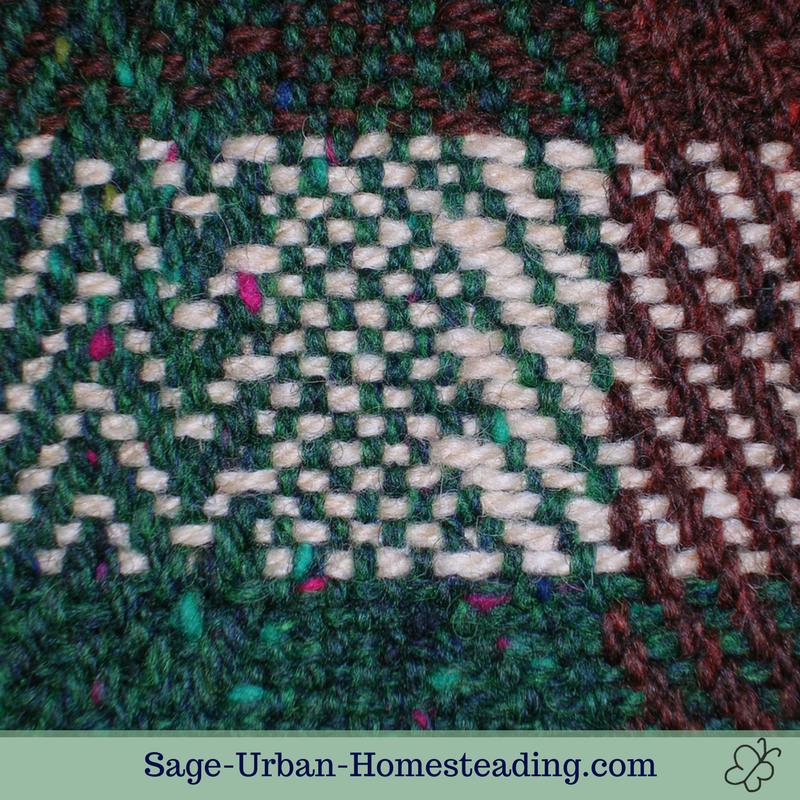

 My wool ruana in 1/3 twill. The other side shows grey as the main color with a navy stripe near the ends, so I can wear it either way.
Which one I'd weave first
Start with plain weave. It works on any loom, and your mistakes are easy to see, which means they're easy to learn from. Move to twill when you want softer drape, like for a scarf or a blanket.
On a 4-shaft loom, a straight threading weaves both. So one warp lets you try tabby and twill just by changing the tie-up, which is a low-risk way to see the difference for yourself.
Weave balance in plain words
Balance is about which threads show. You'll see these words in draft notes and pattern instructions.
- Balanced: The same number of warp threads per inch as weft threads per inch, so both show. Most towels and blankets are balanced.
- Warp-faced: The warp is packed close enough to hide the weft. Inkle bands are a good example.
- Weft-faced: The weft is packed down to hide the warp, as in many rugs and tapestries.
Warp-faced and weft-faced cloth bends easily in the direction with fewer threads and feels stiffer across the denser direction. For words like sett, e.p.i., and p.p.i., see Weaving Terms.
Color patterns that are still plain weave
These patterns use the plain weave draft you just learned. Only the color order changes.
- Stripes: Change colors in the warp, the weft, or both.
- Plaid: Stripes in both directions. Plaids work in twill too, and the color possibilities are endless.
- Log cabin: Alternate a dark and a light thread in both warp and weft, then swap the order at the edge of each block. Little vertical and horizontal lines appear, like an optical illusion, but it's still plain weave.
Log cabin still fascinates me. It's the best proof that you don't need a complicated draft to get a striking pattern.
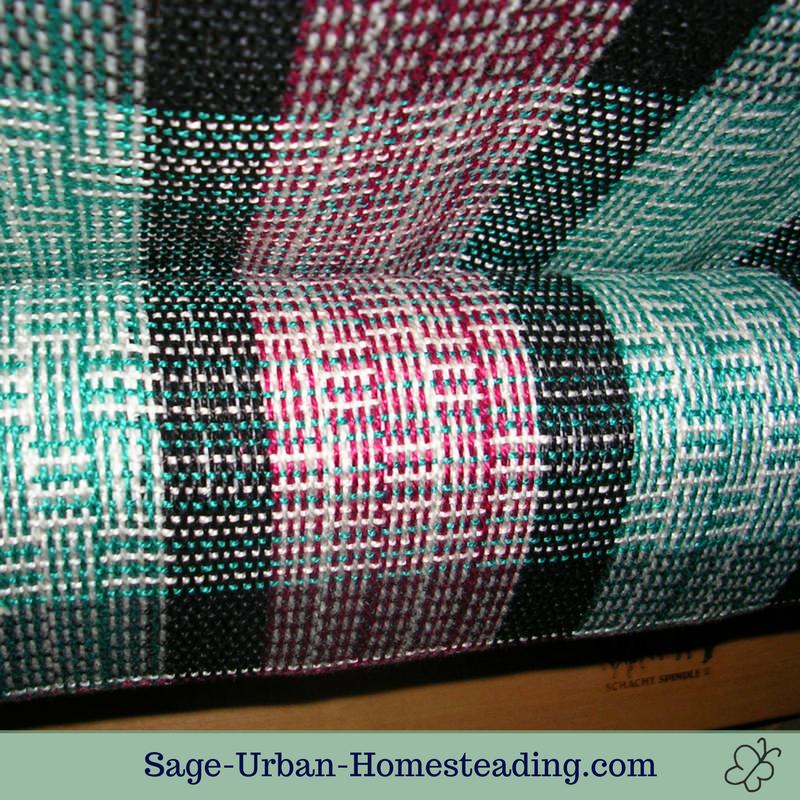 My log cabin dishtowel, still rolled up on the loom.
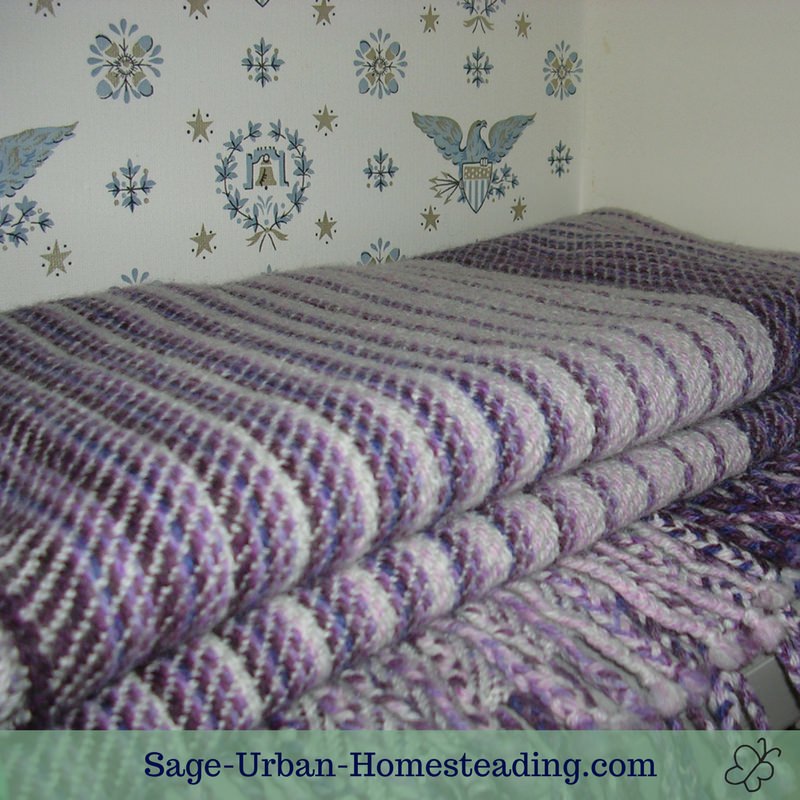
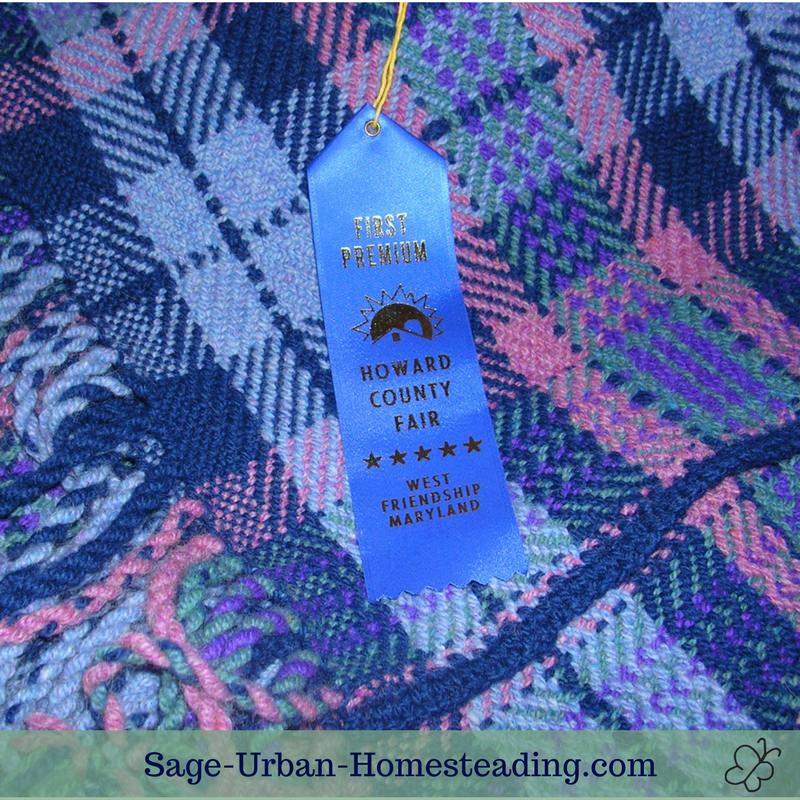 My first wool blanket. Color stripes in the warp and weft make a plaid, even in twill.
Other structures you'll see in drafts
I haven't woven these, but you'll run into their names in pattern books like the Handweaver's Pattern Directory (Amazon affiliate link). Here's a quick guide so they don't throw you.
- Satin: The third basic structure. Long floats give it a smooth, shiny surface, but it snags and wears faster. A true satin needs more than four shafts.
- Waffle weave: Deep square cells with a lot of take-up. You'll see it in dish and bath towels.
- Honeycomb: Cells of plain weave outlined by a heavier weft, which puff up once the cloth comes off the loom.
- Lace weaves: Huck, Swedish lace, and Atwater-Bronson lace group floats so the cloth opens into lacy spaces after washing.
- Overshot: A thicker pattern weft floats over a plain weave background, using two shuttles. It makes the curves and circles on classic coverlets.
- Summer and winter: A two-sided cloth with opposite colors on each face. Its floats are shorter than overshot's, so it holds up better.
- Double weave: Two layers of cloth woven at once. I tried it once in a class, and that was enough to know it's a whole topic of its own.
How I kept my weaving records
When I was weaving regularly, I kept a weaving binder. Each project got a record form I adapted from Deborah Chandler's Learning to Weave (Amazon affiliate link). Here's what went on it:
- A small hand-drawn copy of the draft and tie-up
- Photos and a snip of each yarn, instead of a woven swatch
- My time in and out, every time I sat down to weave
At the loom, I pinned a safety pin to one edge every 6 inches to keep track of how much I'd woven.
For drafts on the computer, I used WeaveDesign, a free program from the Pikes Peak Weavers Guild. It opens .WIF files (a common draft file type) and draws the draw-down for you. I found it easy to use. For yarn amounts and sett, I kept The Weaver's Companion beside my loom (Amazon affiliate link).
I collect free drafts, inspiration photos, and loom ideas on my Pinterest weaving board.
If you're shopping
You don't need any of these to start weaving. They earned their place once I was at a 4-shaft loom and wanted to weave from drafts (Amazon affiliate links).
- Learning to Weave by Deborah Chandler: The book I studied during and after my first weaving class. It explains drafts step by step, and my project record form started from hers.
- The Weaver's Companion: A small reference I kept beside the loom for sett, yarn amounts, and the math I didn't want to memorize. I use it for every project, most often to review how to tie knots.
- Handweaver's Pattern Directory: A big book of weave structures, all written for 4-shaft looms like mine, each with a draft and a photo of the cloth. It's a good next step once you can read a basic draft, but it's a reference book, not a how-to for brand-new weavers.
Where to go next in weaving
- Just starting? How to Start Weaving walks you from a fork to a real loom.
- Choosing a loom? Types of Weaving Looms compares rigid heddle, table, and floor looms, and 4 shafts vs. 8.
- Weaving on a rigid heddle? Rigid Heddle Weaving covers what a 2-shaft loom can do.
- New words in a draft? Weaving Terms defines sett, take-up, fell, and the parts of the loom.
- Ready for a twill project? How to Weave a Blanket shows how I wove my first blanket in undulating twill.
- Want something small first? The Cardboard Loom Pouch and How to Make a Rag Rug are plain weave projects you can finish.
How to read a weaving draft FAQ
Is tabby the same as plain weave?
Is tabby the same as plain weave?
Yes. Tabby and plain weave are two names for the same over-one, under-one structure. In overshot drafts, the "tabby" weft is the plain weave background between the pattern rows.
Can you weave twill on a rigid heddle loom?
Can you weave twill on a rigid heddle loom?
Not with one heddle alone, because it only makes two sheds. Pick-up sticks or a second heddle let you weave twill-like patterns. See Rigid Heddle Weaving for what a 2-shaft loom can do.
Why does my draft look backward?
Why does my draft look backward?
Drafts aren't all written the same way. Many read right to left, and some tie-ups mark the shafts that sink instead of the ones that lift. Check the key in your book or pattern before you thread anything.
Can I weave an 8-shaft draft on a 4-shaft loom?
Can I weave an 8-shaft draft on a 4-shaft loom?
Usually not as written, because the threading uses shafts your loom doesn't have. Look for drafts written for 4 shafts. If you're deciding between looms, see Types of Weaving Looms.
Do I need weaving software?
Do I need weaving software?
No. A pencil and graph paper work fine, and drawing a few rows of draw-down by hand is a good way to learn. Software is handy when a draft doesn't include a draw-down or you want to try color changes quickly.
Do I have to read drafts to weave?
Do I have to read drafts to weave?
No. On a fork, a potholder loom, a cardboard loom, or a rigid heddle loom with one heddle, you can weave plain weave without ever reading a draft. Drafts become useful once you have a 4-shaft loom and want patterns beyond plain weave.

Amy DeVries helps beginner urban homesteaders learn by doing. A lifelong gardener, she has grown food in spaces that expanded to 18 raised beds, patio containers, dwarf fruit and nut trees, and gravity-fed rainwater systems. She shares practical lessons shaped by real experience. Amy homeschools her children and teaches the same hands-on skills that guide her work.
More Information
Disclosure
All information found on this website is editorial in nature and intended to motivate and inspire rather than be used as medical advice or legal advice.
As an Amazon Associate, I earn from qualifying purchases. I also use Google Ads and cookies as described in the Privacy Policy.
Thank you for your support!
By Amy DeVries, Copyright © 2011-2026 Sage-Urban-Homesteading.com All rights reserved.
