FYI: This website contains affiliate links. As an Amazon Associate I earn from qualifying purchases.
- Home
- More Topics
- How to Start Weaving
- Types of Weaving Looms
Types of Weaving Looms: Which One to Start With (and When to Upgrade)
By Amy DeVries
Short answer: There are a lot of types of weaving looms, but you only need to choose one: the smallest loom that can make the thing you actually want to weave. Start with a free or cheap loom, and move up only when your loom is the thing stopping you.
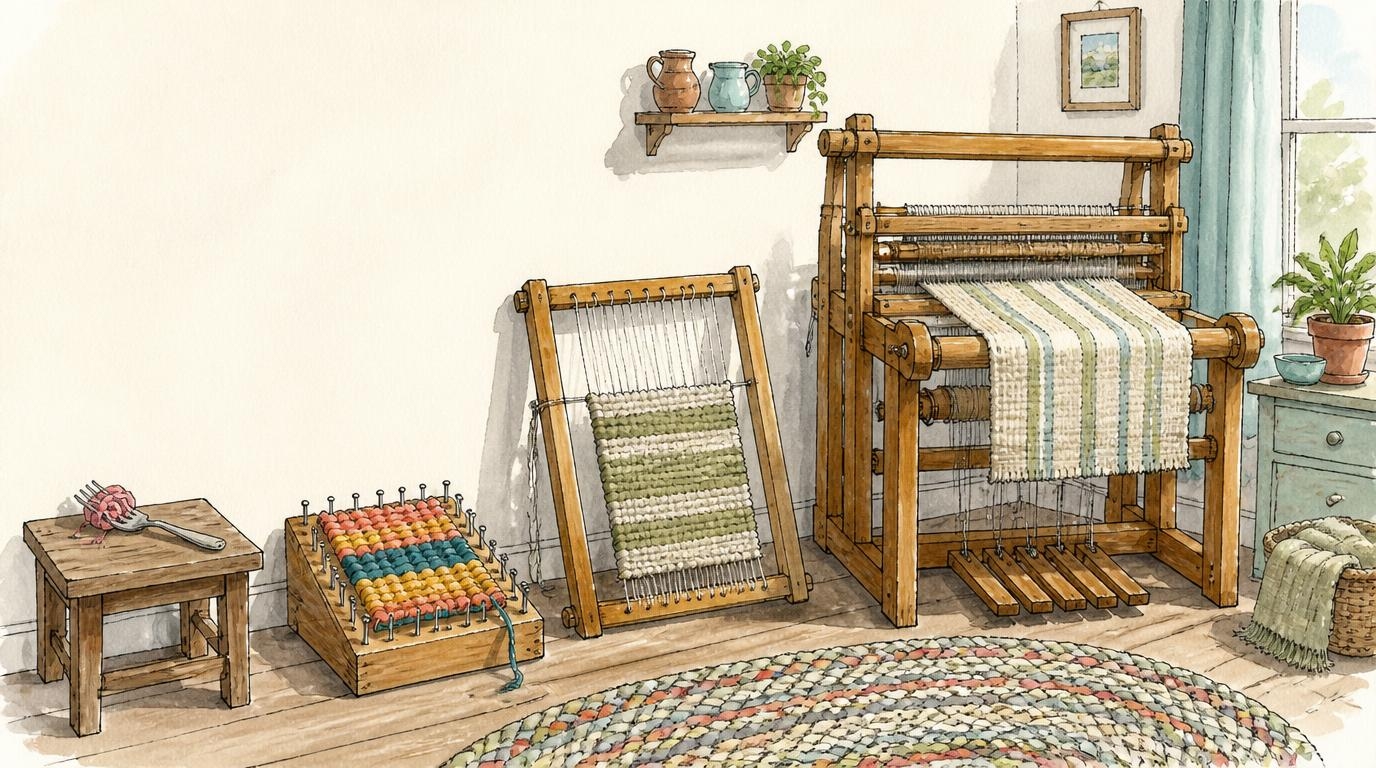 From a fork to a floor loom, every loom does the same basic job. The trick is picking the smallest one that makes what you want.
If you've looked at loom websites lately, you've probably seen words like countermarche, jack, and dobby, and wondered if you need a degree before you can buy anything. You don't. Every loom does the same basic job: it holds one set of threads tight so you can weave another set over and under them.
My first weaving was a paper place mat in school. One summer as a kid, before the internet, I wove on a homemade loom made of plastic forks with holes drilled through the handles. I set the tension by how I sat and leaned back. Years later I took a weaving class, and now there's a Baby Wolf floor loom in my living room.
So I've been at both ends of this list. Below are the main types of weaving looms, from the ones you already own to the big ones, with what each is good for and the real problem that would make it worth moving up. I've woven on some of these. Others I've only watched in demos at the Maryland Sheep and Wool Festival, and I'll tell you which is which.
How looms differ (the short version)
The easiest way to sort looms is by what they can make:
- Fixed-size pieces: fork, cardboard, potholder, and frame looms. You can weave smaller than the loom, but never bigger.
- Narrow bands: inkle and backstrap looms, for belts, straps, and trim.
- Long lengths of cloth: rigid heddle, table, and floor looms. The warp winds onto a roller, so a scarf or a set of dishtowels can be much longer than the loom.
The other big difference is how the loom makes the shed, the opening the yarn passes through. On the simplest looms, you go over and under by hand. On bigger looms, a heddle or shafts lift whole groups of threads at once, which is faster and opens up patterns.
Types of weaving looms, from smallest to biggest
Fork and paper: the looms you already have
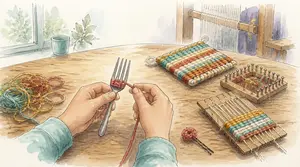
A loom is anything that holds threads still while you weave. A fork works. So does a sheet of paper cut into strips. I learned over-and-under with a paper place mat, and I teach my kids with fork roses around age 3 or 4. I learned fork roses in Girl Scouts.
These projects are small, but they're real weaving. They're also a free way to find out whether you enjoy the rhythm of over and under before you spend anything.
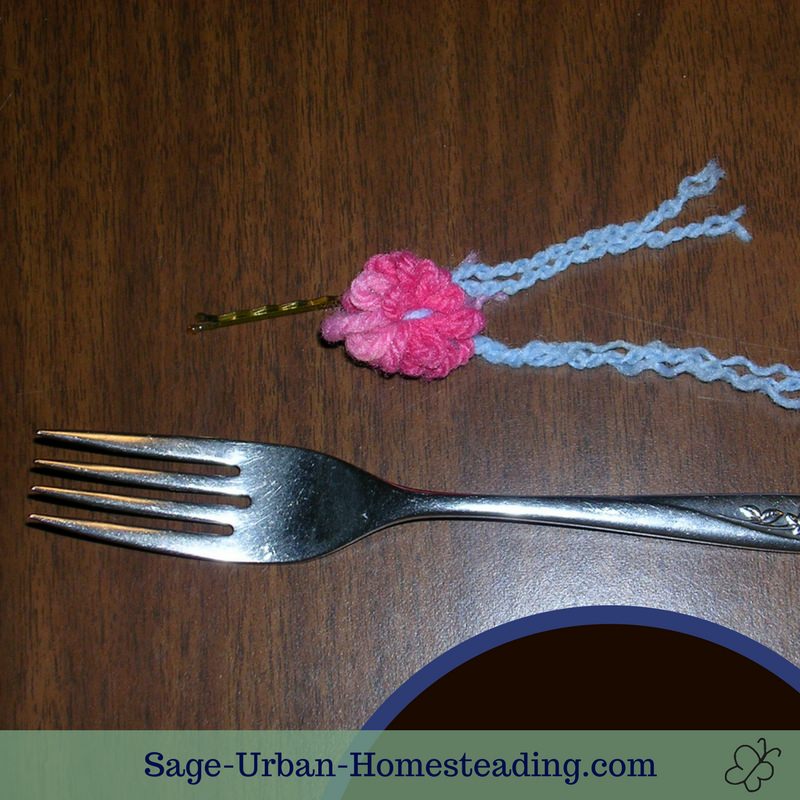 Weaving yarn around a fork makes a little rose. It's so easy I taught my 4-year-old to do it.
Cardboard looms
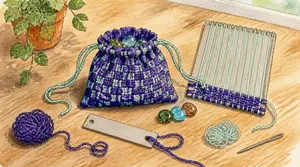
A piece of cardboard with notches or spikes can hold a warp, and you can weave right around it to make a small pouch. I've taught this as a library workshop, and it's the next project I give my kids after potholders. My step-by-step is on the Cardboard Loom Pouch page.
Upgrade when: you want something flat and sturdy you can use, like a potholder or a mat.
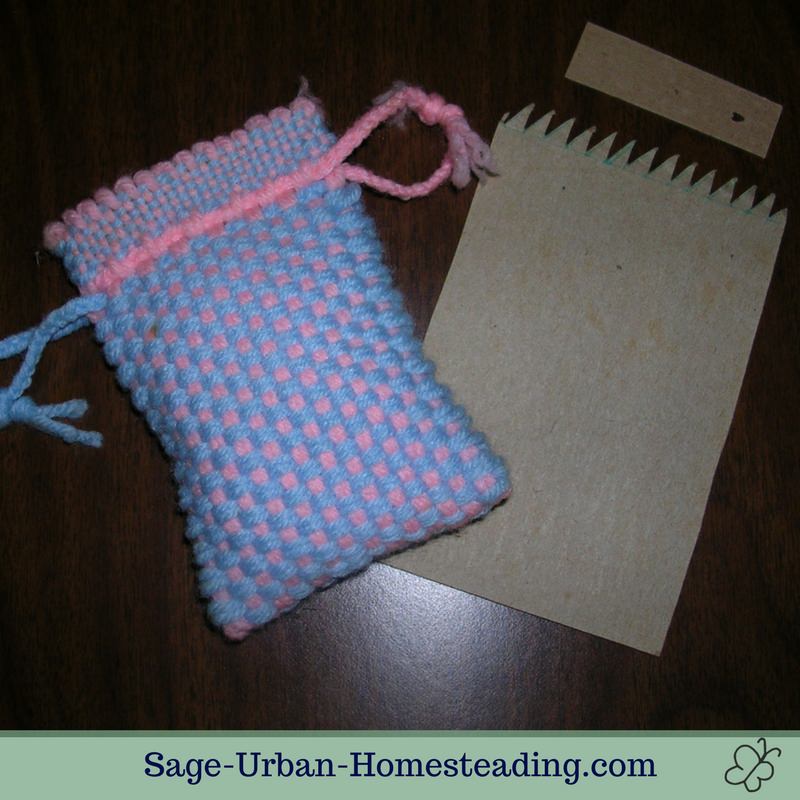 My finished pouch next to the notched cardboard loom I wove it on. The cardboard sits inside the pouch while you weave.
Potholder looms
A potholder loom is a small square frame with pegs and stretchy loops. My kids each start on one in kindergarten. It's the first loom that makes something you'll actually use in the kitchen, and the loops come in refill packs, so one loom lasts for years.
Upgrade when: you want to choose your own yarn, or make something bigger than a potholder.
Frame and tapestry looms
A frame loom is a rectangle that holds the warp at a fixed size. They range from small wooden frames for wall hangings to big upright tapestry looms. Most have no way to lift threads for you, so you weave over and under by hand or with a stick. They're great for picture-style weaving, but slow for plain cloth, and you can't weave anything larger than the frame.
Upgrade when: you want yardage, like scarves or towels, instead of single pieces.
Inkle and backstrap looms
These are band looms. An inkle loom is a small table-top frame with pegs that holds a narrow warp, for belts, straps, and trim. A backstrap loom ties one end to a post and the other to a strap around your waist, so you control the tension by leaning. My plastic-fork summer loom worked that way. Both are cheap and portable, but they only make narrow strips.
Upgrade when: you want wider cloth.
Rigid heddle looms
A rigid heddle loom is where a lot of weavers start making real cloth. One piece, the rigid heddle, has slots and holes that lift half the threads at a time, space them evenly, and beat the yarn into place. That gives you plain weave and lengths of fabric like scarves, shawls, and dishtowels. They're portable and can sit on a table or in your lap.
My kids moved from potholders to a small 2-shaft tabletop loom we found used. Two shafts gives you the same plain over-and-under cloth a rigid heddle makes, so it's the same step up.
Upgrade when: you keep wanting patterns (like twills) that need more than two sets of threads lifting separately, or finer yarns than your heddle handles well.
Table looms
A table loom usually has 4 or 8 shafts that you raise by hand with levers. That opens up patterns like twill and overshot without the size of a floor loom. They need a table or stand, and they can't make anything wider than the loom, so a blanket means weaving panels and sewing them together.
I've tried table looms only in demos and at a shop that has since closed, The Mannings. Compared to my floor loom, the hand levers feel slower to me. Nothing's wrong with them; it's just a different rhythm.
Upgrade when: you're weaving often enough that lifting shafts by hand slows you down, and you have the room.
Floor looms
Floor looms are the biggest looms for weaving at home. You press treadles with your feet to lift the shafts, so your hands are free to throw the shuttle. The bigger movements give an easier rhythm, and you can weave wide pieces like blankets and rugs. Floor looms come in a few styles, depending on how the shafts move. Mine is a jack loom, where pressing a treadle lifts the shafts tied to it.
You'll see floor looms (and table looms) sold as 4-harness or 8-harness. Harnesses, also called shafts, are the frames that hold the heddles. Each one lifts its own group of warp threads, so more harnesses means more ways to combine threads and more possible patterns.
- 4-harness: the most common choice for home weavers. It handles plain weave, twills, rag rugs, dishtowels, and blankets, which covers a lot of weaving.
- 8-harness: opens up more complex patterns, like fancier twills and block designs. It also means more heddles to thread, more treadles to tie up, more weight, and a higher price.
My Baby Wolf is a 4-harness, and I don't feel limited. There are still plenty of patterns I haven't tried. An 8-harness loom is heavier to lift with each treadle, and it's more likely to give you a small shed, which makes the shuttle harder to pass through. If you're not sure, start with 4. Some looms can have harnesses added later, so ask about that before you buy.
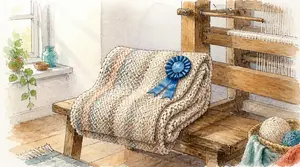
My first blanket was woven in class on my teacher's Mighty Wolf, and it won first place at the Howard County Fair. I never actually shopped for my Baby Wolf. My mom's co-worker heard I was taking the class and offered to lend me hers, since it had just been sitting in her barn. I had to scrub off some bird droppings and replace the rusty reed, but it worked fine. After borrowing it for a while, I bought it from her for a good price. I've woven rag rugs on it, including the T-shirt rug that's been by my bed for more than 20 years.
Here's the honest trade-off. A floor loom takes up real space; ours lives in the living room. And it doesn't go anywhere. When life got busy with dance classes and track meets, I could knit while waiting, but I couldn't bring my weaving. It hasn't been used in a while. If your time comes in little pieces away from home, a smaller loom may get much more use.
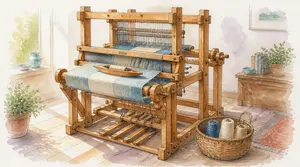
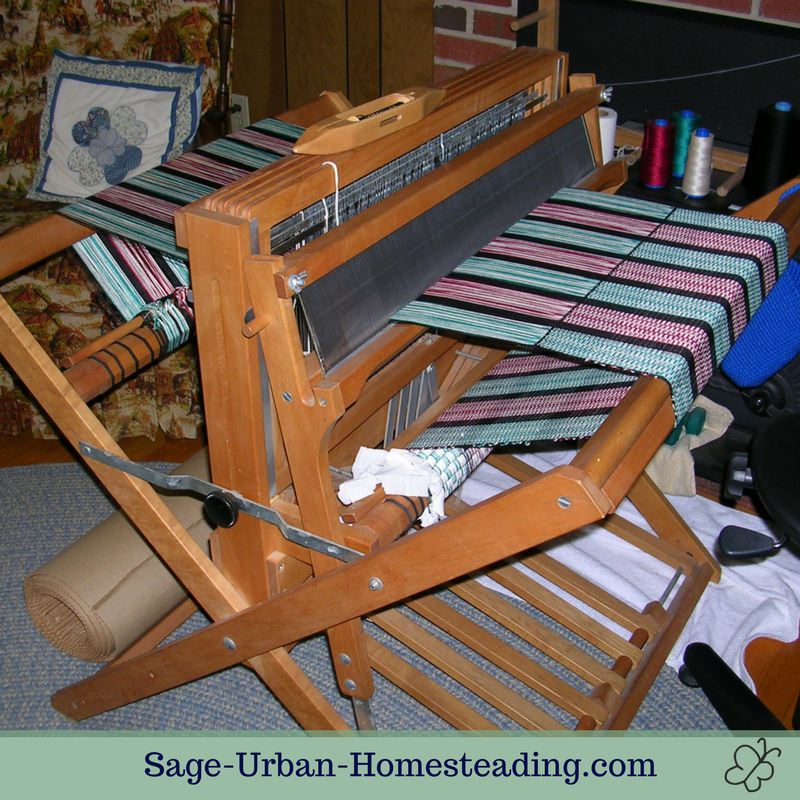 My Baby Wolf, set up for weaving striped dishtowels. It's a wonderful loom, and it takes up a corner of our living room.
The rule I'd use: upgrade only when your loom stops you
It's easy to buy a big loom for the weaver you hope to be. A better question is, "What's the next thing I want to make, and can my loom make it?" If it can, keep weaving. If it can't, here's where to look next:
- You want to know if you even like weaving: fork, paper, or cardboard
- You want something useful, fast: a potholder loom
- You want art pieces or wall hangings: a frame loom
- You want belts or straps: an inkle loom
- You want scarves and dishtowels: a rigid heddle loom
- You want patterns, with limited space: a table loom
- You want blankets and rugs, and you have the room: a floor loom
This is the same way I approach everything on Sage Urban Homesteading: start with the smallest version that works, and upgrade only when it solves a real problem.
Try a class or guild before you buy a big loom
I learned to weave in a class with Gwen Handler at Common Ground on the Hill, around 2004. Weaving on a floor loom with a teacher beside me told me more than any catalog could, and I only bought my own loom after that.
Before you spend real money on a table or floor loom:
- Take a class. You'll weave on a good loom with help right there when something goes wrong.
- Visit a local weaving or fiber guild. Members often let you try their looms, and used looms change hands there.
- Go to a fiber festival. We've watched loom demos at the Maryland Sheep and Wool Festival, and seeing looms side by side makes the differences click.
During and after my class, I studied Deborah Chandler's Learning to Weave (Amazon affiliate link). It's the book I'd hand a new floor or table loom weaver.
If you're shopping
You don't need much to start, but these are what we actually use (Amazon affiliate links):
- Potholder loom and loop refills: what my kids start on in kindergarten. Get the refill packs too, because one bag of loops goes fast.
- Learning to Weave by Deborah Chandler: the book I learned from. It's best once you have, or are seriously thinking about, a shaft loom.
Where to go next
- New to weaving? Start with How to Start Weaving.
- Try a first real project: Cardboard Loom Pouch.
- Ready for cloth: Rigid Heddle Weaving.
- Turn old clothes into a rug: Rag Rugs.
- Dreaming bigger: How to Weave a Blanket.
- Confused by loom words? Weaving Terms explains heddles, reeds, shuttles, and the different floor loom styles.
- Curious about other small homestead skills? Urban Homesteading for Beginners walks you through where to start. My free guide, "Which Urban Homestead System Should You Start First?", helps you pick one first step that fits your real life, the same way you'd pick a first loom.
Types of weaving looms FAQ
What is the easiest loom for a beginner?
What is the easiest loom for a beginner?
For kids or a first try, a potholder loom. For adults who want to make cloth, a rigid heddle loom is where many weavers start. If you can, try one in a class first.
Do I need a floor loom to weave blankets?
Do I need a floor loom to weave blankets?
Not necessarily. You can weave narrower panels on a smaller loom and sew them together. I wove a ruana in two panels and sewed them. A floor loom just lets you weave wider in one piece.
Is a table loom or a rigid heddle loom better?
Is a table loom or a rigid heddle loom better?
Neither is better; they do different things. A rigid heddle loom is simpler, sometimes more portable, and makes plain weave. A table loom has more shafts for patterns, but it takes more space and setup.
Should I buy a used loom?
Should I buy a used loom?
Used looms can be a great deal, and they often come through word of mouth. Mine came out of a barn. Check that all the parts are there, and look at the reed for rust. You can easily buy a new reed and replace it, like I did. A weaving guild is a good place to find one and to ask someone to look it over with you.
Your loom-choosing checklist
- Decide the next thing you want to weave.
- Pick the smallest loom that can make it.
- Try it free first (fork, paper, or cardboard) if you're not sure you'll like weaving.
- Take a class or visit a guild before buying a table or floor loom.
- Measure your space, and think about where you'll weave, at home or on the go.
- Upgrade only when your loom can't make what you want next.

Amy DeVries helps beginner urban homesteaders learn by doing. A lifelong gardener, she has grown food in spaces that expanded to 18 raised beds, patio containers, dwarf fruit and nut trees, and gravity-fed rainwater systems. She shares practical lessons shaped by real experience. Amy homeschools her children and teaches the same hands-on skills that guide her work.
You might like these
How to Weave a Blanket: What I'd Tell You Before Your First One
How to weave a blanket without wasting money: try a loom first, plan for uneven edges, and care for wool right. What my first prize-winning blanket taught me.
Weaving Terms: A Beginner's Guide in the Order You'll Use Them
Weaving terms explained in the order you meet them at the loom, from warp and weft to sleying the reed, with tips from my own beginner mistakes.
Cardboard Loom Pouch: Weave a Drawstring Bag With No Sewing
Weave a cardboard loom pouch with a drawstring and no sewing. My measurements, photos, and the warping mistake I checked for at every workshop.
More Information
Disclosure
All information found on this website is editorial in nature and intended to motivate and inspire rather than be used as medical advice or legal advice.
As an Amazon Associate, I earn from qualifying purchases. I also use Google Ads and cookies as described in the Privacy Policy.
Thank you for your support!
By Amy DeVries, Copyright © 2011-2026 Sage-Urban-Homesteading.com All rights reserved.
