FYI: This website contains affiliate links. As an Amazon Associate I earn from qualifying purchases.
- Home
- More Topics
- Weaving
- How to Weave a Blanket
How to Weave a Blanket (What I'd Tell a Beginner First)
By Amy DeVries
Short answer: To learn how to weave a blanket, start by trying a loom before you buy one. Take a class or visit a local fiber guild. A blanket is woven by winding a long warp, threading it onto a loom, weaving the length in a simple pattern like plain weave or twill, then finishing the edges and washing it. Plan on a few wobbly edges the first time. That's normal.
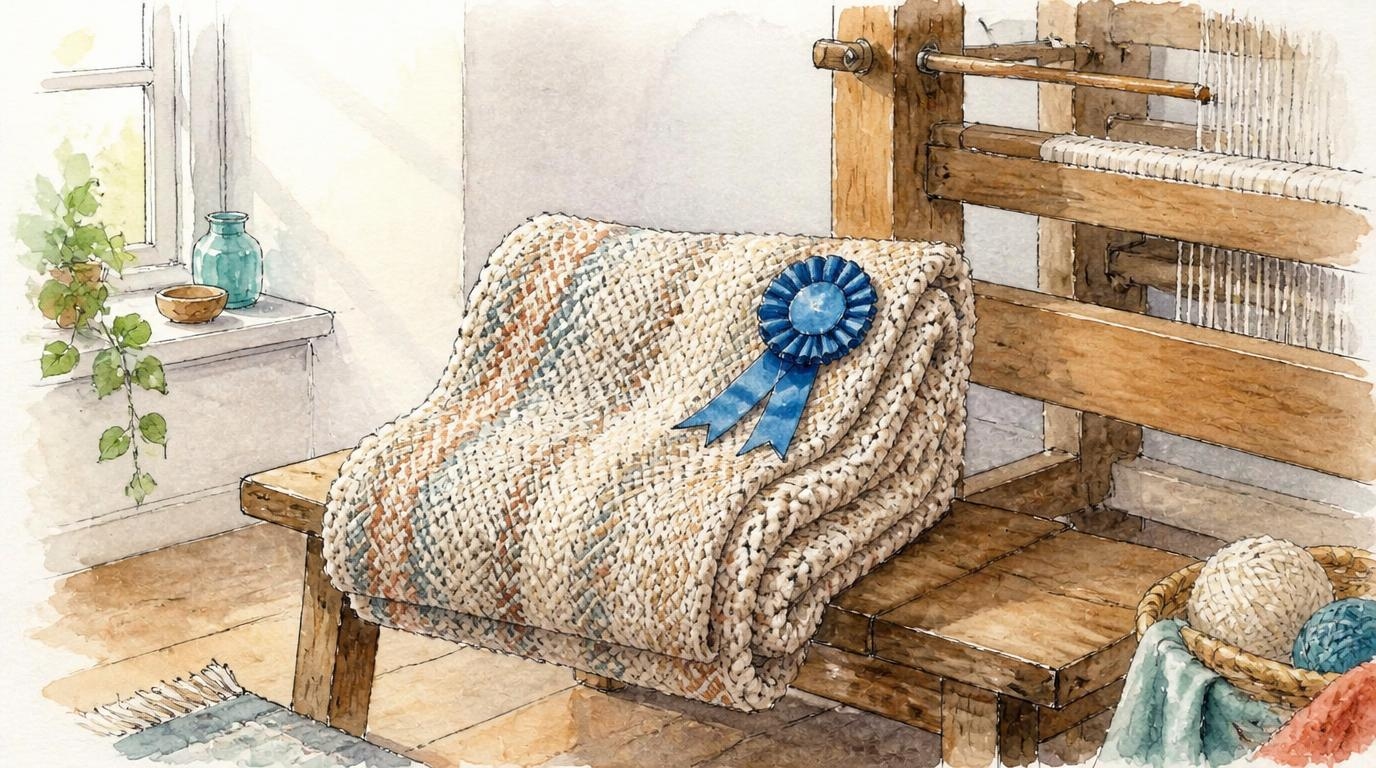 A handwoven wool blanket is a slow project, and it's worth trying a loom before you buy one.
I wanted a wool blanket and couldn't justify what they cost. So around 2004 I signed up for a weaving class with Gwen Handler through Common Ground on the Hill, thinking I'd make one myself.
That first blanket took me about two weeks on my teacher's Mighty Wolf floor loom. It's an undulating twill, sized for a single bed, and when it was done Gwen talked me into entering it at the Howard County Fair. It won first place.
I'm not telling you that to make weaving sound easy. It isn't a quick craft, and the gear takes up real room. But you don't need to own a loom, or know a single weaving term, to find out whether you'd enjoy it. Here's what I'd tell a friend before they start.
Try weaving before you buy a loom
The cheapest first step is to put your hands on a loom that belongs to someone else.
- Take a class. You'll learn the steps that are hard to pick up from a page, like how tight the warp should feel.
- Contact a local fiber guild. Guild members are usually happy to let a beginner try, and they know which looms are worth having.
- Make sure you have the space. A floor loom is a piece of furniture. Mine lives in our living room.
A table loom isn't a bad choice. It's just a different experience: smaller, and slower once you've used a floor loom, where your feet do part of the work and it's easy to get into a rhythm. For a blanket, though, a floor loom is the better fit. You can weave small things on a big floor loom, but a table loom can't make a blanket unless you sew narrow panels together.
Used looms are out there. I got mine used from someone who had it sitting in storage. A guild can often point you to equipment like that.
If you don't have the room or the time for a loom right now, that's a perfectly good answer. Put weaving on your "someday" list and enjoy a class when you can.
How to weave a blanket, step by step
This is the big-picture view, so the class or guild steps make sense when you see them. Your teacher will walk you through the details for your loom.
- Choose your yarn. Look for wool yarn made for weaving. I used Harrisville Designs Highland, a thicker wool, for my blanket.
- Plan the size and pattern. Decide how wide and long the blanket should be and pick a weave. Plain weave is the simplest; twill gives you diagonal lines.
- Wind the warp. These are the long threads that run the length of the blanket.
- Dress the loom. Wind the warp onto the loom and thread each end through the heddles and reed. This takes longer than the weaving itself feels like it should.
- Weave. Pass the weft yarn back and forth, following your pattern, until you reach the length you want.
- Cut it off and finish the edges. Tie, hem, or fringe the ends so nothing unravels.
- Wash it gently. The first wash helps the yarn settle into a soft, finished fabric.
Expect uneven edges at first
The side edges are called selvages, and keeping them even is one of the hardest things for beginning weavers. Mine weren't perfect.
After my blanket came off the loom, I crocheted along the side edges in a row of single crochet. It made the whole thing look neater, and nobody but me knows what's under there. If your edges wander, that's a fix you can use too.
If your loom isn't wide enough
A blanket is wider than many home looms. You have two common workarounds:
- Weave panels and sew them together. That's how I made my ruana (more on that below).
- Try double weave. This technique weaves two layers at once, joined at one side, so the cloth opens up to about twice the width of your loom. I experimented with it in class. It's worth learning once you're comfortable with the basics.
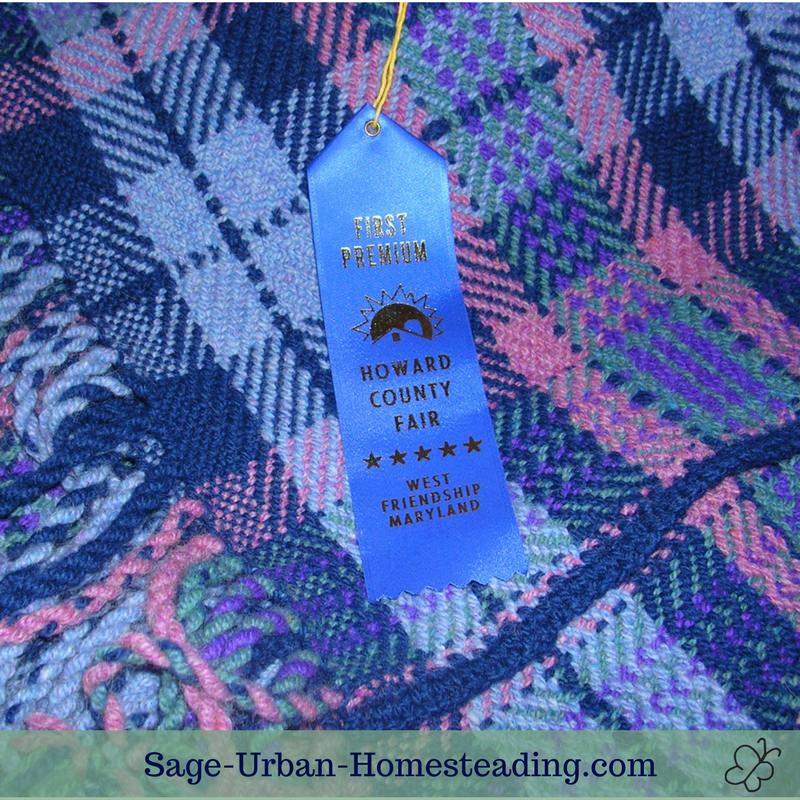 My first wool blanket with its first-place ribbon from the Howard County Fair. The crocheted edges hide my wobbly selvages.
How I use my first blanket now
When I wove it, the blanket fit a single bed. These days my husband and I lay it longways across the bottom of our queen bed during the in-between seasons, when it isn't cold enough for our big wool comforter but our legs and feet want a little extra at night.
I like that about a handmade blanket. It doesn't have to stay in the role you planned for it.
A wool ruana: a wearable blanket
My next project was a ruana, which is basically a blanket you wear. I used a thinner Harrisville Designs Shetland yarn and wove it in a 1/3 twill, so one color shows more on each side.
I wove two rectangles and sewed them together partway up, leaving a slit for my neck and an open front. Years ago, before I was married, I kept it by my computer and pulled it on whenever a cold draft found me.
If drafts are the real problem in your house, though, a ruana is a slow fix. Finding the draft and blocking it is faster and cheaper. My Home Efficiency pages walk through that.
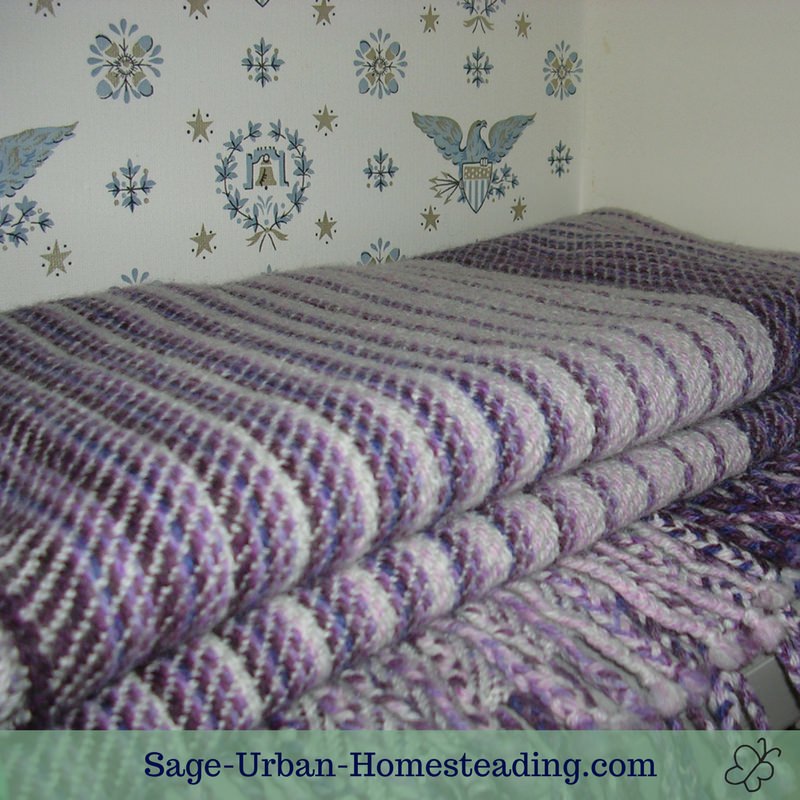


Woven blankets have a long history around the world, from Navajo blankets to Scottish tartans to colonial overshot coverlets, and each one is worth a rabbit hole of its own.
How to care for a wool blanket
Wool doesn't need washing very often. Airing it out goes a long way.
When I do wash mine:
- Wash by hand in cold water.
- Don't agitate it. Let it soak and press the water through gently.
- Air dry it flat. Plan for this to take a long time, because wool holds a lot of water.
Storage matters more than washing. Moths and carpet beetles will eat wool, so I store my blanket and ruana with a homemade potpourri of lavender flowers, cinnamon sticks, and whole cloves.
If you're shopping
The big purchase, the loom, is one I'd make after a class and with a guild's help, and often used rather than new. Weaving yarn and shuttles are easiest to find at a local craft or yarn shop, or at a fiber festival with lots of vendors in one place. Here in Maryland, that's the Maryland Sheep and Wool Festival. I bought my blanket and ruana yarn from Harrisville Designs.
A few things I use that you can find online:
- Learning to Weave by Deborah Chandler: the book I studied while taking my class and for years after.
- Unicorn Fibre Wash: what I use on the rare occasions I wash wool.
- Muslin drawstring bags: I fill these with my homemade lavender, cinnamon stick, and clove potpourri and tuck them in with my wool.
Weaving taught me the same thing I tell beginners about homesteading: try the smallest version first, then upgrade only when it solves a real problem. If you're trying to figure out which small self-sufficiency system fits your space and schedule, my free guide, "Which Urban Homestead System Should You Start First?", helps you pick one first step. You'll find the signup at the bottom of this page.
Where to go next
- Weaving drafts: how to read the pattern charts weavers use
- Weaving patterns: ideas for your next project
- Rigid heddle weaving: a different kind of loom to try
- Rag rugs: weave or braid a rug from old clothes
- Draft Fixes for Renters: the faster fix if a cold room is the real problem
- Urban Homesteading for Beginners: where to start if you're new here
How to weave a blanket FAQ
Can you weave a blanket on a small loom?
Can you weave a blanket on a small loom?
Yes. You can weave narrow panels and sew them together, or learn double weave, which makes cloth about twice as wide as your loom.
How long does it take to weave a blanket?
How long does it take to weave a blanket?
My first one took about two weeks. A lot of that time goes into winding the warp and threading the loom, before the weaving even starts.
Should I buy a table loom first?
Should I buy a table loom first?
Only if small pieces are your goal. A table loom is fine for those, just a different experience from a floor loom, where you use your feet and get into a rhythm. For a blanket, a floor loom is the better fit, since a table loom would mean sewing panels together. Try both at a class or guild first.
What yarn is best for a woven blanket?
What yarn is best for a woven blanket?
Wool yarn made for weaving is a good place to start. I used Harrisville Designs Highland for my blanket and their thinner Shetland for my ruana.
How often should you wash a wool blanket?
How often should you wash a wool blanket?
Not often. When you do, hand wash it in cold water without agitating, and air dry it.
Your blanket weaving checklist
- Try a loom at a class or local fiber guild
- Make sure you have space for a floor loom
- Ask the guild about used equipment
- Choose wool yarn made for weaving
- Expect uneven edges your first time
- Crochet the edges if they need tidying
- Hand wash rarely, in cold water, and air dry
- Store wool with a moth-deterring potpourri
Amy DeVries helps beginner urban homesteaders learn by doing. A lifelong gardener, she has grown food in spaces that expanded to 18 raised beds, patio containers, dwarf fruit and nut trees, and gravity-fed rainwater systems. She shares practical lessons shaped by real experience. Amy homeschools her children and teaches the same hands-on skills that guide her work.
More Information
Disclosure
All information found on this website is editorial in nature and intended to motivate and inspire rather than be used as medical advice or legal advice.
As an Amazon Associate, I earn from qualifying purchases. I also use Google Ads and cookies as described in the Privacy Policy.
Thank you for your support!
By Amy DeVries, Copyright © 2011-2026 Sage-Urban-Homesteading.com All rights reserved.
