FYI: This website contains affiliate links. As an Amazon Associate I earn from qualifying purchases.
- Home
- More Topics
- Low Waste Baby
Low Waste Baby: What Actually Worked for Our Family
By Amy DeVries
Short answer: A low waste baby routine doesn't have to be all cloth, all the time. What worked for us was flat cloth diapers in covers during the day, homemade wipes, a potty by the changing table, and disposables at night once the kids were older. Pick the one swap that fits your week and let the rest wait.
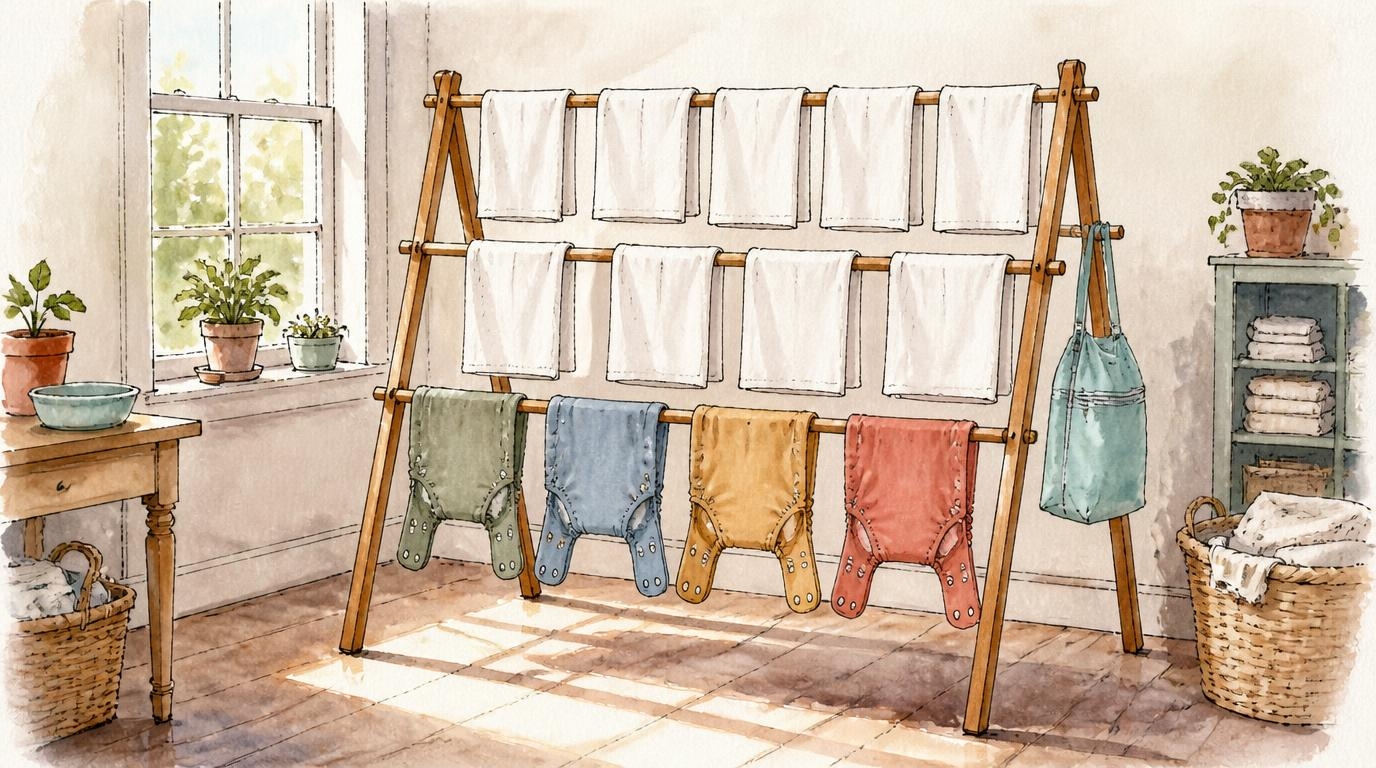 Our drying racks earned their keep in the cloth diaper years, and they still hold our laundry today.
Our first baby arrived a couple of months after our first wedding anniversary, back when we lived on a quarter acre inside the Baltimore Beltway. Like a lot of new parents, I had big ideas about doing everything the "right" way. Real life edited those ideas fast.
What stuck were a few small systems that cut our diaper trash without taking over our days. Some I'd do again in a heartbeat. Others I'd skip. Here's the honest version, including the parts that didn't go to plan.
If you're expecting or have a little one right now, you don't have to switch everything at once. One reusable swap you keep is worth more than a full cloth setup sitting in a closet.
Start with the one swap that fits your week
Each of these works on its own. Choose one, give it a couple of weeks, then decide whether to add another.
- Homemade wipes if you want the lowest-effort change. Nothing new goes in the laundry.
- A few flats for daytime at home if you're curious about cloth but not ready to commit.
- A potty near the changing table if you'd like fewer messy diapers to deal with at all.
- A wet bag in the diaper bag if you already use cloth at home and want it to work on outings too.
Nights, travel, and the newborn blur can stay disposable while you figure out what fits. That isn't failing at low waste. It's how we did it too.
Cloth diapers: Why we settled on flats
I tried several kinds of cloth diapers before settling on plain flats. They're the least exciting option on the shelf and the one I'd pick again.
The types we tried
- Flats in a cover: One big, thin square of cotton you fold to size and tuck into a waterproof cover. You change the flat and reuse the cover until it's dirty.
- Prefolds in a cover: Like flats, but a thicker rectangle with extra layers sewn into the middle, so there's less folding.
- Pocket diapers: A cover with an absorbent insert stuffed inside. Handy, but every change means washing the whole diaper.
- One-size diapers: Rows of snaps adjust the fit as your baby grows, so you buy fewer sizes.
- All-in-ones: Everything sewn together. Closest to a disposable, and the slowest to dry.
Why flats won
Flats were the easiest to wash and the fastest to line dry. A single layer of cotton rinses clean easily and dries on a rack instead of needing the dryer. Covers wiped clean and went back into rotation, so we didn't need a huge stash.
At first we used pocket diapers overnight. As the kids got older and slept longer, I switched to disposables at night. That one change made our mornings easier and kept our cloth routine going for the long haul.
Our washing and drying routine
- Two hanging pail bags, so one could be in the wash while the other was in use. No disposable liners.
- Unscented detergent, used according to the package directions.
- Everything dried on folding racks near a sunny window. This is when I started relying on drying racks, and I still line dry most of our laundry indoors today.
Washing diapers did add laundry. I won't pretend it didn't. Flats just kept that extra load as small and quick as it could be.
What I'd buy again
I tried a lot of brands with my first baby. By my second, I knew exactly what I wanted: unbleached cotton birdseye flats with Snappi cloth diaper fasteners and Thirsties Duo Wrap covers with snap closures, not velcro (Amazon affiliate links).
Birdseye flats are thin enough to wash clean and dry fast on a rack, and you fold them to fit as your baby grows. A Snappi is a stretchy, T-shaped fastener that grips the folded flat so it stays put, with no diaper pins.
I picked covers with snaps instead of velcro because snaps last much longer and hold up better to constant washing. I also liked the leg gussets on the Duo Wrap. The covers come in two sizes rather than truly one size, so plan on buying the bigger size later (size two). But each size is adjustable to grow with your baby.
Homemade baby wipes: Supplies and steps
Our wipes were a roll of paper towels cut into thirds and soaked in wipe solution. A friend gave me the container and showed me the trick, and my mom mixed our first batch the night our daughter was born.
Supplies
- A roll of paper towels (one roll made three batches)
- A sharp serrated knife
- A plastic container with a lid, a little taller than a third of the roll
- Wipe liquid: a store-bought baby wipe solution at first, then just water with a drop of tea tree oil
Step 1: Cut the roll
Cut the paper towel roll into thirds with the serrated knife. Set two sections aside for later batches.
Step 2: Load the container
Set one section in the container and pull the cardboard tube out of the center.
Step 3: Soak the towels
Mix a cup of wipe liquid and pour it over the towels until they're wet all the way through. Put the lid on.
Step 4: Pull from the center
Pull the first wipe up from the middle and tear at the perforation. The next one feeds up as you go.
If a batch sat too long, it could start to mold, so I made smaller batches as my daughter got older and needed fewer wipes. Because we used EC (see below), we went through far fewer than I expected.
Once my daughter was a toddler, I stopped buying wipe solution and used water with a drop of tea tree oil instead. I loved the smell, and it was one less thing to buy.
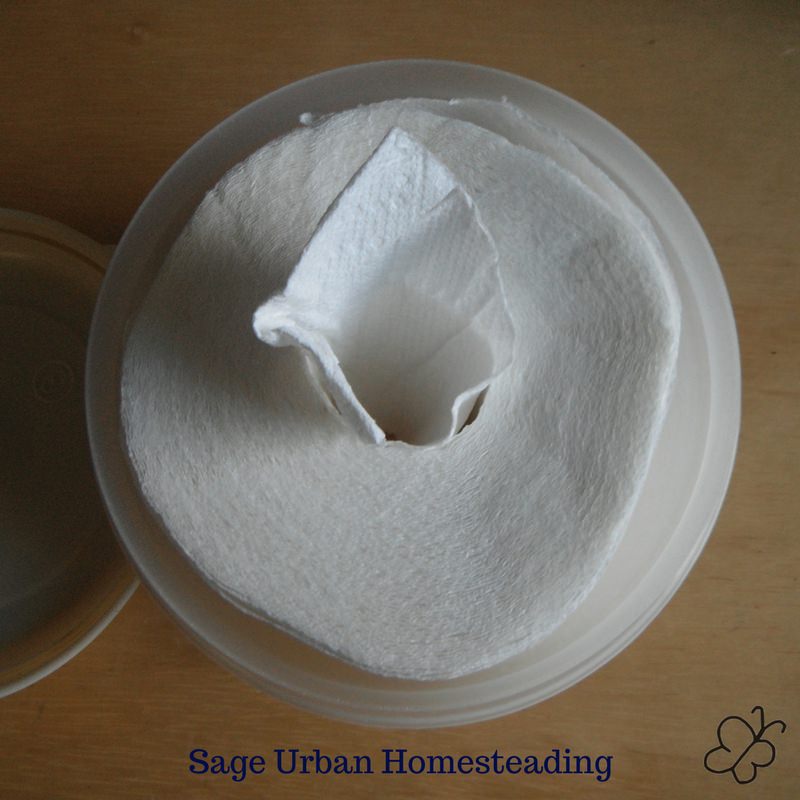 A third of a paper towel roll in a lidded container, with the tube pulled out so wipes feed up from the center.
Cloth wipes on the go
For outings, I kept wipe liquid in a mini spray bottle and carried cloth wipes in the diaper bag. Used ones went into the wet bag with the cloth diapers.
I tried cloth wipes at home too, but I liked the paper towel wipes better there. They cleaned better and tore to whatever size I needed. Use what works in each spot. It doesn't have to match.
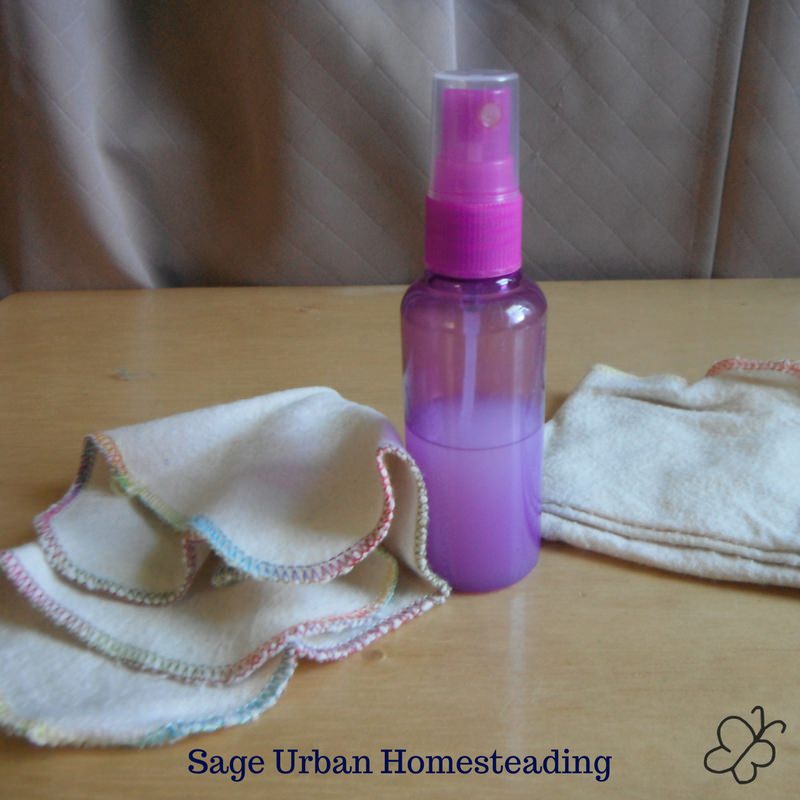 The little purple spray bottle fit easily in the diaper bag, and the rainbow-edged wipes always made me smile.
Elimination communication without chasing every pee
Elimination communication (EC) means offering your baby the potty at times they're likely to go, instead of relying only on diapers. We used it alongside cloth diapers with two kids. For poop, it was absolutely worth it. For pee, it didn't really work for us, and that's OK.
How we started
- We waited until each baby had good head and neck control.
- I kept a small potty right by the changing area.
- I offered the potty at every diaper change, and about every 1½ to 2 hours otherwise.
- I used the same little sound each time so they connected it with going.
The book that helped me most was Diaper Free by Ingrid Bauer, especially the middle chapter with holding positions and photos (Amazon affiliate link).
What worked: Poop in the potty
Our daughter first pooped in the potty around 2 months old, and by her first birthday most poop went there. Our son caught on around the same age. By 5 months I could count his poopy diapers since 2 months on my fingers.
Wiping a bottom that's been over a potty is so much easier than cleaning out a full diaper. I can't imagine changing poopy diapers for two or three years.
And it doesn't have to be a perfect catch. Even getting half a poop in the potty counts. Whatever lands in the potty is that much less to scrape out of a diaper, so cleanup is easier.
It did get harder once our son started solid foods and crawling. His old pattern broke, and we had to learn new signs, like a small grunt and rubbing his head. It came back around.
What didn't: Catching every pee
With our daughter, I tried hard to catch pee too and never learned her signals. Around 18 months she moved to cotton underwear, had plenty of accidents, and gradually learned to tell us in time.
With our son, I stopped trying to catch it all. I kept offering the potty regularly and let the diaper do its job the rest of the time. Some days he stayed dry. Other days he didn't, and nobody stressed.
If I could tell my first-time-mom self one thing, it would be this: EC doesn't have to be all or nothing. Catching poop is the big win. Pee can come later.
Baby carriers: How I got anything done
Wearing the baby was the only way I got chores done with a clingy baby. It made grocery trips simpler too. The carrier that's great on a hike isn't always the one you want for washing dishes, so think about where you'll use it most.
With our first, I used an Ergo with the separate newborn insert. When the baby got bigger, my husband took over the Ergo, and it was handy having two carriers, each adjusted to one of us. For myself, I upgraded to a LÍLLÉbaby carrier, and that's the one I'd recommend (Amazon affiliate link).
Not every carrier works for every family. A friend loved her Moby wrap, but it didn't work for my long babies.
If you can, borrow a friend's carrier before you buy, since fit varies a lot. Carriers are also easy to find secondhand and pass along later, which keeps the low waste theme going. Follow your carrier's instructions, especially in the newborn months.
What to do with old cloth diapers: Give them a second life
One of my favorite things about cloth is that it doesn't have to leave the house when the diaper years end. Ours moved into our sauna space, where soft, absorbent cotton is exactly what you want.
- Prefolds: Foot pads on the floor mat.
- Flats: Layered on the stool.
- Cloth wipes: For wiping drips off our skin during a session.
After each sauna session, everything goes in the regular laundry. No special routine, no new purchases, just old diapers still doing useful work.
If you don't have a sauna, the same cotton makes great cleaning rags, dust cloths, or drip catchers. Use them wherever you'd otherwise reach for paper towels.
What I'd skip
- A big diaper stash before the baby arrives. Buy a few, see what you like, then add more.
- Thick, layered diapers if you plan to air dry. They take much longer.
- Trying to catch every pee with EC. Focus on poop and let the rest come.
- Making everything match. Paper towel wipes at home and cloth wipes on the go worked fine for us.
- Guilt about disposables. Nights and trips are allowed to be easy.
If you're shopping
These are the things I used and would buy again (Amazon affiliate links).
- Unbleached cotton birdseye flats: The easy-wash, fast-drying workhorse of our setup.
- Snappi cloth diaper fasteners: Hold the folded flat in place, no pins needed.
- Thirsties Duo Wrap covers with snap closures: Pair them with flats and wipe them clean between changes. I chose snaps over velcro.
- Wet bags: For the diaper bag, travel, and used cloth wipes.
- Folding drying racks: The same kind I still use every day for our laundry.
- A small EC potty: To keep right by the changing area.
- A travel potty seat: Fits on a regular toilet or stands on the floor, so outings and visits don't have to interrupt the routine.
- LÍLLÉbaby carrier: The carrier I upgraded to and would choose again.
- Diaper Free by Ingrid Bauer: The most useful EC book I read.
- Tea tree oil: A drop in water was all our homemade wipes needed once I stopped buying wipe solution.
Where to go next
- Reusable Kitchen Swaps That Actually Stick: The same one-swap-at-a-time approach for the rest of your home.
- Waste Free Lunch: Packing Leftovers Without the Baggies: For when your little one is eating real food.
- My line drying page (Home Efficiency): The full drying rack routine that started with cloth diapers.
- Reduce Food Waste at Home: The hub for all my waste-reduction habits.
With a baby in the house, your time and energy are probably stretched thin. My free guide, "Which Urban Homestead System Should You Start First?", helps you pick one realistic first step, and Waste-Reduction Habits is the path it suggests when time or energy is limited.
If you'd like to plan your first three systems instead of just one, my $12 Small-Space Self-Sufficiency Starter Map walks you through it.
Low waste baby FAQ
Do I have to use cloth diapers full time?
Do I have to use cloth diapers full time?
No. We used disposables at night once the kids were older. Part-time cloth still cuts down on trash, and it's far easier to keep going.
Are flat diapers hard to use?
Are flat diapers hard to use?
Folding them took me a little practice. After that it was automatic, and they were the easiest diapers to wash and dry. When I had my second child, my oldest was able to help fold them.
When did you start elimination communication?
When did you start elimination communication?
We waited until each baby had good head and neck control. Our daughter's first potty success came around 2 months.
What if EC doesn't work for pee?
What if EC doesn't work for pee?
That was our experience too. Catching poop was the part that made EC worth it for us. With our second, I stopped trying to catch every pee and enjoyed it much more.
Are homemade wipes worth making?
Are homemade wipes worth making?
For us, yes. A cut paper towel roll and a cup of wipe liquid took a few minutes, and one roll made three batches.
What can you do with old cloth diapers?
What can you do with old cloth diapers?
Reuse them around the house. Ours became foot pads and stool covers in our sauna, and our cloth wipes catch drips there too. Flats and prefolds also make great cleaning rags and dust cloths.
Your low waste baby checklist
- Pick one swap to try first
- Keep disposables for nights or outings if that's what keeps you going
- Try a few flats before buying a full stash
- Set up a drying rack near a sunny window
- Make one batch of paper towel wipes
- Keep a potty by the changing area if you want to try EC
- Focus on catching poop, not every pee
- Borrow or buy secondhand when you can, and repurpose the cloth when diaper days are done

Amy DeVries helps beginner urban homesteaders learn by doing. A lifelong gardener, she has grown food in spaces that expanded to 18 raised beds, patio containers, dwarf fruit and nut trees, and gravity-fed rainwater systems. She shares practical lessons shaped by real experience. Amy homeschools her children and teaches the same hands-on skills that guide her work.
You might like these
Home Efficiency for Beginners: Start Small, Stay Warm
Home efficiency for beginners: small habits and removable fixes that make your home warmer and cheaper to run, even if you rent.
Urban Homesteading for Beginners: Start Here If You Feel Overwhelmed
Urban homesteading for beginners who feel overwhelmed: no land or perfect setup needed. Start with one small system and get my free guide to pick yours.
Reduce Food Waste at Home With Small Habits That Stick
Reduce food waste at home with small habits that fit real life: a use-first shelf, double-batch dinners, and a simple scrap bin. Start with one.


More Information
Disclosure
All information found on this website is editorial in nature and intended to motivate and inspire rather than be used as medical advice or legal advice.
As an Amazon Associate, I earn from qualifying purchases. I also use Google Ads and cookies as described in the Privacy Policy.
Thank you for your support!
By Amy DeVries, Copyright © 2011-2026 Sage-Urban-Homesteading.com All rights reserved.
