FYI: This website contains affiliate links. As an Amazon Associate I earn from qualifying purchases.
- Home
- More Topics
- Basic Painting
Basic Painting: Start With Two Colors and One Small Panel
By Amy DeVries
Short answer: Basic painting is learning how paint spreads, covers, and dries before you worry about color. The first painting in my acrylic book used only black and white on a 6 x 6 panel with two round brushes. It took about an hour, and most of that was setup.
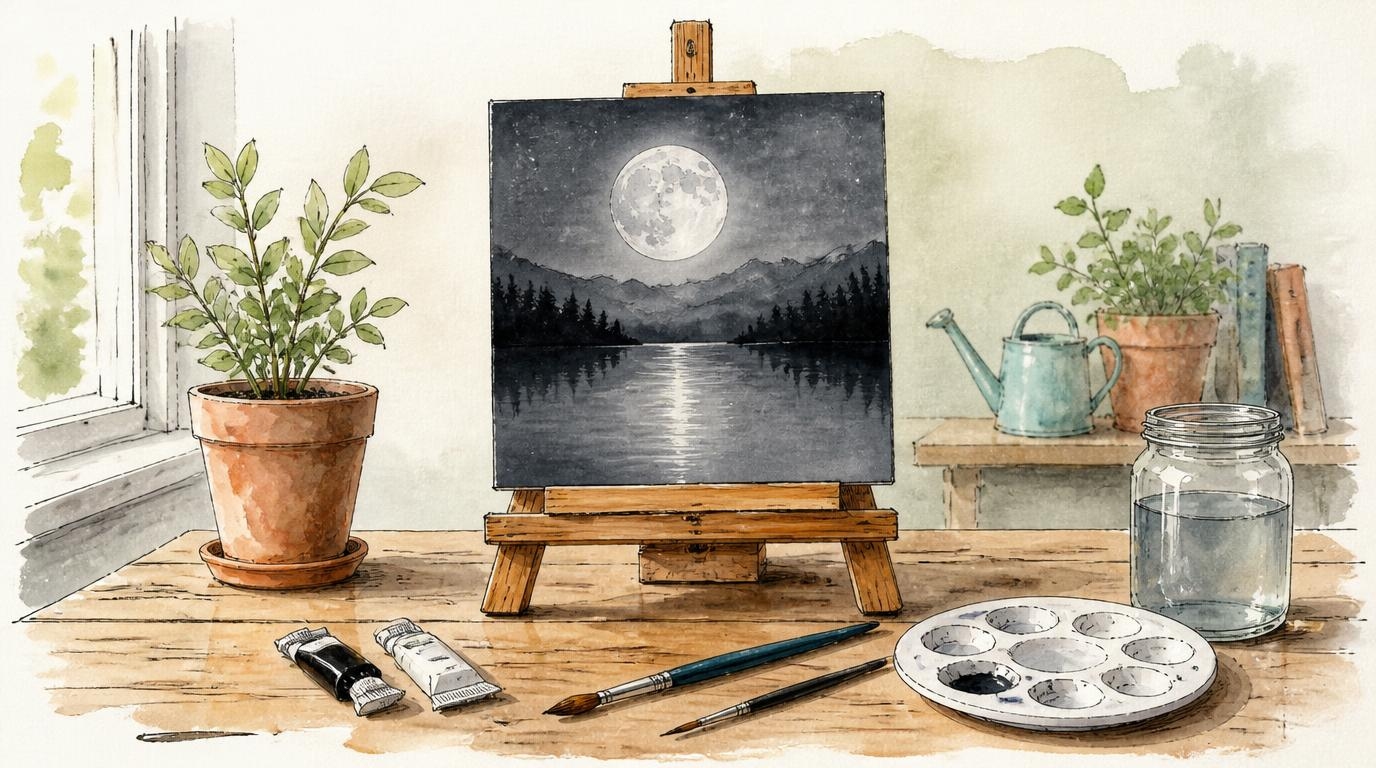 Basic painting can start this small: two colors, two brushes, and one little panel.
Hi, I'm Amy. Most of Sage Urban Homesteading is about small homestead systems, but I have more crafty hobbies than I have time for. Painting is one of them.
The rule I use for homesteading held up at the easel too: start with the smallest version that works. For painting, that meant two tubes of paint, two brushes, and a panel small enough to finish in one sitting.
Why start with just two colors
This painting is the first lesson in Mark Daniel Nelson's book Learn to Paint in Acrylics with 50 Small Paintings (Amazon affiliate link). It's a moon over water, painted with only Mars black and titanium white.
I wanted more color than that at first. But with only black and white, there are no color choices to trip over. You get to notice how the paint itself behaves: how much to load on the brush, where it streaks, and how a thin layer dries.
A small panel helps the same way. You can finish in one sitting, so you see the whole result before you lose steam.
My moon painting: supplies and steps
These are my own notes, not the book's instructions. The book walks you through the painting itself.
Supplies
- Mars black and titanium white acrylic paint
- Matte acrylic medium (optional; I used it for the moonbeams)
- A #8 round brush (the book's pick) and a #5 round for details
- A 6 x 6 panel
- An easel and an easel weight
- A piece of scrap wood to raise the panel
Step 1: Set up once, and leave it up if you can
My painting took about an hour, and most of that hour went to gathering supplies and setting up. If you can leave the easel up between sessions, the next painting starts much faster.
My daughter, who was little then, watched the whole time and then asked to paint too. If you have kids at home, expect company.
Step 2: Raise a small panel so you can reach it
A 6 x 6 panel sits low on an easel. I had to lift mine to paint the leaf details at the bottom. A piece of scrap wood under the panel raised it to a comfortable height, and the easel held it fine.
Step 3: Mix, then twist and roll the brush out
After mixing a gray, I twisted and rolled the brush out of the paint instead of dragging it. That kept streaks out of the strokes. This tip wasn't in the book; I figured it out by doing.
Step 4: Let the plan bend
I planned a cricket on a leaf in front of the moon. That's not what I ended up with, and that's fine. I kept the crater effects on the moon, and I liked how the distant mountains and trees reflected in the water.
I also skipped the book's second coat of gray. The nudge to change the book's version came from Deanna Williamson's blog, where she added a castle to the same painting (no longer available to link).
Step 5: Add one small effect you choose
For the moonbeams, I mixed matte medium with titanium white and painted ripples across the water. One small choice of your own makes a copied lesson feel like yours.
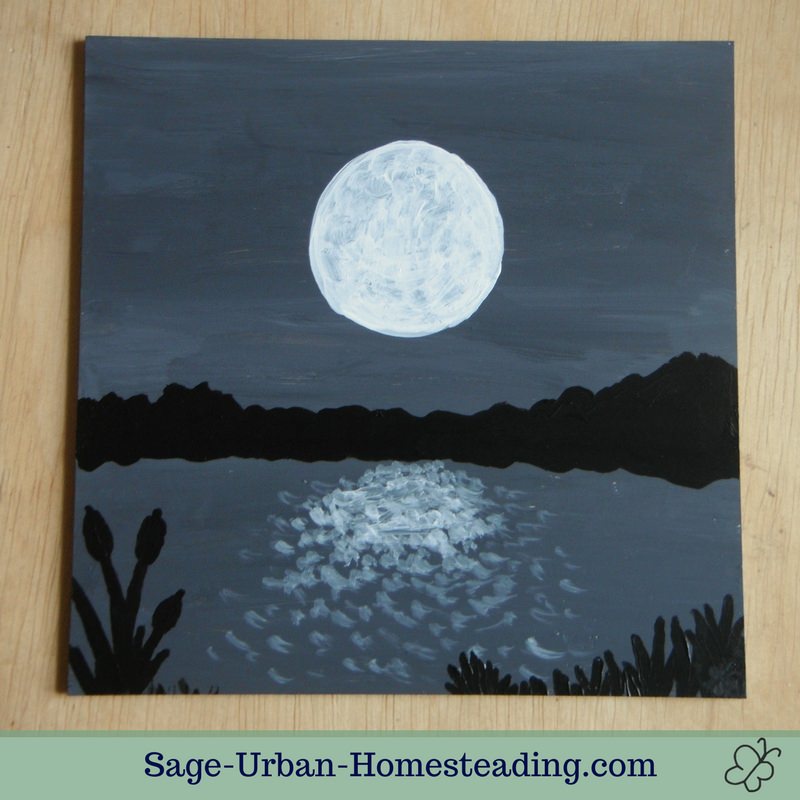 My moon painting from the book: just Mars black and titanium white, with moonbeams I added using matte medium.
Why I stopped at 26, and what I switched to
I meant to paint the whole book. I got through 26 paintings between March 2018 and July 2019, including through some deaths in the family. Then a new baby arrived that fall, and life got very full.
Along the way, for Christmas 2018, I got a sketching book with a quicker, more portable approach. It was Everyday Sketching and Drawing by Steven B. Reddy, a book about building a quick, everyday sketchbook habit. Using his techniques, my painting turned into small watercolor sketches in one notebook. They needed almost no setup, and the notebook fit in my bag during my daughter's dance class.
It was the smallest version of painting that worked for my life then. After the baby came, homeschooling and a garden full of raised beds took up most of my time, and a few years later we moved to a different house.
I still plan to get back to acrylics. On my page about the book, I share all 26 of my paintings, more about the sketching book and the supplies I use with it, and what happened to the paintings.
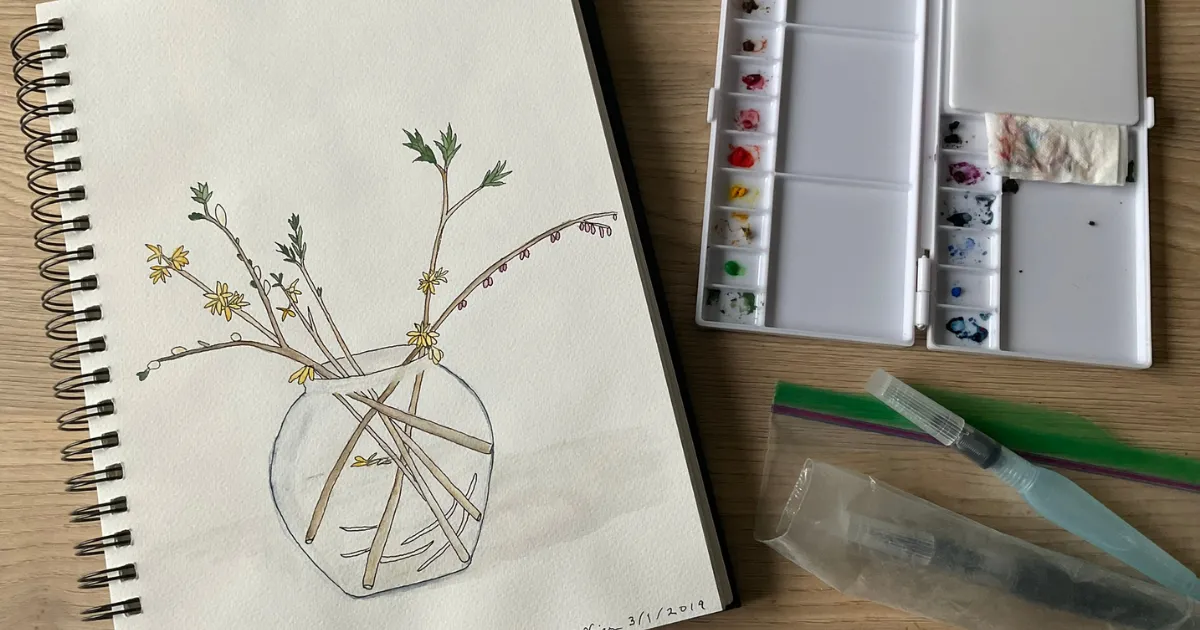 A quick watercolor sketch from March 2019: forsythia and redbud branches we forced to bloom early for a homeschool project, next to my travel palette and water brushes.
If you're shopping
You don't need a big paint set to start. Two tubes and two brushes got me through this whole painting (Amazon affiliate links).
- Learn to Paint in Acrylics with 50 Small Paintings by Mark Daniel Nelson: the book this painting comes from.
- Mars black acrylic paint
- Titanium white acrylic paint
- Matte acrylic medium: optional, but it's what made my moonbeams.
- Round brushes: #8 and #5 are the ones to use first out of this set
- 6 x 6 painting panels: Ampersand Gessobord or Claybord
- Easel: the kind I have is no longer available, choose what suits your needs. Mine can do tabletop height or standing height.
For how I choose brushes, palettes, surfaces, gesso, and the rest, see my guide to Acrylic Painting Supplies.
Where to go next
- My 26 paintings from the book: every painting I finished from Learn to Paint in Acrylics with 50 Small Paintings, with what each one taught me.
- Acrylic Painting Supplies: how to choose brushes, paints, palettes, and surfaces without buying a whole art store.
- Curious about the homestead side? Most of Sage Urban Homesteading is about small, low-overwhelm systems for city and suburban homes. Start Here if you'd like a look around.
Basic painting FAQ
What does basic painting mean?
What does basic painting mean?
It means the first skills of putting paint down: loading the brush, covering an area evenly, and letting one layer dry before adding the next. Color mixing and detail come after.
How many colors do I need to start?
How many colors do I need to start?
Two is enough. My moon painting used only black and white, which kept my attention on how the paint behaved.
How long does a small practice painting take?
How long does a small practice painting take?
Mine took about an hour, and most of that was gathering supplies and setting up. The painting part went faster than I expected.
Is acrylic or watercolor better for a busy beginner?
Is acrylic or watercolor better for a busy beginner?
Acrylic lets you paint over what you don't like once it dries, but it takes more setup. For my busy years, a watercolor sketchbook was easier to keep up with. Pick the one you'll actually get out.
Can kids paint along?
Can kids paint along?
My daughter asked to paint after watching me, so yes, expect them to want a turn. I set her up with her own child brushes, paper, and tempera paints.
Your basic painting checklist
- Two colors: black and white
- One round brush, plus a smaller one for details
- One small panel
- A spot where the setup can stay out
- Something to raise a small panel on the easel
- Twist and roll the brush after mixing
- Let the plan change
Amy DeVries helps beginner urban homesteaders learn by doing. A lifelong gardener, she has grown food in spaces that expanded to 18 raised beds, patio containers, dwarf fruit and nut trees, and gravity-fed rainwater systems. She shares practical lessons shaped by real experience. Amy homeschools her children and teaches the same hands-on skills that guide her work.
More Information
Disclosure
All information found on this website is editorial in nature and intended to motivate and inspire rather than be used as medical advice or legal advice.
As an Amazon Associate, I earn from qualifying purchases. I also use Google Ads and cookies as described in the Privacy Policy.
Thank you for your support!
By Amy DeVries, Copyright © 2011-2026 Sage-Urban-Homesteading.com All rights reserved.
